



Why Lead Time and Cost (Not Capability) Are Holding Robotics Back
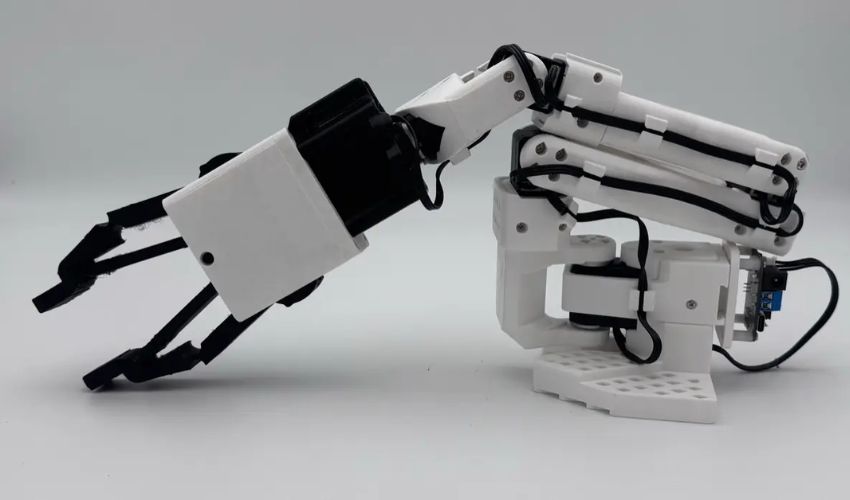
Physical AI, the growing category of AI systems built to act in the real world rather than just process data, is one of the fastest-moving corners of the robotics industry. Companies building autonomous robots, automated lab equipment, and warehouse deployments are scaling quickly. But according to Ethan Wicko, Founder and CEO of US startup Transcend Mechanics, many of them are facing the same challenge: hardware cannot iterate at the speed their software does. We sat down with Wicko, and co-founder Alex McLeod, to learn about their solution to this obstacle.
A Software Mindset Meets a Hardware Challenge
“The biggest problem we heard from people, mostly online, was lead times and cost,” Wicko explained. “The hardware cycle time is way too long, on the order of weeks, while a lot of physical AI companies scaling up come from the software world and are used to much faster iteration cycles.”
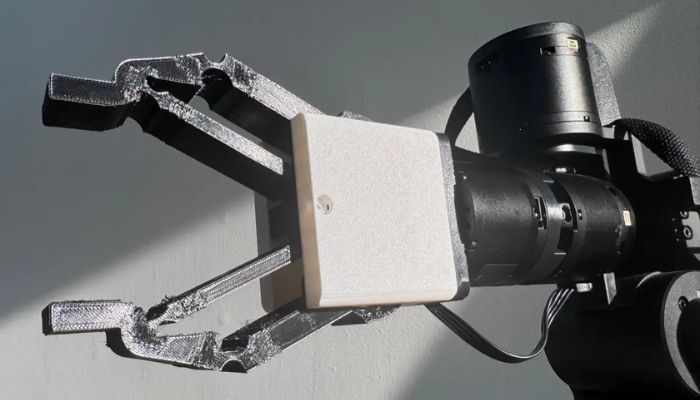
The 2-finger small Nibbler grippers for the YAM arm.
That mismatch is compounding as physical AI scales. Cost, Wicko explained, is not just a barrier for smaller or early-stage teams. It becomes the central bottleneck once a company tries to deploy physical intelligence, robotic arms, grippers, and other components, at any meaningful volume.
Transcend Mechanics, founded in 2022 as Transcend Bicycle before rebranding in 2025, originally developed generative design software for compliant mechanisms, a class of mechanical design that uses flexible material properties instead of separate moving joints. The team later applied that software to robotic grippers, aiming directly at the lead time and cost problem it kept hearing about.
Multimaterial 3D Printing as the Fix
The company’s answer is a gripper 3D printed as a single part, combining rigid PETG with flexible TPU in one print. Traditional parallel gripper fingers rely on pinned pivots, rigid segments joined by rotating connections that require separate manufacturing and assembly steps. Transcend Mechanics replaces those pins with TPU flexures engineered to meet specific fatigue requirements, printed directly into the part.
“It’s cheap precision from a design standpoint, since there are no pins or assembly, and cheap manufacturing, since it’s a single printed part,” Wicko said. Bonding PETG and TPU components together after printing, by contrast, introduces a weak point at the bond line. Printing the material transition directly into one part avoids that failure mode entirely.
Functionally, Wicko is clear that the goal is not necessarily to outperform grippers already on the market. “The idea is to get something functionally equivalent to what customers already buy on the market, then apply our approach to ultra-optimize lead time and cost.”
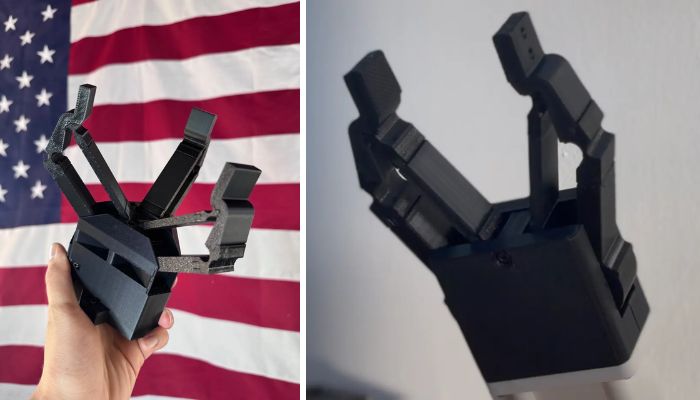
The 3 finger Nibbler for the YAM arm (left) and Parallel long stroke gripper for the SO-101 arm (right).
3D Printing as a Production Tool
Where many companies treat 3D printing as a prototyping step before switching to processes like injection molding at scale, Transcend Mechanics plans to keep 3D printing as its production method, for now. “The biggest challenge isn’t production rate. We can buy more machines and build a print farm,” Wicko said. The bigger obstacle, in his view, is perception: customers seeing layer lines and instinctively wondering whether they bought a prototype rather than a finished product.
That perception gap is narrowing, but Wicko’s comment points to a broader question facing the additive manufacturing industry as more companies push 3D printed parts into end-use, production-grade applications.
Where the Grippers Are Headed
Transcend Mechanics is currently pre-launch, working with early partners, and targeting two customer segments: physical AI companies building data farm equipment, home robotics, and automated lab systems, and more traditional industrial users running platforms such as Universal Robots arms who need higher reliability from their end effectors.
Software remains central to the company’s roadmap. As Wicko put it, the plan is to keep expanding the generative design software’s capabilities and use it to move into new hardware verticals, working up the robotic stack toward designing more of the robot itself, not just the gripper. To learn more about Transcend Mechanics, visit its website here.
What do you think of Transcend’s business strategy? Let us know in a comment below or on our LinkedIn and Facebook pages! Don’t forget to sign up for our free weekly Newsletter here for the latest 3D printing news straight to your inbox! You can also find all our videos on our YouTube channel.
*All Photo Credits: Transcend Mechanics





This is a fascinating perspective on the challenges facing robotics adoption. The point about lead time and cost in hardware development, especially compared to software, is a critical bottleneck. It makes sense that focusing on modular, rapidly producible components like grippers would be a strategic first step for a company like Transcend Mechanics. I’m curious to see how their approach to accelerating hardware iteration plays out in the broader robotics market.
Totally agree with the lead time issue Being in the DIY scene for years knows this well
Hey, fascinating read! It makes a lot of sense that lead time and cost are the bigger hurdles than capability for robotics right now. Sometimes I think about how quickly some games, like Slither io , can be developed and scaled, and then you see the massive undertaking involved in robotics. Really highlights the difference!
Great use of PETG and TPU in one print.
The struggle between rapid software iteration and sluggish hardware lead times is the ultimate bottleneck for physical AI right now. Transcend Mechanics is tackling a critical friction point by helping robotics teams bridge that gap and speed up real-world deployment.
That’s some seriously impressive tech Formlabs is packing into the Fuse X1! The idea of such precise thermal control and AI for print intelligence is a game-changer for SLS. It reminds me of how much subtle physics goes into optimizing things, even in games. I’ve been hooked on this little browser game called Drive Mad lately – it’s all about navigating tricky terrain, and you quickly learn how important weight distribution and speed are. Speaking of optimizing build plates, how do you think these new features will impact the material properties of the final printed parts?