#Startup3D: MatterWave Uses Mechanical Waves to Tame Metal 3D Printing
Metal 3D printing has become very good at melting powder, but what happens as that metal cools and solidifies has been left largely to chance. For anyone working in laser powder bed fusion (LPBF), the result is familiar: residual stress, cracking, part-to-part variability and a long chain of heat treatments and qualification tests. It also means only a handful of alloys are printed reliably today.
US startup MatterWave wants to take control of that cooling phase. Its retrofit module, Daedalus, sits at the build plate of an existing metal 3D printer and sends tuned mechanical vibrations into the melt pool as it solidifies, shaping the metal’s crystal structure in real time. In its SME award submission, MatterWave reports that early results show up to a 10x improvement in fatigue life compared with conventional builds.
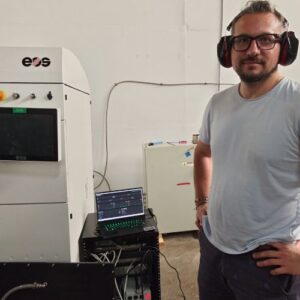
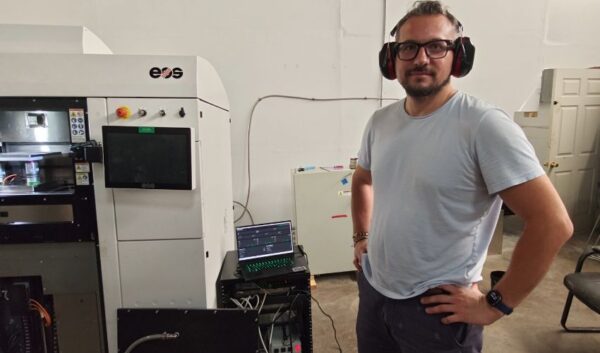
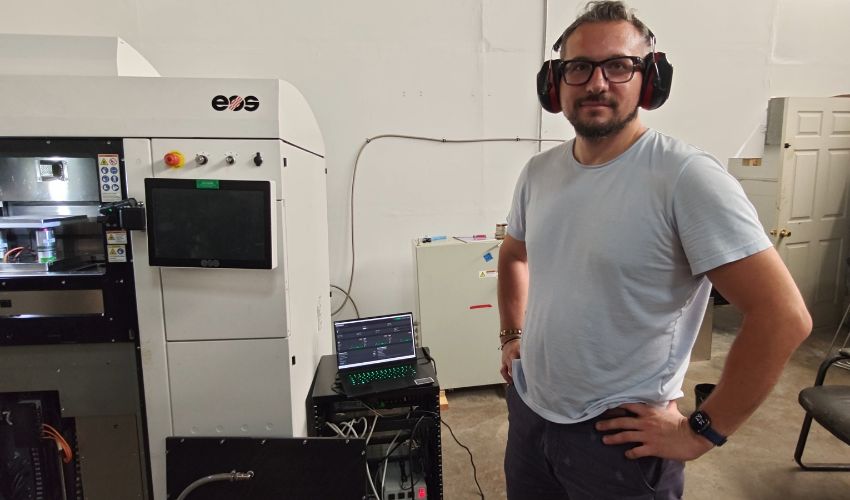
The EOS M 290 rigged with the Daedelus.
We spoke with Alex Tiliță, CEO and Co-Founder of MatterWave, about how the technology works, why the company chose to retrofit rather than build its own printer, and which materials it could unlock. Don’t miss it!
From a Hong Kong Lab to a Retrofit Module
Originally from Romania, Tiliță has spent more than fifteen years researching metal additive manufacturing, including a PhD and postdoc at the Hong Kong University of Science and Technology. He set out to understand why the technology, despite its promise, was so rarely used in production. Drawing on his background in wave physics, he concluded that problems such as low fatigue life, poor repeatability and the need for heat treatment could be traced back to how a metal’s crystal structure forms as it cools.
MatterWave initially set out to build its own metal 3D printer in Hong Kong. After moving to the US, the team concluded that commercial LPBF machines were already capable and well documented, and that there was no need to reinvent the wheel. “So we just focused on: what is our core expertise? What is the thing that no one else can do on the planet that we can do?” Tiliță explained.
How Daedalus Works
Printer manufacturers have become very good at heating metal powder, but the transition from liquid to solid has remained largely passive, according to Tiliță. Daedalus is designed to make it active. The module, essentially a stack of transducers, introduces vibrations at a specific frequency and amplitude while the melt pool solidifies, influencing how crystals nucleate and align. The frequency is tuned to each material, based on its thermo-mechanical properties and other parameters.
These vibrations are phonons, the mechanical counterpart to photons, which give the company its name. Because the module only needs to fit the build envelope, MatterWave says it can be adapted to virtually any metal 3D printer. The benefits are greatest for processes that melt the material, such as LPBF and directed energy deposition (DED).
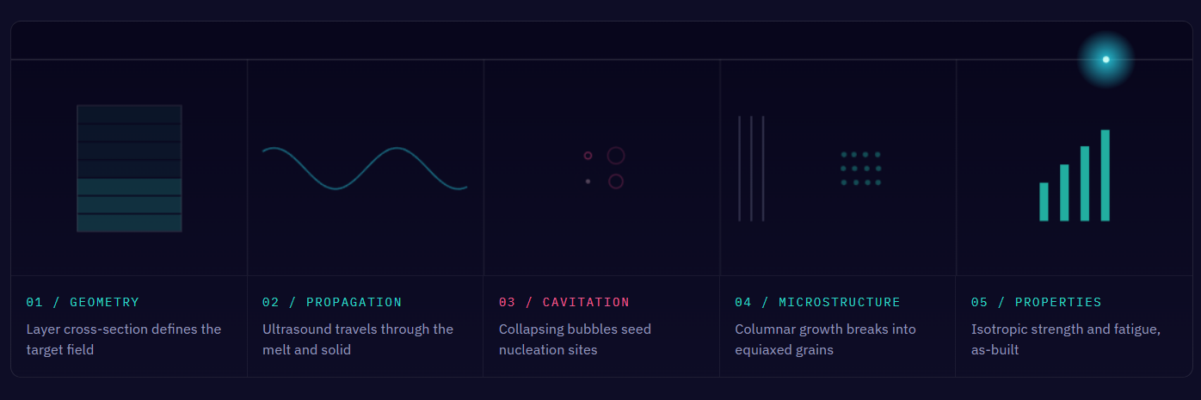
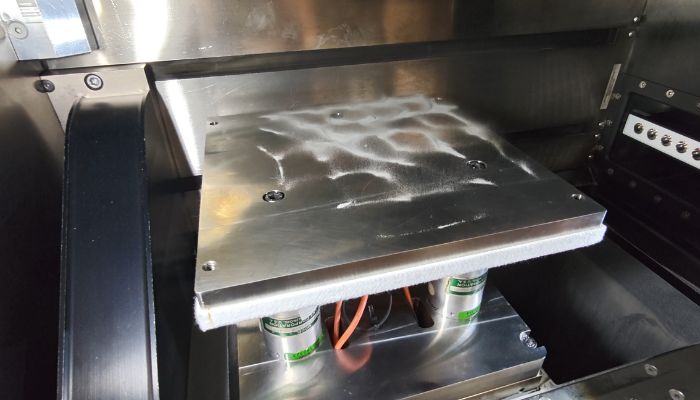
The phonon mechanism influences how crystals nucleate and align during printing.
Opening the Door to New Alloys
One of the technology’s biggest promises is access to materials that are currently too crack-prone to print. Tiliță explained that cracking usually comes down to how crystals form. In high-carbon steels, for example, carbon trapped in the crystal lattice creates stress that makes the material brittle. With Daedalus, crystals form earlier, giving alloying elements time to diffuse outside of the lattice, leaving a less stressed, more ductile and elastic structure.
At the recent International Conference on Advanced Manufacturing (ICAM) in Orlando, potential customers showed interest in alloys such as 7075 aluminum, Hastelloy, Inconel 738, 939 and 247, and tool steels, he said. With metal additive, we’ve just literally been dipping our toes in it in terms of the materials that we’re currently able to 3D print properly,” he said. “There are many studies and everyone’s coming up with new alloys that they can print easier … but we have so many other alloys that we have good knowledge of and are working on.”
Tackling the Qualification Bottleneck
MatterWave has installed Daedalus on an EOS M 290 and is beginning a full qualification run for Inconel 718, under a recently secured contract aimed at the aerospace sector. The goal is to show conclusively the technology can reduce the burden of heat treatment and qualification, which Tiliță describes as one of the main barriers raised by industry at ICAM.
Qualifying a metal AM process typically takes one to two years and can cost around a million dollars or more, he estimates. Much of that comes from variability: properties can differ between machines, geometries and even positions on the same build plate. By narrowing that spread, MatterWave hopes to make qualification faster and, eventually, enable the kind of statistical sampling used in automotive manufacturing.
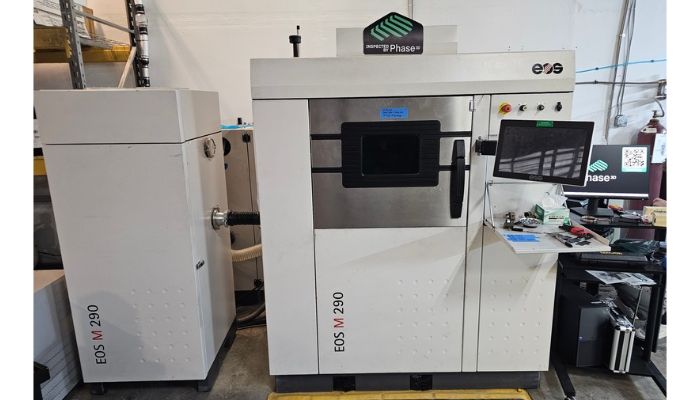
MatterWave is using this machine to qualify Inconel 718.
The longer-term ambition is to gradually reduce the need for post-processing such as stress relief, hot isostatic pressing (HIP) and other heat treatments, by printing the desired mechanical properties directly into a part. MatterWave calls this “programmable matter.” Tiliță acknowledges it is a lofty goal that will take time.
What’s Next for MatterWave
Despite more than a decade of research, MatterWave describes itself as early stage. This year, it began work as a subcontractor on a US government Small Business Innovation Research grant. Since Tiliță published his first work on the approach in 2017, research groups around the world have validated it across different machines, materials and frequency ranges, he says. The company is now validating its commercial claims and estimates a launch could be around two years away.
Asked for his final thoughts, Tiliță answered in a single word: excitement. “I’m excited for the future, because what we are potentially unlocking can really bloom the industry as a whole,” he said.
To learn more about MatterWave, visit its website HERE.
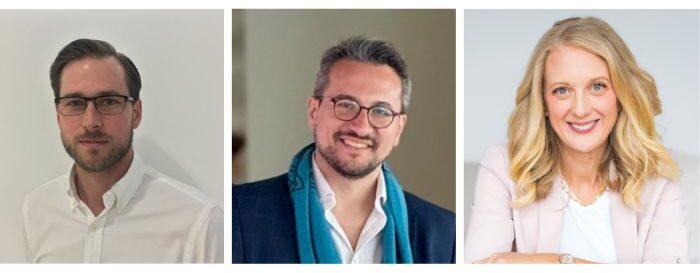
The MatterWave team, from left to right: Ben Ferrar, Co-Founder; Alex Tiliță, Co-Founder and CEO; Caitlin Oswald, Co-Founder and COO.
Could retrofits like Daedalus be the key to unlocking new alloys for metal 3D printing? Let us know what you think in a comment below or on our LinkedIn or Facebook pages! Plus, don’t forget to sign up for our free weekly Newsletter to get the latest 3D printing news straight to your inbox. You can also find all our videos on our YouTube channel.
*Cover Photo: MatterWave CEO Alex Tiliță next to the EOS M 290, rigged with the Daedalus. Photo Credit: MatterWave