



Could Pellet 3D Printing Replace Using Molds for Football Helmets?
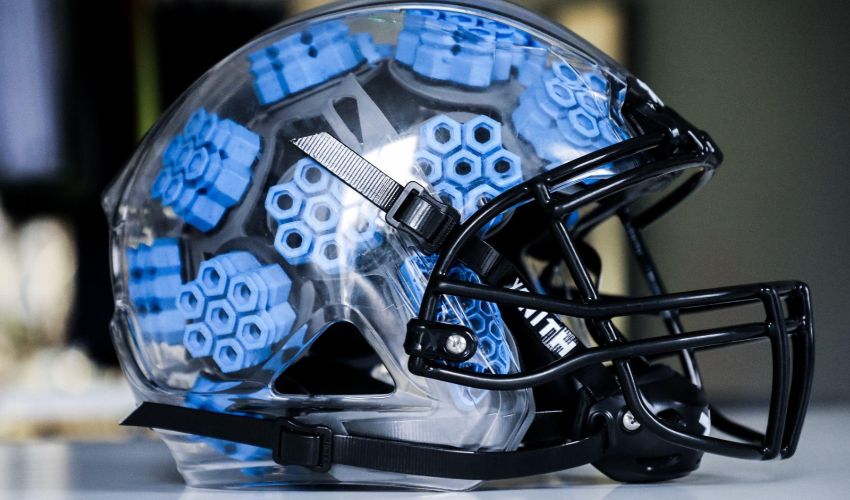
Pollen AM and RHEON Labs have announced a promising partnership. The companies have just qualified the RHEON™ P3D 001 damping material on the Pam Pro pellet printer. The first real-world test integrates protective components into an American football helmet for the NFL. These parts are 30% lighter than their injection-molded counterparts and offer at least equivalent damping.
3D Printing Is Already Used for Helmets
Resin 3D printing has already demonstrated its advantages over injection molding for American football protective gear. The technology offers greater geometric freedom, cheaper customization and weight reductions.
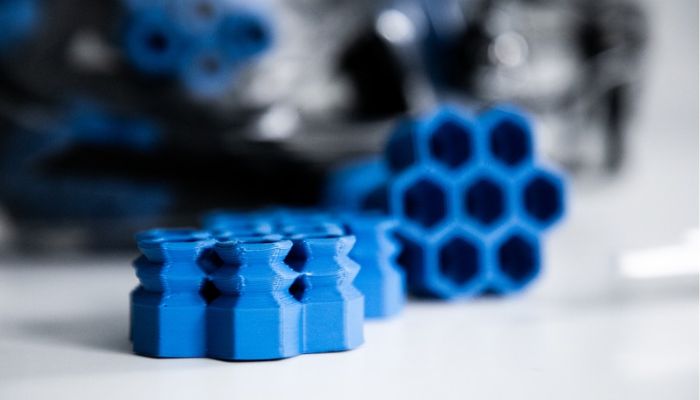
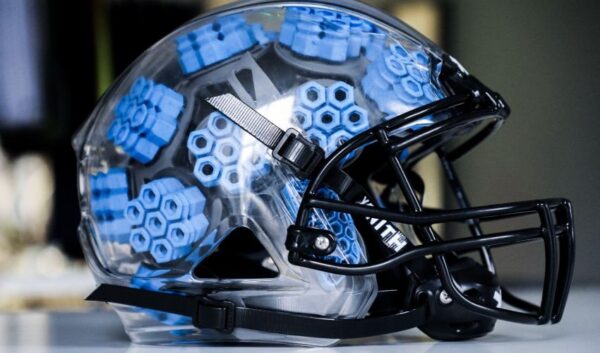
The 3D printed helmet components (Photo credits: RHEON Labs)
What about pellet additive manufacturing? French pellet 3D printer manufacturer Pollen AM and shock-absorbing polymer specialist RHEON Labs are exploring this approach.
The two companies printed internal protective components and integrated them into the Xenith Shadow XR, a helmet already equipped with RHEON materials. What is the real added value of the PAM technology used?
The True Cost of the Mold
Manufacturers currently injection-mold these components. A typical production run involves 5,000 to 10,000 helmets. Each helmet contains between 1 and 12 protective parts. The process suits these volumes but requires a heavy investment before producing the first part. Tooling can cost up to €150,000 and lead times can reach three months.
The mold also imposes design constraints. These include draft angles, uniform wall thickness and minimal undercuts. Producing internal lattice structures or varying mechanical properties within a single part is very difficult. Geometry is limited to what the mold can fill and eject.
Eliminating the mold bypasses many of these limitations. Additive manufacturing offers an attractive alternative. PAM technology is especially relevant, particularly regarding materials.
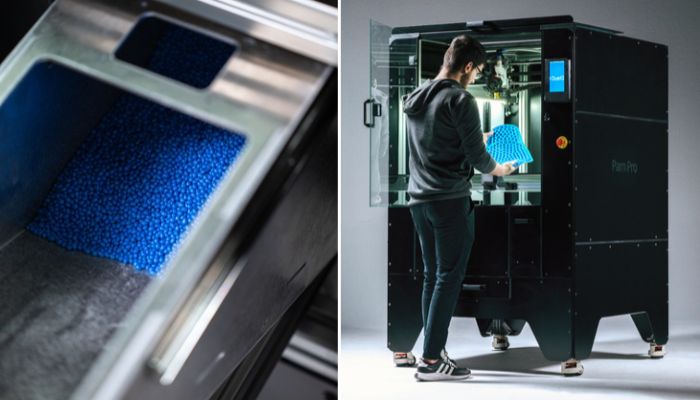
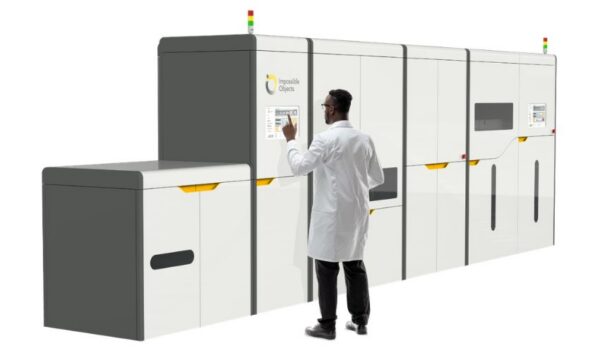
The Pam Pro machine (Photo credits: Pollen AM)
A Material that Hardens Upon Impact
RHEON™ P3D 001 is intrinsically strain-rate sensitive, which means its stiffness depends on how fast it is deformed. It remains soft and flexible when worn, then stiffens upon impact to absorb energy. This behavior is inherent to the material and doesn’t rely on any post-processing or secondary treatments.
The material comes as pellets, the same raw material used for injection molding. Material costs stay close to injection molding, without the mold investment. 3D printing makes it possible to vary lattice density, cell shape and wall thickness across different areas of the helmet. Modifying the geometry fine-tunes the impact response zone by zone.
To achieve this, the Pollen AM team had to adapt the settings RHEON used on other pellet printers to work on the Pam Pro. These validated parameters are key technical outcomes of the collaboration.
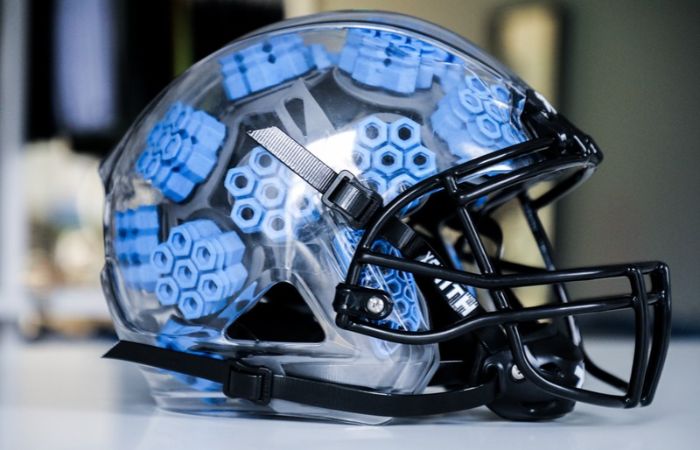
The helmet is 30% lighter (Photo credits: RHEON Labs)
30% Lighter, without Compromising Damping
RHEON Labs compared the printed components to injection-molded parts of similar geometry. The laboratory measured the energy transmitted through the part during low-energy and high-energy impacts.
The printed part weighs 30% less than the molded version. Despite the reduced mass, its damping performance is at least equivalent to the injection-molded part. It even performs better under certain impact conditions.
Download the full case study to discover all the results. It includes:
- the complete transmitted energy versus impact energy curve comparing the printed part and the molded part;
- the exact weight of the compared components;
- the validated print settings for the Pam Pro;
- the mechanical properties of RHEON™ P3D 001 (hardness, melt flow index, elongation and stress at break);
- how the lattice is adapted zone by zone;
- a summary technical data sheet.
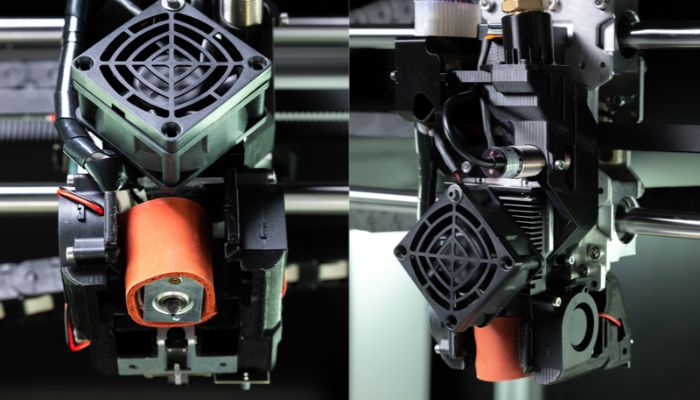
The Pam Pro pellet extrusion head (Photo credits: Pollen AM)
Motorcycles, Bicycles, Defense: The Next Targets
Pollen AM and RHEON Labs view this qualification as a starting point. The partners are targeting other protective equipment: motorcycles, bicycles, and defense – anywhere where shock absorption is just as important as production costs and lead times.
“Sport is one of the most demanding environments for a material: parts have to protect, flex and stay light, and brands want them faster,” said Victor Roux, co-founder and President of Pollen AM. “Working with RHEON Labs shows what an open, pellet-based process makes possible when it meets an advanced material. Our goal is to bring more material producers onto the platform, so that brands and manufacturers can move from a new material to a finished part faster.”
Dr Sarah Karmel CSO, RHEON Labs, concludes: “This collaboration demonstrates how advanced materials and additive manufacturing can work together to unlock new possibilities for protective equipment. By combining RHEON Labs’s dynamic material technology with pellet-based 3D printing, we’re enabling faster development, greater design freedom and application-specific performance.”
Pollen AM and RHEON Labs will present the results in a live webinar on 25 November 2026: register for free HERE. Pollen AM will also exhibit at Formnext 2026 in Frankfurt (Hall 12.1, Booth A78).
Check out the full results in the Pollen AM x RHEON Labs case study HERE.
What do you think of this project? Let us know what you think in a comment below or on our LinkedIn or Facebook pages! Plus, don’t forget to sign up for our free weekly Newsletter to get the latest 3D printing news straight to your inbox. You can also find all our videos on our YouTube channel.
*Cover photo credits: RHEON Labs