






Phrozen Launches the Sonic Mighty Revo 16K MAX for Large-Format Resin 3D Printing
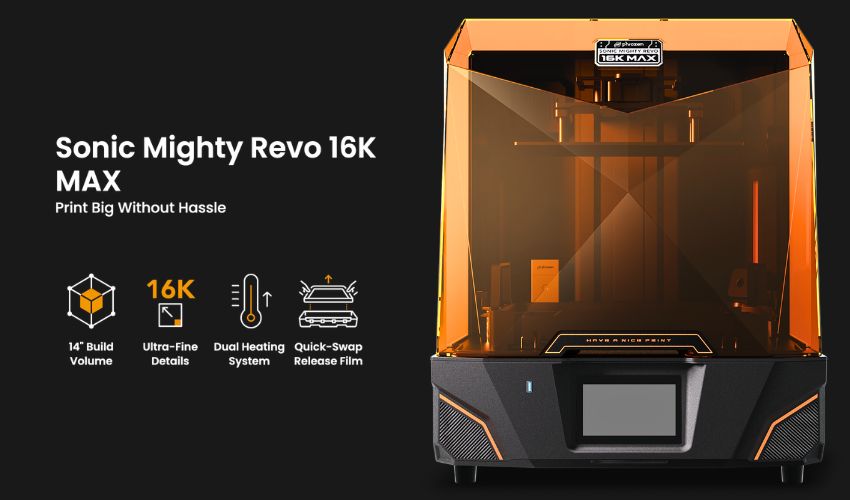
Phrozen has filled a gap in its own catalog. Until now, creators who wanted the Taiwanese manufacturer’s sharpest resolution reached for the Sonic Mighty Revo 16K, a precision tool bound by a modest 211.68 × 118.37 × 235 mm build envelope. Those who needed scale took the Sonic Mega 8K S, which offered volume at the cost of a coarser 43 µm pixel. Printing a large display model with crisp detail meant picking a compromise, or slicing the model apart and gluing it back together.
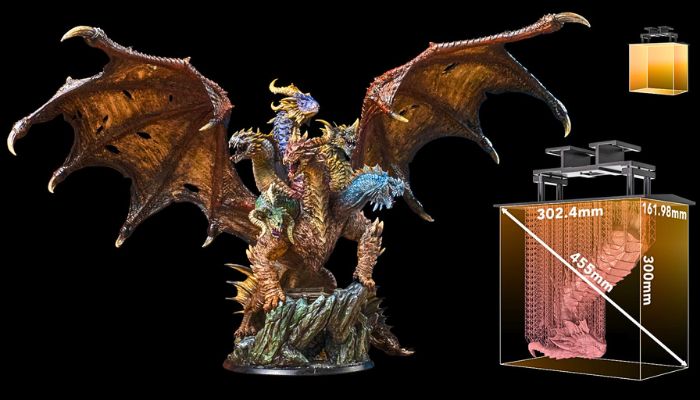
The Sonic Mighty Revo 16K MAX, or simply the Revo MAX as Phrozen calls it, closes that gap, taking the resolution from one and the scale from the other. It pairs a 14.7 L build volume (302.4 × 161.98 × 300 mm) with a 14-inch 16K mono LCD.
Size and pixels are only half the story. Ask a resin studio what ruins a multi-day print run and the answers repeat: a cold room, a vat running dry overnight, downtime lost to changing a release film. Phrozen built the Revo MAX around those complaints: a $1,600 machine with a standard heating chamber, a 2 L vat and a release film that swaps without tools. An optional heated vat, sold separately, completes the dual-heating setup. Pre-orders opened in Taiwan in July 2026, with the first units shipping in September.
Resolution spread over a larger plate
Phrozen sells this as a 16K machine, a name taken from the roughly 15,000 pixels running along the long axis of the screen. Spread across a 14-inch panel, each of those pixels works out to 20 × 26 µm, coarser than the 14 × 19 µm on the smaller Mighty Revo. That is geometry rather than a design failure. The two screens hold almost the same number of pixels, but the MAX screen is roughly 40% wider, so each pixel has more ground to cover. Anti-aliasing, which the earlier machine did not offer, smooths what the pixel alone cannot.
File ceiling and real-world workflow
The file size ceiling matters more day to day. Sliced files on the Revo MAX can reach 10 GB, compared to the 2 GB cap on the Mighty Revo. Pack a 14-inch plate with dense, high-detail miniatures and the sliced data explodes. On a machine with a 2 GB limit, that forces you to split a single build plate into multiple sliced jobs.
Speed and peel physics
Speed is where the larger format extracts its price. Every layer cures against the transparent film at the bottom of the vat, and the build plate has to peel it away before the next one can form. The wider the layer, the harder it clings, so the printer lifts more slowly to avoid tearing the part loose. That is why Phrozen quotes an average of 245 layers per hour here, down from the 676 maximum on the smaller machine. Anyone stepping up from a mid-size printer should budget for longer run times.
Dual heating, chamber and vat
Cold resin turns viscous, which shows up as weak first-layer adhesion or layers that separate partway through a print. Most large-format competitors tackle this by heating the vat. Phrozen takes a dual approach.
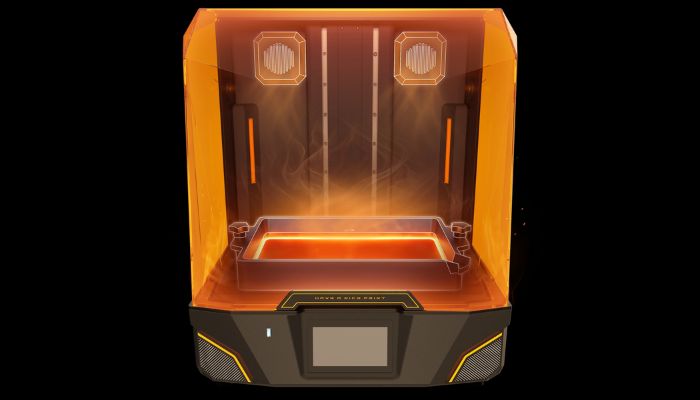
The Revo MAX has a dual-fan chamber heater as standard, bringing the air inside the enclosure to 30 °C. Heating is an on/off control rather than a settable target. Users can then add a heated vat, priced separately, to directly warm high-viscosity materials up to 4,000 cps. The company describes this pairing as an industry-first for consumer resin machines.
Fewer interruptions on long jobs
The vat holds 2 L of resin, roughly two and a half standard bottles, and operates without an automated resin feeder. Phrozen argues that a vat large enough to handle overnight runs removes the need for a pump, avoiding the leaks, clogs and mechanical failures active systems can introduce. Elegoo reaches the opposite conclusion on the Jupiter 2, pairing a smaller vat with a two-way pump fed by a 2 kg bottle.
The rest of the hardware design targets routine studio downtime:
- Tool-free film swaps. The quick-release film system lets you swap out release film in about three minutes without reaching for tools.
- Quick-release LCD and plate. The LCD comes out after removing a single screw, and the build plate has dual side handles for a secure grip and a sloped top surface that lets residual resin drain directly back into the vat instead of requiring manual scraping.
- Enclosed drip rack. An internal hanger suspends the build plate over the vat to drain after printing, and the lid still closes over it.
Monitoring built for unattended runs
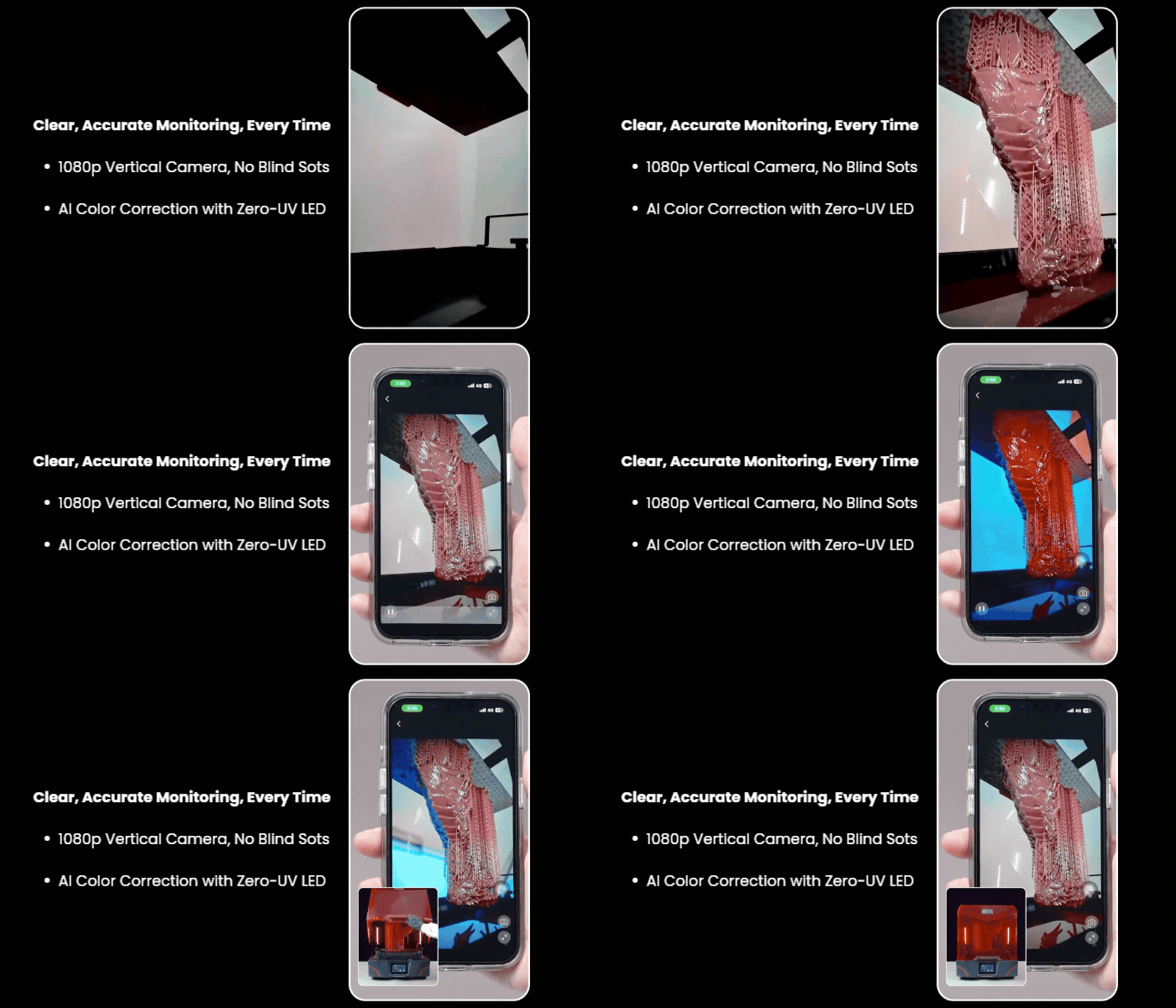
The 1080p camera points straight down at the build plate rather than across it, preventing the build platform from blocking the lens as the print grows. Dual UV-free amber light bars illuminate the chamber without accidentally curing resin, while built-in AI color correction compensates for the heavy amber tint that typically turns remote print snapshots orange.
Fail-safes and reminders
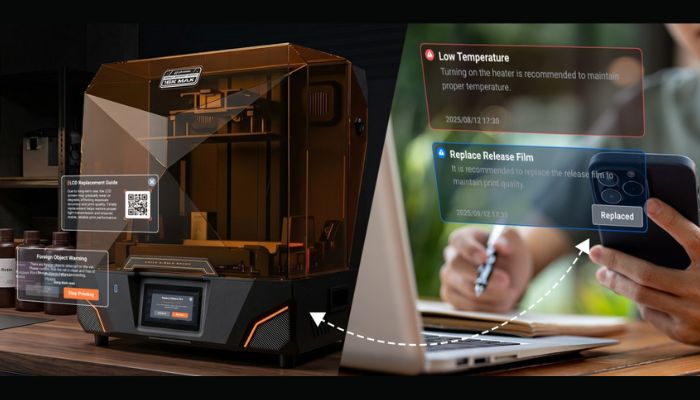
The machine monitors for print failures and foreign object residue in the vat. In the event of a power outage it resumes from the exact layer where it stopped, though Phrozen notes that a faint line can appear at the restart point. System alerts also issue maintenance reminders for the Z-axis, the LCD, and release film replacement. A four-color status light on the front of the machine reports success, running, preparing and error states, so a studio running several printers can read each one from across the room.
Smart leveling and exposure calibration
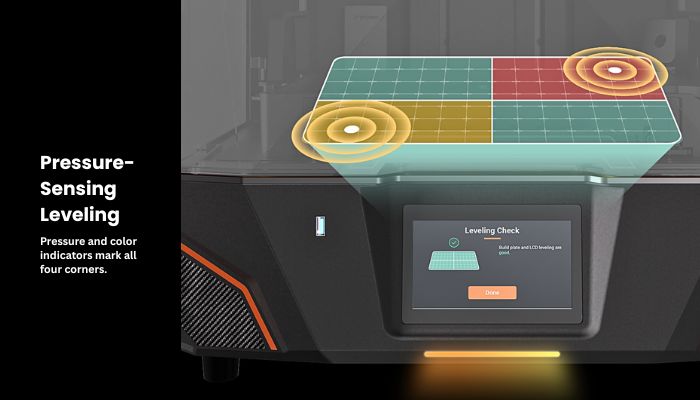
Calibration is handled by two built-in software tools. Pressure-sensing assist displays real-time force readings for all four corners during manual leveling, taking the guesswork out of platform balance. The zonal exposure test prints two, four, six or eight exposure settings on a single test model, cutting the trial-and-error cycle needed after switching resin types or adjusting for seasonal room temperature changes.
Where it sits in the market
The 14-inch class is crowded. Elegoo’s Jupiter 2 has an identical build volume and the same XY resolution for $949. Anycubic’s Photon P1 Max is larger at 18.3 L but drops to a 12K panel with 24.8 µm pixels, at $959. Uniformation’s GK3 Ultra covers similar ground for $1,499.99.
Phrozen’s $1,600 list price sets it above the field, though a Super Early Bird offer, which opened September 22, brings it to $1,300, or $1,250 with a subscriber code, in line with the GK3 Ultra. What the price buys isn’t raw resolution, where two of the three rivals also run 16K panels, but what surrounds the print. By Phrozen’s own comparison, it is the only machine in the group to pair a standard chamber heater with the optional heated vat. Its 2 L vat holds roughly two and a half bottles without needing a feeder, where the Jupiter 2 and GK3 Ultra rely on automatic refilling. Its 1080p camera looks down on the plate with AI color correction, against a 720p side view on the Jupiter 2, 480p on the P1 Max and no camera on the GK3 Ultra. And the build plate and film are both quick-release, with an LCD that comes out after removing a single screw, a combination only the Jupiter 2 matches.
Who it’s for, and what it prints
Phrozen aims the printer at professional model makers, independent studios and small-batch production. Key use cases include 28 mm wargaming figures printed at full size, 20 to 30 jewelry wax patterns per plate with a 60% high-wax castable resin, and single-piece enclosures for engineering prototypes. Pre-production units were placed with creators including MR.JOE HOBBY.tv, MADWORKS, and FauxHammer, with full independent reviews rolling out post-launch in October.
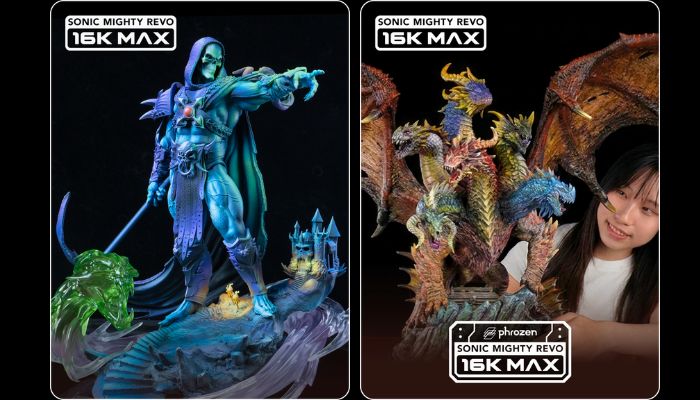
Sample prints from the Phrozen Sonic Mighty Revo 16K MAX. Left: Model designed by @zez.studios, painted by @wormxp. Right: Model designed by @loot.studios, painted by @yong_cheng99 and @dream_worker66.
You can find full technical specifications, pricing, and availability on the official Phrozen Sonic Mighty Revo 16K MAX product page.
What do you think of the Phrozen Sonic Mighty Revo 16K MAX? Let us know in a comment below or on our LinkedIn or Facebook pages! Plus, don’t forget to sign up for our free weekly Newsletter to get the latest 3D printing news straight to your inbox. You can also find all our videos on our YouTube channel.
*All Photo Credits: Phrozen







Hey Phrozen,
please get rid of those crappy 16:9 LCD screens !! We need at least 4:3 (300mmx230mm)
Better would be 1:1 (eg: 300x300x400h) or (350x350x450 much better)
Please work on this asap !!!
thx Wolfgang