


MIT Researchers Find a Way to Reuse Resin 3D Printing Supports
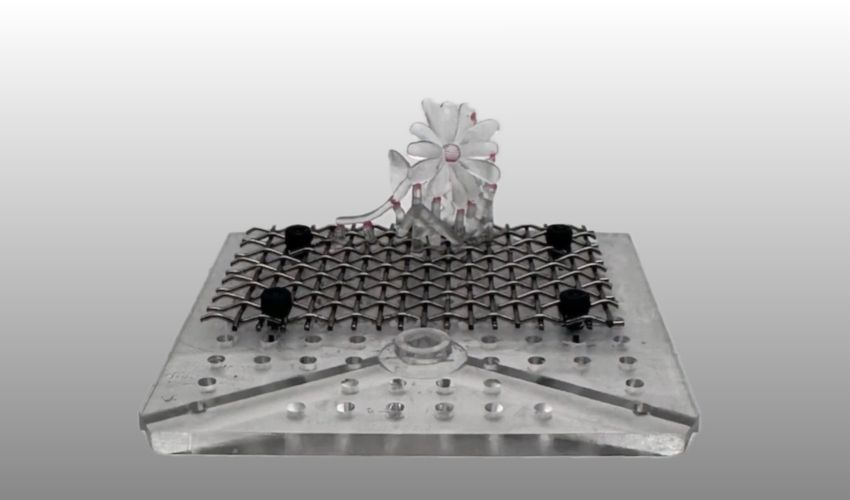
In resin 3D printing, support structures make it possible to produce complex geometries, overhangs, and very thin features that would otherwise collapse during printing. However, they also increase material consumption, require manual removal that can leave marks on the part’s surface, and can even cause damage if not handled with care. Furthermore, once removed, the supports are discarded and cannot be reused.
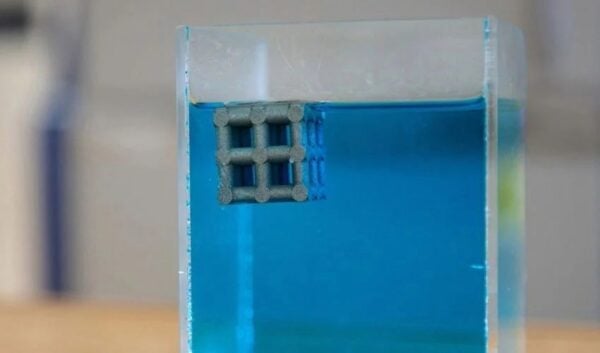
A team of researchers at the Massachusetts Institute of Technology (MIT) believes it has found a way to reduce these drawbacks. In a study published in Additive Manufacturing Letters, the scientists present a new process that allows the same supports to be reused across multiple prints. Instead of manufacturing and discarding the supports with each part, the system keeps them virtually intact thanks to a thin layer of water-soluble resin that acts as a separation point between the support and the final part.
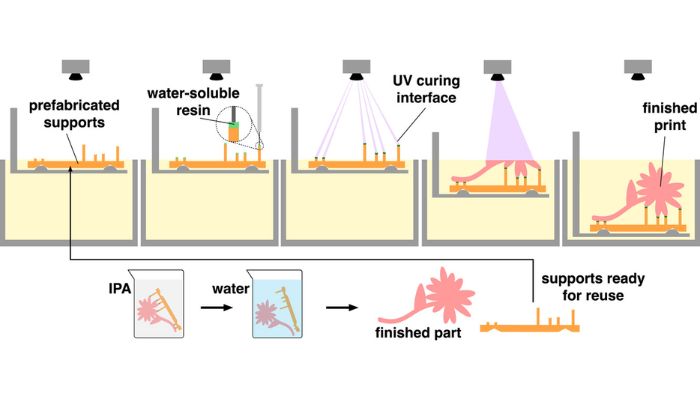
The process used by the MIT interface to reuse supports in resin 3D printing.
How Does the System Work?
The process begins with a set of prefabricated supports tailored to a specific part. Once manufactured, these are mounted on the print bed using a kinematic coupling system: a high-precision mechanism that ensures they are always positioned in the same place.
Next, a needle controlled by an automated system deposits a small amount of a water-soluble, curable resin onto the tip of each support. This resin is cured using ultraviolet light, forming a thin interface between the reusable support and the part. So, the support never comes into direct contact with the part but is separated by a sacrificial layer that can be removed later.
Once the interface is prepared, the platform descends into the resin tank and begins printing the part using conventional resin. After the usual washing and curing steps, the assembly is placed in an ultrasonic bath filled with water. There, the soluble interface breaks down and releases the part with virtually no mechanical force, while the supports remain intact and ready to be reused in the next print.
Testing the System
To verify whether the system truly allowed for the reuse of support structures, the team printed four models shaped like a dragonfly wing. This is a particularly delicate geometry due to its fine structural ribs. After each print, the part was removed by dissolving the support structures in water, and the same support structures were prepared for the next print.
The researchers observed no noticeable changes in either the behavior of the supports or the quality of the resulting parts during the four printing cycles. Although small traces of cured resin began to appear adhering to the tips of some supports, these did not affect the system’s performance during the tests conducted. That said, the authors themselves acknowledge that it will still be necessary to study how many times the supports can actually be reused before significant wear sets in.
One of the most striking findings of the study emerges when comparing this system to a commercial 3D printer. The researchers printed the same part (the dragonfly wing) using a Formlabs Form 4 with the default support settings. In that case, only 24% of the total resin volume ended up forming the part, while the remaining 76% was used for supports that were subsequently discarded.
With the new method, the supports still serve their purpose, and only the small amount of water-soluble resin used to create the interface is consumed. According to the team’s calculations, that material accounts for approximately 5% of the total resin consumption during each new print cycle.
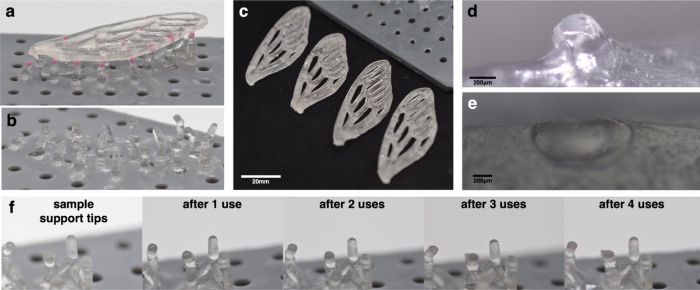
Reuse of supports in four successive prints of a dragonfly wing. The marks left by conventional supports (d) and the soluble interface method (e) are compared, as well as the accumulation of resin residue on the tips after each cycle (f).
A Promising Technology, Though Still Experimental
The authors themselves emphasize that the technology is still in an experimental phase. The process requires a photopolymerization printer specifically designed to operate from the top down, equipped with an automated system capable of precisely depositing the soluble resin onto each support structure before printing begins. This means that, for now, the method cannot be directly implemented on most commercial resin printers, which use a different architecture.
Even so, the study opens up an interesting avenue for overcoming one of the main obstacles to automating 3D resin printing. If future research succeeds in simplifying the process and extending the lifespan of reusable supports, this strategy could significantly reduce material waste and manual intervention, bringing resin-based additive manufacturing closer to more automated production processes. You can read the full study HERE.
What do you think of the research? Let us know in a comment below or on our LinkedIn and Facebook pages! Don’t forget to sign up for our free weekly Newsletter here, the latest 3D printing news straight to your inbox! You can also find all our videos on our YouTube channel.
*All Photo Credits: Peraire-Bueno et al. (2026), Additive Manufacturing Letters