Litronics, the Company Designing the Light Behind DLP 3D Printers
When we think about a 3D printer, we tend to focus on the machine’s design, the materials it uses or the parts it can produce. Yet some of the most interesting advances happen inside, in its components. In DLP printers, one of the most important is the optical engine, which projects the image that cures the material layer by layer.
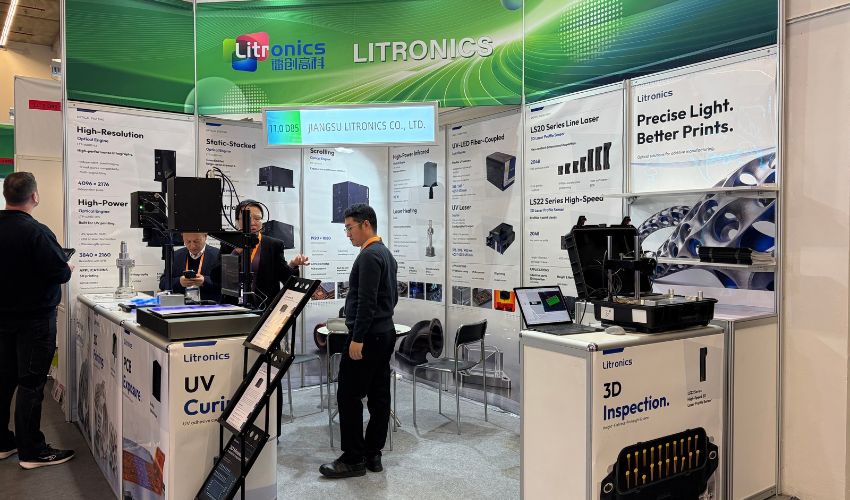
Chinese company Litronics builds these systems for other equipment manufacturers. Although it also works with LEDs, the most common light source in these machines, it specializes in engines that combine a DLP chip with a laser. This week, the company is exhibiting at Formnext for the first time, in Hall 11.0, Booth D85. We spoke with its CEO, Wenhong Gao, about his background, the company’s technology and what it is showcasing at the show.
A Component Supplier Rooted in Laser Research
Litronics’ story begins in Norway. In 2008, Wenhong Gao started a PhD there on laser speckle reduction, a subject he worked on for four years. He then spent another four years developing laser imaging technology. “We realized that our technology could provide imaging solutions for equipment manufacturers and make it easier for them to develop their machines, for example in laser direct imaging (LDI) for high-resolution lithography,” he explains. With that idea in mind, he founded Jiangsu Litronics in 2016.
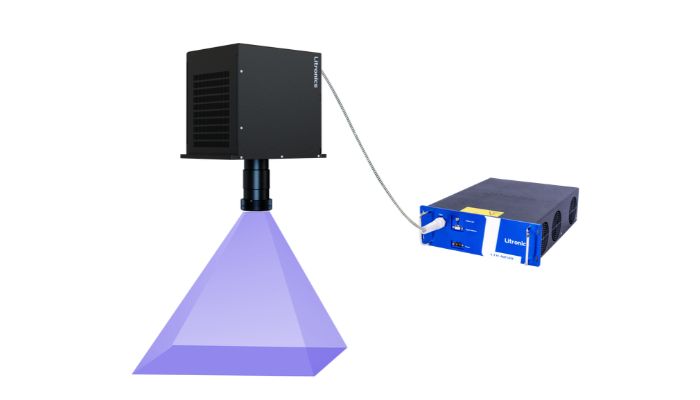
A UV optical engine connected to a laser source. (Credits: Litronics)
A UV optical engine connected to a laser source. (Credits: Litronics)
Today, its additive manufacturing portfolio includes UV and NIR DLP optical engines, laser and LED light sources and laser area-heating lenses, as well as line laser profilers for 3D measurement. Its customers include 3D printer manufacturers serving sectors such as medical and dental, jewelry and industry, as well as LDI equipment makers. According to the company, its team includes 5 PhDs and more than 50 engineers, and it holds over 120 patents in optics and laser technology.
What Does a DLP Optical Engine Do, and Why Use a Laser?
DLP (Digital Light Processing) technology is based on a chip called a DMD, made up of hundreds of thousands or even millions of micromirrors. Each mirror corresponds to a pixel. As they tilt, the mirrors form the image of an entire layer, which is projected onto a resin or another photosensitive material to cure it. The optical engine brings together the light source, the optics that shape the beam, the chip and the projection lens.
Lasers deliver more power than LEDs, but they come with a drawback. Because laser light is coherent, it produces speckle, a grainy interference pattern that makes the illumination uneven. In 3D printing, this can affect how each layer is exposed. Reducing this effect is exactly what Gao specialized in during his PhD.
“Laser-based DLP engines can achieve higher precision, higher contrast and greater production efficiency,” says Gao.
A Range for Different Materials and Applications
Litronics offers optical engines in several wavelengths: 365, 378, 385, 405, 435 and 455 nm, as well as near-infrared (NIR). According to the company, they are compatible with resin, ceramic and nylon 3D printing. For nylon, the infrared engine is used, as it is designed to sinter powder materials area by area.
The engines operate in three modes. In static mode, they project the entire layer at once. In scrolling mode, the projection moves to cover larger surfaces. Tiling combines several images into a mosaic.
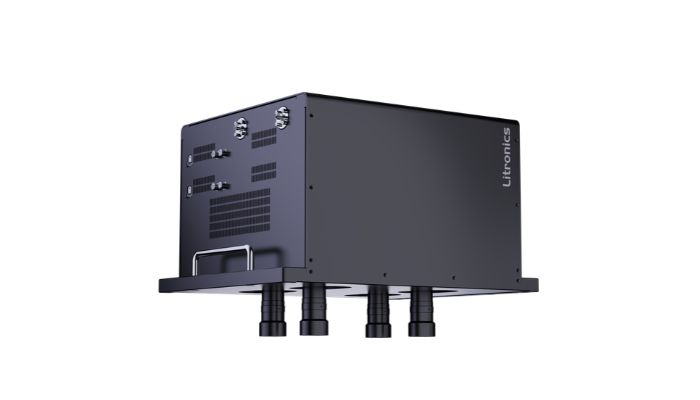
Several static optical engines tiled together to extend the build area. (Credits: Litronics)
Gao gives several examples based on DLP chip size, measured diagonally in inches. A 0.78″ engine paired with a 405 nm laser source can print elastomer footwear materials in large formats with high productivity. These resins contain fillers and pigments that absorb some of the UV light, so they need more power to cure properly. According to the company, its large-format engines offer build areas of up to 576 × 324 mm, enough to print several soles at once, and can exceed 1,000 mm when tiled. A 0.95″ scrolling engine is aimed at large, high-resolution ceramic parts. The 0.99″ engine is designed for ultra-high-resolution applications.
Manufacturers can customize the lenses and the light source’s output power. The optical engine and laser source are also separate modules, which makes maintenance easier. And because Litronics also makes profilers to measure parts, it offers a closed-loop workflow between printing and inspection.
Litronics Makes Its Formnext Debut
At its booth, Litronics is showcasing its range of static, scrolling and high-resolution engines, along with UV laser sources, a line laser profiler and laser area-heating lenses. These lenses turn a laser beam into a uniform heating zone to preheat the powder bed in processes such as SLS or selective laser melting, which helps reduce part warpage. Most of its products are designed for non-metallic materials, although the company is already developing optical engines for metal printing.
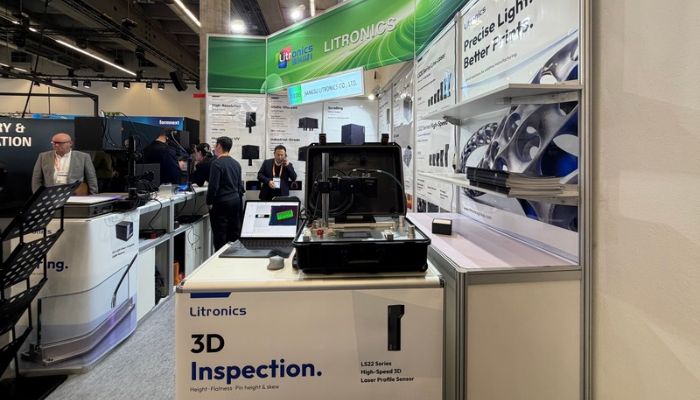
A line laser profiler on display at the Litronics booth. The company combines these sensors with its optical engines to link printing and inspection. (Credits: 3Dnatives)
On how the industry is evolving, Gao puts it simply: “The additive manufacturing market is not exploding; it is stratifying.” In his view, the consumer segment competes on scale and cost, while the industrial segment competes on reliability and adaptability to production.
You can find more information about Litronics’ optical engines and other solutions HERE.