



Apple 3D Prints the Hinge for Its First Foldable Phone: The iPhone Duo
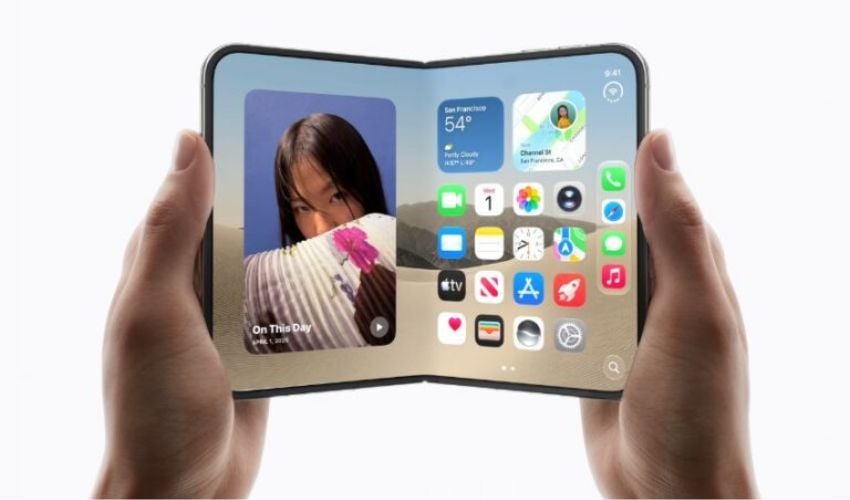
Last week, Apple unveiled the iPhone Duo, its first foldable phone. Many people online are comparing it with Samsung’s Galaxy Z Fold8. For the additive manufacturing sector, however, the main development lies in a critical foldable-phone part: the hinge.
The iPhone Duo’s hinge cover is 3D printed from 100% recycled Grade 5 titanium. Its bead-blasted finish contrasts with the mirror polish on the rest of the chassis. The complete hinge assembly contains more than 100 components.

Inside the iPhone Duo, the hinge and its more than 100 components sit alongside the new A20 Pro chip and a vapor chamber that dissipates heat.
The next stage of the process is particularly significant. During the product presentation, Apple Senior Vice President of Hardware Technologies Johny Srouji explained that a confocal laser scans the topology of each unit. The system then prints up to 25 micro-layers of a custom-developed photopolymer to eliminate residual waviness. Artificial intelligence (AI) algorithms also match each hinge with the housing that provides the best fit.
Honor and OPPO Used Additive Manufacturing First
The approach is not new. We reported on it in March, when OPPO applied the same principle to its Find N6 through a process it calls Liquid 3D Printing. The technique combines laser scanning with 5-picoliter photopolymer droplets. Repeating the process around 20 times creates a flat base beneath the display. Two manufacturers had reached the same conclusion before Apple.
They are not the only companies using additive manufacturing in this area. Honor adopted additive manufacturing in 2023 with the Magic V2’s titanium hinge, produced using laser powder bed fusion (LPBF). It was the first use of additive manufacturing in series production for consumer electronics.
Samsung, the Apple rival attracting most comparisons, has not announced any use of additive manufacturing in the Z Fold8. Instead, its foldable mechanism uses a titanium alloy film beneath the panel.
For Apple, this development is not a sudden step. In November 2025, the company explained that it had moved to 3D printing all titanium cases for the Apple Watch Ultra 3 and Series 11 using LPBF. The results led Apple to produce the iPhone Air’s USB-C port with 3D printing as well.
Apple says it has spent a decade experimenting with additive manufacturing while waiting for the technology to meet its quality and scale requirements. With the iPhone Duo, the company has stopped observing and now uses the technology for the device’s most critical part and the one most exposed to wear.
What do you think about the use of 3D printing in the iPhone Duo hinge? Let us know in the comments below or on our LinkedIn and Facebook pages. Plus, sign up for our free weekly Newsletter to get the latest 3D printing news straight to your inbox. You can also find all our videos on our YouTube channel.
*All photo credits: Apple