
3DCeram Launches the CLP50: A Top-Down DLP Ceramic 3D Printer Starting at €80,000
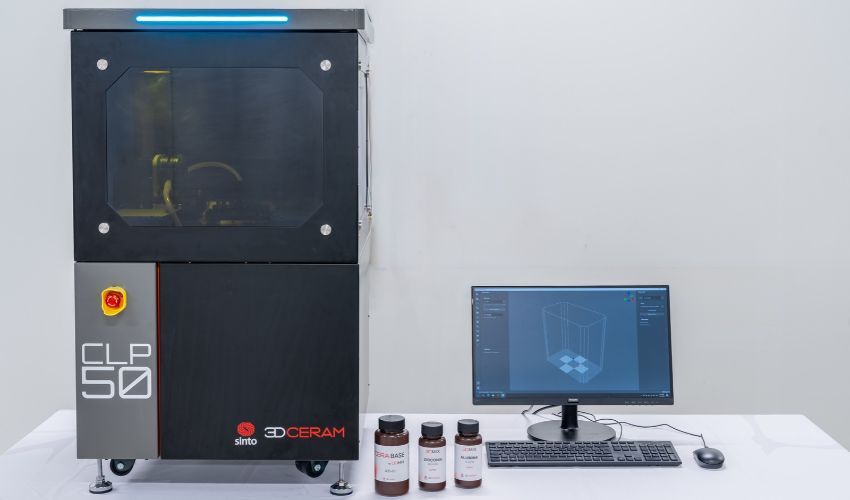
French manufacturer 3DCeram is using Formnext 2026 to unveil its new technical ceramic 3D printer, the CLP50. Featuring top-down Digital Light Processing (DLP) technology and a starting price of €80,000, the machine enables ceramic part manufacturers to access photopolymerization. It allows them to prepare for scaled production without immediately committing to a major industrial investment.
For years, 3DCeram has sold stereolithography (SLA) machines equipped with UV lasers. These 3D printers come in several build platform sizes, ranging from 100 x 100 x 150 mm to 600 x 600 x 300 mm. In 2017, the company expanded its portfolio with its M.A.T. (Multi Additive Technology) solution based on material extrusion. This technology has primarily found a home in laboratories, universities and research centers.
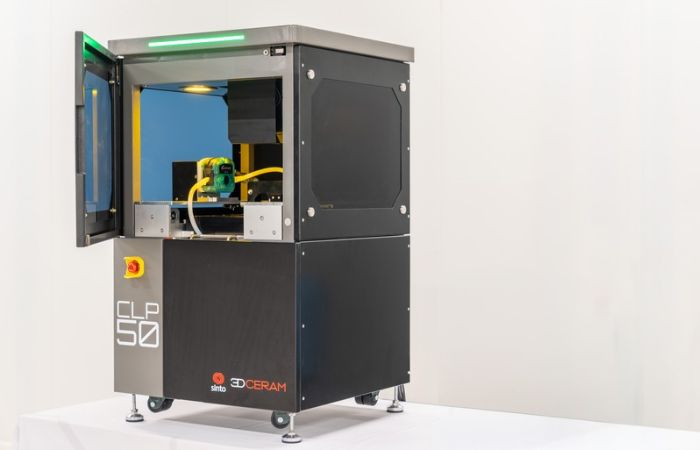
The CLP50 machine
A Response to “First-Time Industrial Buyers”
A gap remained between these two offerings. Many manufacturers want to integrate ceramic 3D printing to meet new customer demands. However, they hesitate to make heavy investments until those customers are actually there. “It is a bit of a chicken-and-egg situation,” summarizes Maxence Bourjol, Sales Manager at 3DCeram. “These manufacturers tell us they need ceramic additive manufacturing to convince their customers. Without those customers, they cannot spend €200,000 on a machine. In a challenging economic climate across many countries, this is a real obstacle.”
Material extrusion meets many research, development and manufacturing needs. However, photopolymerization offers specific advantages in geometric intricacy, surface quality, accuracy and density. These qualities are particularly sought after in certain demanding industrial applications.
Target customers expect a technology based on ceramic paste. This is a mixture of ceramic powder and photosensitive resin cured by a light source. This is exactly what the CLP50 offers. The machine will appeal to laboratories and research centers, but its primary target remains these first-time industrial users.
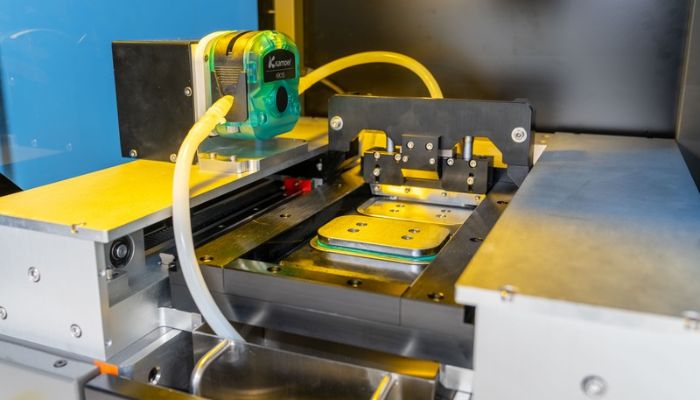
The CLP50, A DLP System True to 3DCeram’s DNA
Despite its small size, the CLP50 maintains the features that built 3DCeram’s reputation, like using a projector instead of a laser. The manufacturer also kept the top-down configuration that has characterized its 3D printers from the start. By building the part from the top down on the platform, the need for support structures is significantly reduced or even eliminated entirely.
Notably, the new machine is compatible with the same consumables as the manufacturer’s SLA 3D printers. A customer starting with alumina on the CLP50 can quickly switch to a larger-format machine if their part volume increases, meaning they won’t have to requalify their material. “The idea is for a manufacturer to take a first step with a small machine to win over customers. They can then turn to our premium machines once their business takes off,” explains Maxence Bourjol.
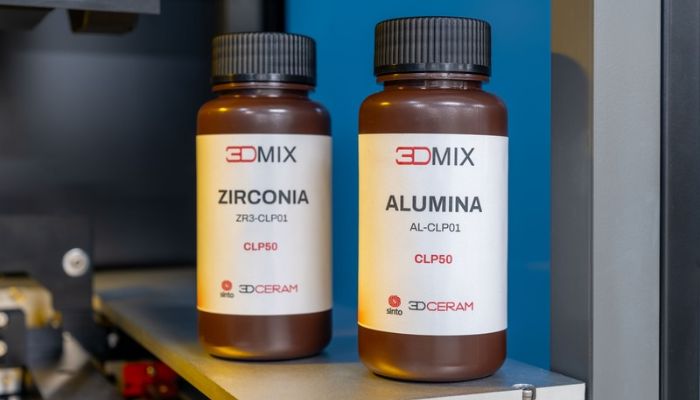
The machine is compatible with the same consumables as 3DCeram’s SLA printers.
The machine also remains an open system. As with the brand’s SLA 3D printers, customers who wish to do so can develop their own material formulations.
Looking at a few technical specifications, note that the CLP50 offers a print volume of 96 x 54 x 100 mm and can reach a speed of 400 layers per hour, depending on the material.
When it comes to manufacturing, 3DCeram embraces a partnership strategy: an industrial partner designs the hardware. 3DCeram then qualifies and certifies the equipment, incorporating its own improvements. The manufacturer focuses its added value on the elements that determine the quality of a ceramic part: materials, software and support.
The CLP50 complements 3DCeram’s industrial SLA 3D printers rather than replacing them. DLP offers a highly attractive entry-level solution for manufacturers looking to expand their operations. However, SLA platforms retain their advantages for large print areas, production flexibility and cost-per-part optimization, especially for industrial production runs.
Materials Expertise Open to All
The company will also showcase two ranges of consumables at Formnext. The first, CERA-BASE, is a ready-to-use organic base. Customers add their own ceramic powder to formulate their material. This product targets manufacturers who want to control their formulations without holding all the expertise, and without relying on a subcontractor for this step.
The second range, CERA-XXX, marks a strategic shift. For the first time, 3DCeram is selling its ceramic pastes for 3D printers from other manufacturers that operate at 355, 385, 405 or 465 nm. The demand came from the customers themselves. “Even a manufacturer equipped with a fleet of competing machines does not want to rely on a single materials supplier. They want two sources of supply,” Maxence Bourjol added.
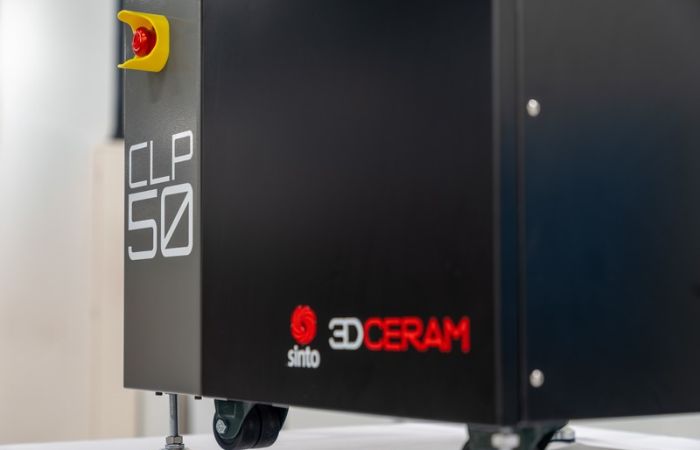
Where to Discover the CLP50
The ceramic 3D printer is already available to order for €80,000. Interested buyers can contact the 3DCeram team by clicking HERE. The 3D printer is currently on display at the manufacturer’s booth B32 in Hall 11.0 at Formnext. Several parts are also on show to demonstrate the machine’s print quality.
What do you think of the CLP50? Let us know on our LinkedIn or Facebook pages! Plus, don’t forget to sign up for our free weekly Newsletter to get the latest 3D printing news straight to your inbox. You can also find all our videos on our YouTube channel.
*Photo Credits: 3DCeram