

A Super Fast Soft Robot that Runs without Electronics (and Was Printed in One Piece!)
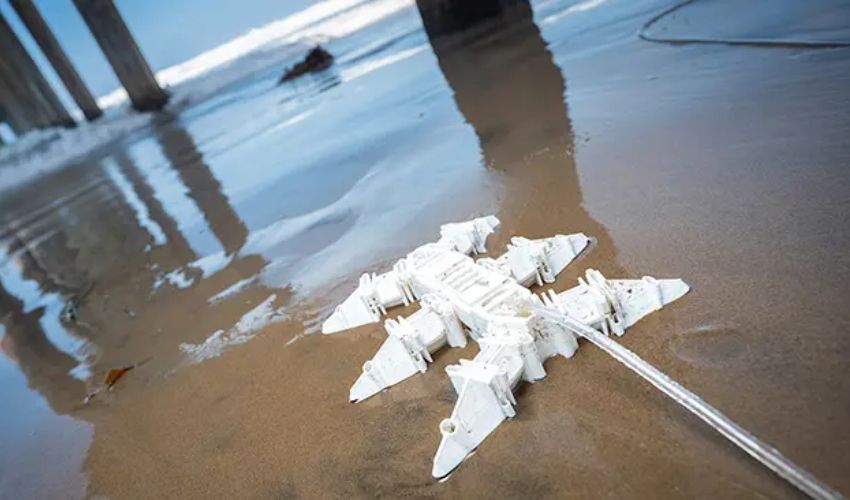
Researchers from the University of California San Diego recently published a project in Science Robotics that caught our eye this week: a 3D printed soft robot that runs completely without electronics. It’s not magic. It runs via compressed air with a mechanism like a compound steam engine. The robot can run remarkably fast, reaching speeds of 4.72 meters (about 5 yards) per second. The little guy isn’t limited to certain terrain, either. The engineers tested it on grass, sand, mulch, concrete, and even underwater.
Building on Past Attempts
The team was led by postdoctoral researcher Yichen Zhai and Professor Michael T. Tolley, in the Bioinspired Robotics and Design Laboratory at the UC San Diego Jacobs School of Engineering. This wasn’t the first time they tried to build a robot like this. In 2022 they 3D printed an air-powered robot, described in a 2025 article in Advanced Intelligent Systems. The results were far from what their more recent robot can achieve. The original robot could only go 4 centimeters (roughly 1.5 inches) per second.

The robot in action.
How the Mechanism Works
To improve the speed capabilities, the engineers designed a robot that contains connected chambers, valves, and tubes that drive the movement of the legs when pressurized air passes through. By increasing the pressure that goes through these structures, they can increase the speed of the robot. The 2022 version of the robot didn’t have big or strong enough internal structures to accamodate the higher pressures, so the team made these features larger and stronger. However, with higher pressures, the robot moved so fast that it lost efficiency, expending high pressure air that still had energy.
So, the group implemented the design of a compound steam engine. This system permits steam to expand through multiple chambers, getting the most out of energy in the high pressure air. According to UC San Diego, The design lets pressurized air circulate twice. First, it goes through the smaller high-pressure chambers to power the valves, and then in larger, low-pressure chambers to move the legs. This meant that the new robot could run 100 times faster than the original version!
“The key challenge was to implement a time-tested solution (the compound steam engine) in a soft running robot that can be printed in a single piece out of a single material. We see this as a step towards complex and powerful robots that can be printed on the desktop using inexpensive materials,” Zhai said.
Limitations and Possible Applications
As it stands, the robot has to be tethered to a compressed air source, which limits its functionality. In future research, the team would like to develop designs that require less compressed air. That way, the robot can run around without being tied down, using a portable air source like a compressed air cartridge.
A little robot like this might not seem particularly practical, given it can’t steer or manipulate objects yet, but going forward, the researchers would like to implement those capabilities. It could be used in environments where electronics would struggle to function: places with strong magnetic fields or high radiation, disaster zones, or in space. Watch the robot in action below, and read the study here.
What do you think of the concept? Let us know on our LinkedIn or Facebook pages. Don’t forget to sign up for our free weekly Newsletter for the latest 3D printing news straight to your inbox! You can also find all our videos on our YouTube channel.
*All Photo Credits: David Baillot/University of California San Diego