



How Jean Paul Gaultier and Sculpteo 3D Printed AW26 Haute Couture
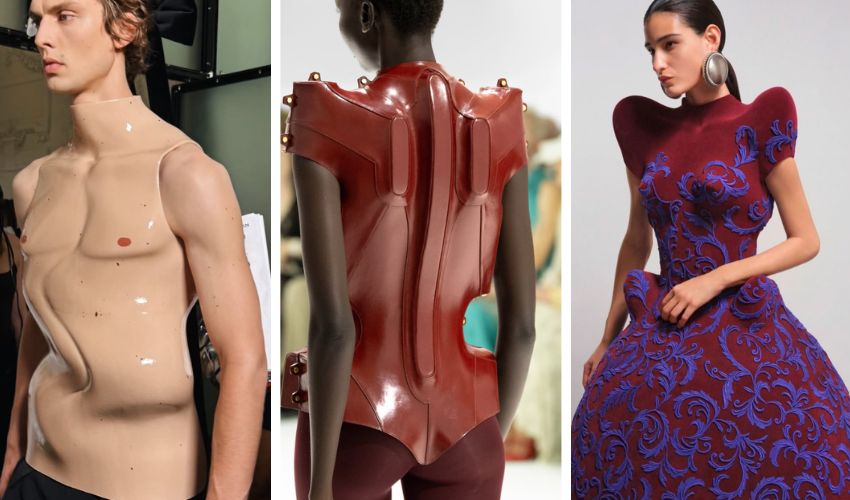
From the 3D printer to the couture runway. Jean Paul Gaultier turned to additive manufacturing for five looks in its Autumn/Winter 2026-27 haute couture collection, shown in Paris in July.
The collection was Duran Lantink’s first couture outing as creative director of the house. The Dutch designer builds garments that reshape the body rather than conform to it: a bust that could have come out of a Dalí painting, and an exoskeleton built to read as a feathered serpent.
Designer ROMI, who developed the collection’s printed pieces, turned to French 3D printing service Sculpteo to produce the components. The parts were printed in PA12 and flexible TPU, with the structural pieces produced on HP Multi Jet Fusion (MJF) and the scales for Look 19 on SLS.
Five 3D printed looks, five hand finishes
Look 7, the deformed bustier, arrived at Matisse Di Maggio’s Paris atelier fresh off the printer in raw TPU. Sanding and priming came first, then the latex bath. To achieve that lifelike finish, the bust was repeatedly dipped into a pool of latex tinted to match the model’s skin. The detail didn’t stop there. Freckles and moles were hand-painted on. The nipples were cast separately in latex, then applied.
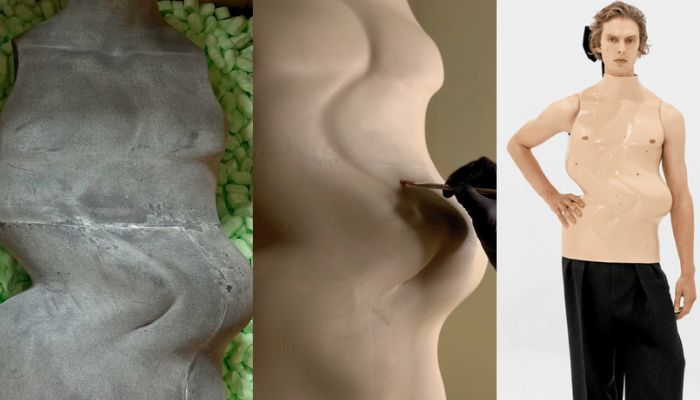
Look 7 in three stages: printed in raw TPU by Sculpteo, finished in latex at Matisse Di Maggio’s atelier, and worn on the runway. Photo credits: left and centre, Matisse Di Maggio; right, Jean Paul Gaultier.
Look 11 is the 3D printed guipure dress. The bodice and the domed skirt structure were both printed, then Maison du Flock applied the surface by hand, laying fibre directly onto the shell.
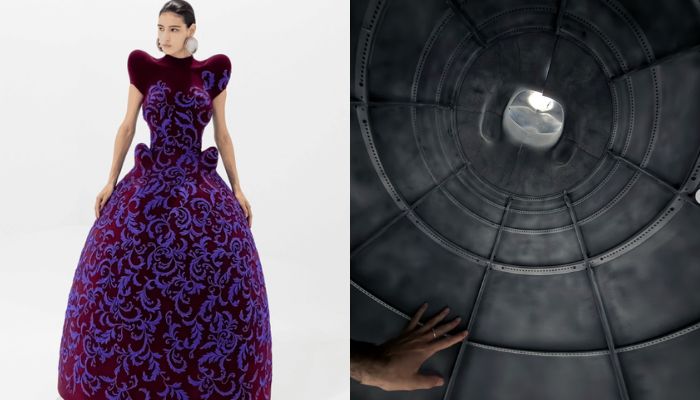
Look 11, the 3D printed guipure dress, and the printed skirt structure hidden beneath it. Photo credits: left, Jean Paul Gaultier; right, ROMI via Instagram.
Look 19 isn’t one printed piece. It’s thousands. The snake scales dress is built entirely from individual PA12 scales, each printed separately on SLS, then sewn on by hand. They overlap in rows down the garment the way they do on an actual snake. The material doesn’t bend, but the garment does.
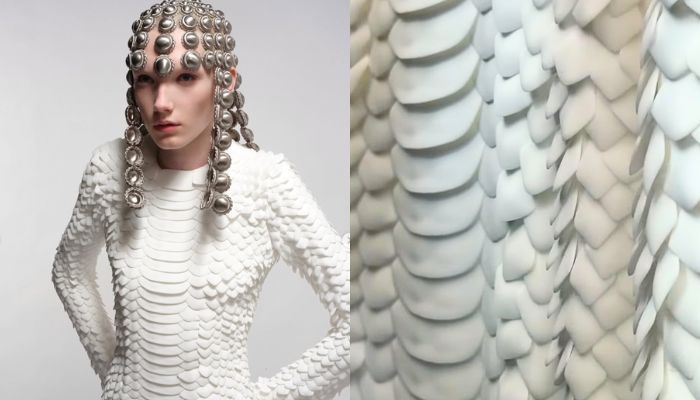
Look 19, the snake scales dress, built from thousands of individually printed PA12 scales sewn on by hand. Photo credits: left, Jean Paul Gaultier; right, Alexandra Dautel.
Look 26 started with a 3D scan of the model’s body. That scan was then reworked in 3D modeling software, growing animal-like protrusions until the torso had turned into something closer to a feathered serpent. Sculpteo printed the result in TPU, in sections, and those were assembled into one exoskeleton. Paris plumassier Maison Février then covered the whole thing in pink feathers.
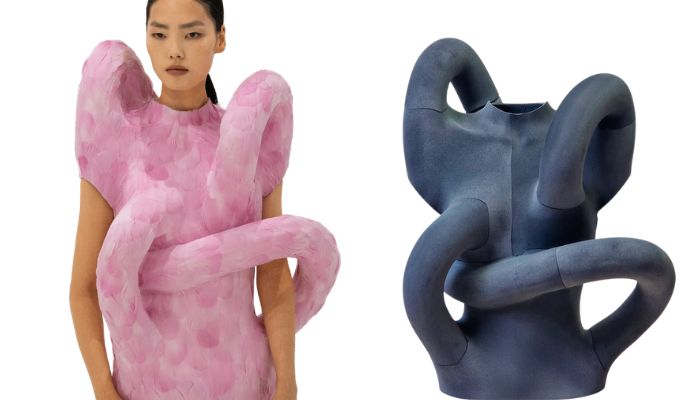
Look 26: the feathered exoskeleton and the printed TPU structure beneath it. Photo credits: left, Jean Paul Gaultier; right, ROMI via Instagram.
Look 32 is a burgundy bodysuit built around a 3D printed core, most likely in TPU. Whitaker Malem formed the leather over that base into an armored torso shell, closed with nut-and-bolt tabs. Lantink asked for a burgundy finish, so the hide was hand-dyed, a job that took around eight hours before the cutting, skiving, edge-dyeing, polishing, sewing and forming even began.
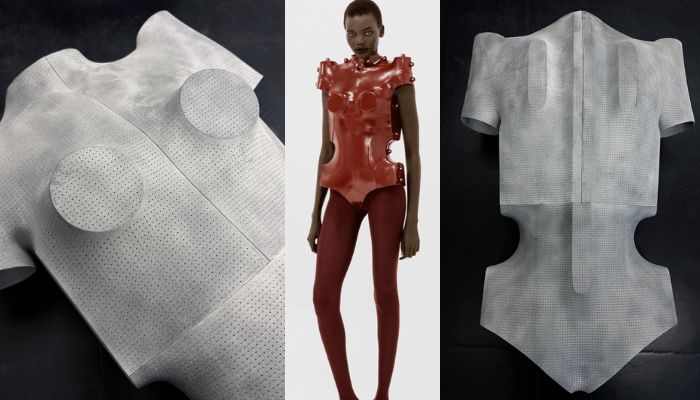
Look 32: the printed base, front and back, and the finished bodysuit after Whitaker Malem’s leatherwork. Photo credits: left, Jean Paul Gaultier; right, ROMI via Instagram.
What 3D printing actually did for the collection
The pattern holds across all five looks. The printer made the shape; the ateliers made it couture. What that buys a house like Gaultier is geometry it couldn’t otherwise cut and sew, on a schedule that has no room for trial and error.
What do you think of this collaboration? Let us know in a comment below or on our LinkedIn and Facebook pages! Don’t forget to sign up for our free weekly Newsletter here, the latest 3D printing news straight to your inbox! You can also find all our videos on our YouTube channel.
*Cover photo credits, left to right: Franklin Headen, Yannis Vlamos, Jean Paul Gaultier.







Fashion is getting weird lol. –geometry dash scratch