





Researchers 3D Print a Custom Guide to Help Beginners Play the Shakuhachi Flute
One day in my elementary school music class, our teacher brought in all kinds of instruments for us to try, to see if there was one we’d be inspired to learn. I remember trying a violin, a cello, a tuba, the flute…and when it came to the wind instruments, and I could barely squeak out a sound. I didn’t know how to use my breath or position my lips, and all I managed was one quack from a trumpet. I didn’t end up playing any instruments in the school band. Maybe, if I had a device like the one just developed by Institute of Science Tokyo, I wouldn’t have been so discouraged!
Researchers at Science Tokyo have digitally fabricated a device that recreates the spatial relationship between a musician’s lips and an air-reed instrument. Essentially, it’s a small guide that sits between your chin and the instrument to make sure everything is positioned correctly. The broader goal of the study was to find out whether a prosthodontic digital guide workflow could work for applications beyond conventional intraoral ones. As a proof of concept, the team designed a device specifically for the shakuhachi, a traditional Japanese end-blown flute.

The shakuhachi is made from bamboo. (Photo Credit: Gen)
The shakuhachi is tricky for beginners, who must learn to coordinate the shape of their lips, the angle of their breath, and the position of the instrument to produce the right sound. This spatial relationship is hard to demonstrate, so new players traditionally rely on plenty of observation, instruction, and practice. According to the study, the lack of visual and tactile positional references can make it harder to judge the correct embouchure and slow down learning, so the researchers set out to design a device that could help.
How Was The 3D Printed Flute Guide Created?
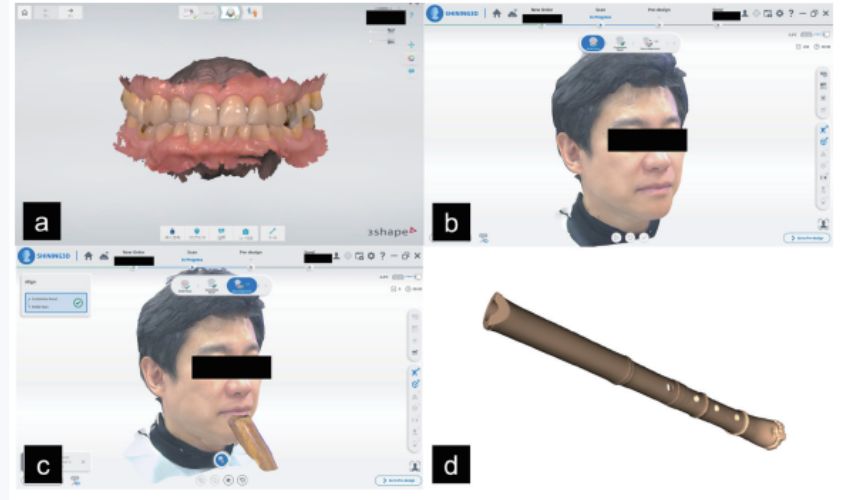
First, the team scanned the shakuhachi, along with facial and intraoral scans of an experienced male player’s embouchure. The musician then got into his optimal playing position so the researchers could capture the exact spatial relationship between his face, lips, and instrument mid-performance.
Next, the scientists brought this data into CAD, using dental landmarks, the occlusal plane, and facial reference points to reproduce the relationship between the player’s lips and the instrument. From this digital model, they designed a spherical clay model about 70 mm in diameter to fill the gap between the musician’s chin and the shakuhachi, then converted it into a hollow guide. Since the final part was produced using stereolithography, the team added a window to let uncured resin drain out. For the material, they chose a biocompatible photopolymer commonly used for dental surgical guides, ensuring the device could be properly disinfected and sterilized.
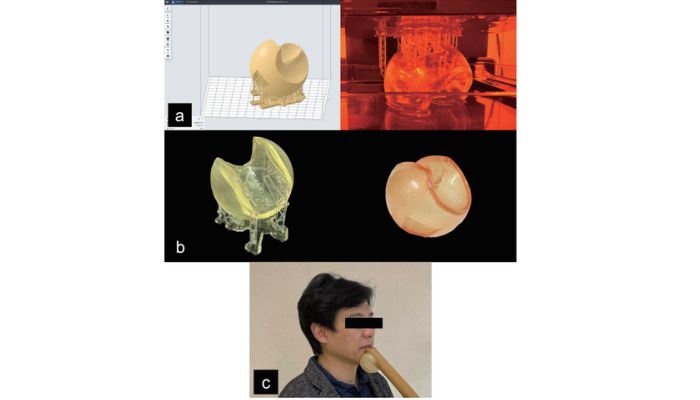
The fabrication of the air-reed instrument guide. (Image credit: Hada et al.)
The result is a guide tailored to the player’s own dentofacial morphology, with a hollow, lightweight design meant to keep it comfortable. Its bracing arm can also be customized for fine positional adjustments. When an expert musician put the guide to the test, it scored well for stability, fit, and overall usability.
“Beyond music education, we expect this concept could potentially be extended to maxillofacial prosthetics, orofacial rehabilitation, and other extraoral devices requiring precise perioral spatial control,” concludes Assistant Professor Tamaki Hada, who led the project along with Professor Manabu Kanazawa. If you want to learn more about the study, read it HERE.
What do you think of this research? Are there other applications that come to mind? Let us know in a comment below or on our LinkedIn or Facebook pages! Plus, don’t forget to sign up for our free weekly Newsletter to get the latest 3D printing news straight to your inbox. You can also find all our videos on our YouTube channel.
*Cover Image: 3D scans of the face and shakuhachi. Image Credit: Hada et al.).