


3D-Printed Suit Lets Cyborg Cockroaches Dive Underwater
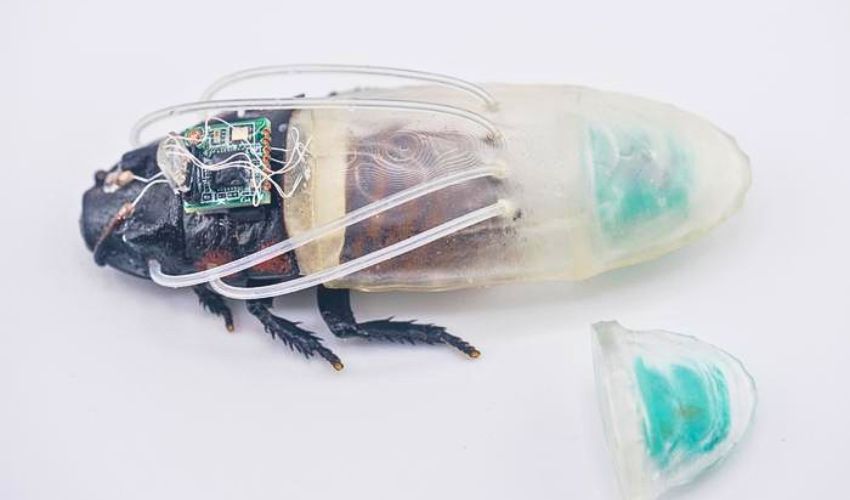
Cockroaches are usually the last creatures anyone wants to encounter. But researchers at Nanyang Technological University and Waseda University have turned them into unlikely rescue tools, fitting living insects with 3D-printed underwater suits that let them navigate flooded environments.
It sounds like the plot of a science fiction film. It’s actually the premise of a study published in Nature Communications: remote-controlled cyborg insects that can move between land and water and stay active for hours at a time, in confined, extreme environments where humans and conventional robots struggle.
Rather than build a robot to mimic a cockroach, the researchers took the living insect and wired it up instead. Pairing an animal with an electronic controller is what’s known as a cyborg insect, a hybrid that uses the body nature already built rather than trying to copy it. Using Madagascar hissing cockroaches, the team combined the insects’ natural abilities with an existing control backpack and a newly designed 3D-printed breathing system, giving them amphibious capabilities.
Why a cockroach?
The choice isn’t arbitrary. Cockroaches squeeze through gaps a few millimeters wide, scramble over uneven debris without missing a step, flip themselves upright almost instantly if knocked over, and keep going for hours on very little energy. Engineers have spent years trying to get small robots to do any one of those things well.
On land, that resilience holds up fine. Underwater, it falls apart fast. Cockroaches breathe through small openings along their sides called spiracles, and once those are submerged, the insect can’t get air. That’s the problem the researchers set out to solve.
A 3D-printed diving suit
Their answer is a scuba suit: a flexible 3D-printed shell that wraps around the abdomen, separate from the control backpack that handles movement. Suited insects stayed active underwater for up to three hours. Without the suit, that dropped to about two minutes.
Fitting the suit to a living insect was harder than it sounds. It had to be lightweight, waterproof, and precisely shaped so it didn’t interfere with how the cockroach naturally moves, three constraints that are difficult to hit at once with anything but 3D printing.
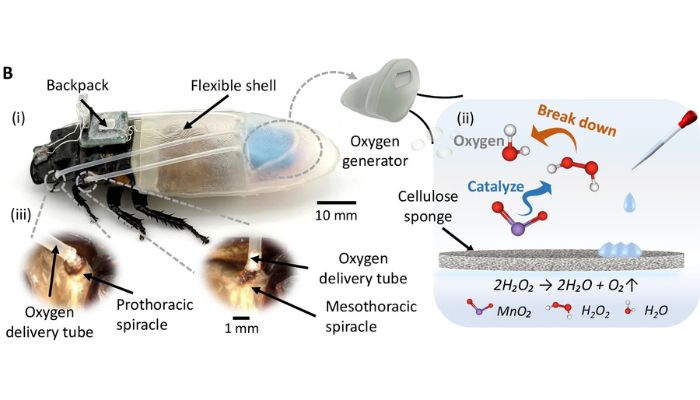
Photo Credit: Nature Communications
Every part was printed around the individual insect’s own body. The centerpiece is a 3D-printed oxygen tank, made from a transparent, PMMA-type resin chemically close to acrylic. Inside, a sponge coated in manganese dioxide reacts with a little hydrogen peroxide to generate oxygen, piped through tiny silicone tubes straight to the insect’s breathing holes. The shell around the tank is printed in a flexible resin, so it moves with the cockroach instead of fighting it. Even the connectors linking the shell to the spiracles were custom-printed, since the two pairs of breathing holes aren’t shaped the same way and each needed its own seal.
Could cyborg cockroaches become rescue tools?
This isn’t hypothetical. Sato’s cyborg insects have already been used in real search-and-rescue work, including Operation Lionheart, deployed after the magnitude-7.7 earthquake that struck Myanmar in March 2025. The team is now developing the technology further for infrastructure inspection.
Our new insect diving suit works like the oxygen tank used by human divers. It generates oxygen and delivers it directly to the insect’s breathing holes, allowing the cyborg cockroach to survive and move in underwater or low-oxygen environments.” — Hirotaka Sato, Professor, School of Mechanical and Aerospace Engineering, NTU Singapore
The team also thinks the approach could extend past cockroaches. Locusts and beetles rely on a similar spiracle-based respiratory system, so a version of this suit could, in theory, be adapted to fit them too.
What do you think about cyborg cockroaches? Let us know in a comment below or on our LinkedIn and Facebook pages! Don’t forget to sign up for our free weekly Newsletter here, the latest 3D printing news straight to your inbox! You can also find all our videos on our YouTube channel.
*Cover Photo Credits: NTU Singapore