





What Is 3D Printing?
Additive manufacturing, commonly known as 3D printing, builds three-dimensional objects from digital CAD models by adding material layer by layer, rather than removing it as in traditional subtractive manufacturing. Since emerging in the 2000s as part of the 4th industrial revolution, additive manufacturing has moved well beyond prototyping into production across aerospace, medical, automotive, and consumer sectors. The global 3D printing materials market alone is projected to reach around $85-95 billion by 2035, reflecting the pace at which new 3D printing technologies are being adopted worldwide.
-
- Fused Deposition Modeling (FDM), also known as Fused Filament Fabrication (FFF)
-

- Chuck Hull made history by inventing Stereolithography
-
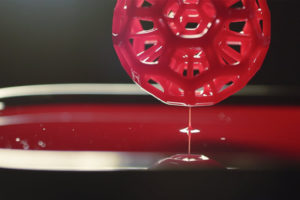
- CLIP, an ultra-fast 3D printing technology developed by Carbon3D
History & Development of 3D Printing Technologies
3D printing traces back to 1981, when Hideo Kodama of Nagoya Municipal Industrial Research Institute first described a layer-by-layer fabrication method using UV-cured photopolymers. He published his findings but never patented the process, and a French team that filed a similar patent three years later abandoned it for lack of commercial interest.
The first patent for the technology went to Chuck Hull in 1986, who developed Stereolithography (SLA), a process that solidifies liquid resin with UV light. Hull went on to found 3D Systems and release the SLA-1, the first commercial 3D printer.
Two more foundational technologies followed in 1988. Carl Deckard of the University of Texas patented Selective Laser Sintering (SLS), which fuses plastic powder with a laser layer by layer, while Scott Crump, co-founder of Stratasys, patented Fused Deposition Modeling (FDM), also known as Fused Filament Fabrication (FFF). Stratasys held the FDM patent until 1992; its expiration paved the way for the open-source RepRap movement that still underpins most entry-level 3D printers today.
Which Materials Can Be 3D Printed?
Material choice is tied closely to the printing process. FDM machines run on thermoplastic filaments; SLA and DLP use photopolymer resins; SLS and DMLS process fine powders in nylon, plastic, or metal. Beyond standard plastics and metals, the material palette now includes composites, advanced engineering polymers like PEEK and ULTEM, and even unconventional materials such as edible ingredients. Each new material is developed to improve a specific property, whether that’s strength, heat resistance, or surface finish, and that pace of development is a major driver of where additive manufacturing can be used next.
What Is the 3D Printing Process?
- Create a digital model. Design the part in CAD software, or capture an existing object using a 3D scanner or photogrammetry.
- Export the file. Save the model as an STL or the newer AMF format.
- Check for errors. Inspect the file for defects before printing. Scanned models typically need more cleanup than CAD-designed ones, since scan data carries noise and missing detail that has to be corrected before slicing.
- Slice the model. Run the file through slicing software, which converts it into thin, printable layers.
- Generate the G-code. The slicer outputs a G-code file with instructions tailored to the specific printer, ready to print.
What Are the Benefits of Additive Manufacturing?
3D printing’s core advantages start with design freedom: complex geometries, internal lattices, and part consolidation that are difficult or impossible with traditional manufacturing become straightforward, often replacing multi-part assemblies with a single printed component. That same flexibility supports custom and adaptive designs, since each part can be tailored to a specific use case without retooling, and because no molds or fixtures are required, iteration is fast and low-volume production stays cost-effective. The process is also more material-efficient than subtractive methods, since it adds material only where needed rather than cutting it away, which translates into less waste and a smaller environmental footprint.
These advantages are pushing additive manufacturing well beyond its original role in prototyping. As the technology matures, more companies are using it for industrial-scale production of end-use parts, not just early-stage models, a shift reinforced by growing pressure for supply chain resilience: on-demand, localized printing reduces dependence on large inventories and long-distance shipping, making it an increasingly viable option for scaled manufacturing rather than a low-volume niche.