



The Top Resin 3D Printers in 2026
Stereolithography, better known by the abbreviation SLA, became the first 3D printing technology when it was imagined in 1984 by American Chuck Hull, later founder of 3D Systems. The process, which is based on the photopolymerization of a UV-sensitive resin using a laser, has since inspired new techniques falling under the ever-expanding vat photopolymerization umbrella, such as DLP and LCD (MSLA), with the popularity of resin 3D printers only growing over the past few years. To get a better idea of what exactly is out there, we have compiled some of the most popular resin 3D printers of 2026. Check out our non-comprehensive list, which covers everything from desktop printers to industrial production systems.
3D Systems: SLA 825 Dual
The SLA 825 Dual is an industrial resin 3D printer from 3D Systems designed for high-throughput production and large-format applications. Using stereolithography with two synchronized 4W lasers, the system offers a build volume of 830 x 830 x 550 mm and layer thicknesses ranging from 50 to 150 microns. Unveiled at Formnext 2025, it offers a build volume around 22% larger and build speeds up to 25% faster than 3D Systems’ previous SLA models. Its large build area allows manufacturers to produce larger parts or multiple components in a single run, while the SLA process delivers detailed parts with a minimum feature size of 0.127 mm in XY. The printer is compatible with a broad range of Accura resins, including materials developed for functional prototypes, investment casting patterns, tooling, and production parts. Pricing is available on request.
Anycubic: Photon P1 Max
The Photon P1 Max is Anycubic’s large-format resin printer, big enough to print a single large model or fill the plate with smaller parts. It has a 285.5 x 214 x 300 mm build volume and a 14-inch 12K monochrome LCD with an XY resolution of 24.8 x 24.8 µm. Layer heights range from 0.02 to 0.15 mm. With standard resin at 0.05 mm, Anycubic quotes print speeds of 15 to 25 mm/h. Its Wave Release technology reduces the force needed to separate each layer. The 1.9-liter vat is temperature controlled, which lets the printer work with most mainstream resins, including thick formulations up to 8,000 cps. Leveling is automatic, with feedback and a self-check, and the printer connects over Wi-Fi or Ethernet. A built-in camera lets users follow prints remotely through the Anycubic app. A single unit starts at $849.
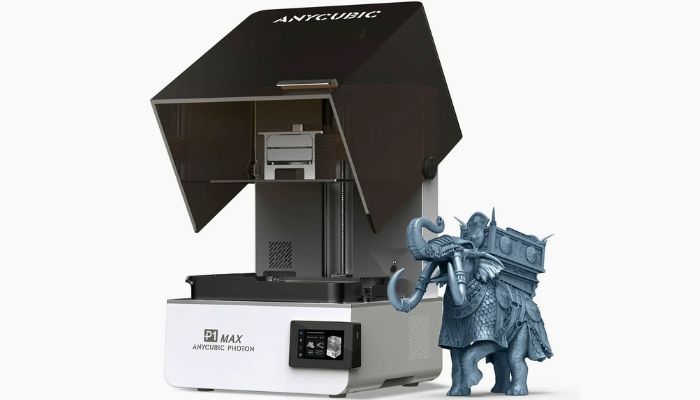
Photo Credit: Anycubic
Asiga: Max 2
The Max 2 is Asiga’s compact DLP printer for dental and medical applications. It uses a 385 nm UV LED light source (405 nm is available on request) and comes in two versions: a 50 µm pixel model with a 96 x 54 x 76 mm build volume, and a 62 µm model with 119 x 67 x 76 mm. Asiga’s Smart Positioning System (SPS™) monitors every layer as it prints, and the UV LED calibrates itself automatically to keep output consistent over the years. The printer also has chamber heating for temperature-sensitive resins, a Transparent Mode for printing water-clear materials, and UltraGLOSS™ for glossy surfaces straight off the build plate. It is compatible with over 650 validated materials through Asiga’s open material system, connects over Wi-Fi or Ethernet, and is operated through a touchscreen interface. It comes with Composer software and unlimited lifetime technical support. Pricing is available on request.
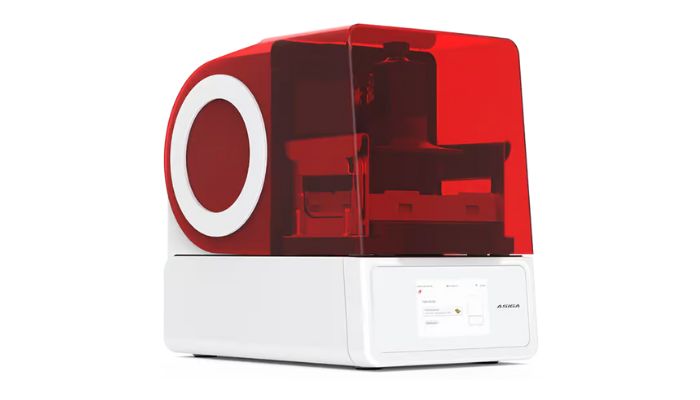
Photo Credits: Asiga
Axtra 3D: Lumia X1
Axtra3D’s Lumia X1 uses Hybrid PhotoSynthesis (HPS), a process that combines the strengths of SLA and DLP to overcome their individual limitations. It cures each layer with a laser and a 4K DLP projector at the same time: the projector covers large areas quickly, while the laser focuses on finer details. To speed things up further, the patented TruLayer technology detaches each layer from the vat quickly, even with highly viscous resins. The printer has an XY resolution of 45 microns and a 249 x 140 x 495 mm build volume. It can run as a closed system or as an open one that accepts third-party 405 nm resins.
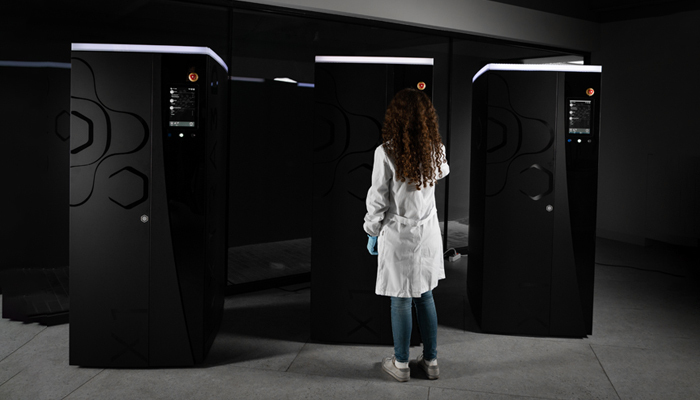
Photo credit: Astra3D
B9Creations: B9 Core 550
The American brand B9Creations offers a range of professional resin 3D printers, including the B9 Core 550, which offers a larger build area than the B9 Core 530. Based on DLP technology, it uses an industrial HD UV LED light engine at 405 nm to cure the liquid resin, and reaches print speeds of 25 to 100+ mm/h depending on the material and model geometry. The B9 Core 550 offers a 10-micron Z resolution, an effective XY resolution below 25 microns with B9’s FAST™ technology, and a build volume of 96 x 54 x 127 mm. It connects via Wi-Fi, Ethernet and USB, works with both B9Creations resins and third-party materials, and uses resin vats that B9 says last over 1,250 prints. It is priced at $10,750.
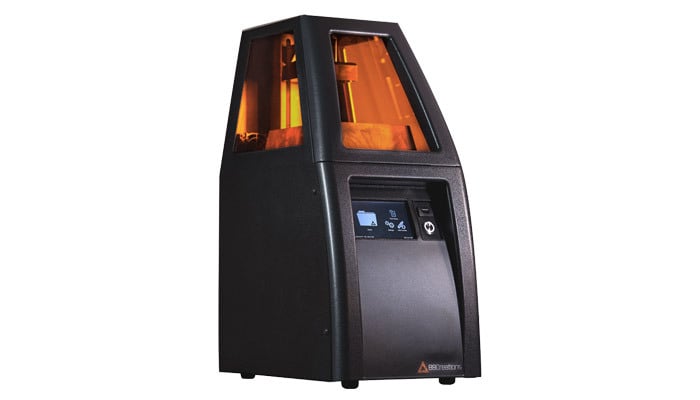
Photo credit: B9Creations
BMF: microArch D1025
Boston Micro Fabrication (BMF) was founded in 2016 and built its reputation on PμSL (Projection Micro-Stereolithography), a technology capable of micron-level precision. The microArch D1025 adds a second resolution to the mix. Users can print at 10 µm or 25 µm, or use the hybrid mode to combine both in different layers of the same part, switching to the higher resolution where tolerances are tight and to the lower one to save time. The printer has a 100 x 100 x 50 mm build volume, layer thicknesses from 10 to 50 µm and tolerances of ±25 to ±50 µm. Much of the setup is automated: the platform, membrane and roller calibrate themselves, the platform attaches magnetically, and the resin vat is heated. BMF describes the D1025 as a good fit for researchers and manufacturers who need two resolutions in a single machine. Pricing is available on request.
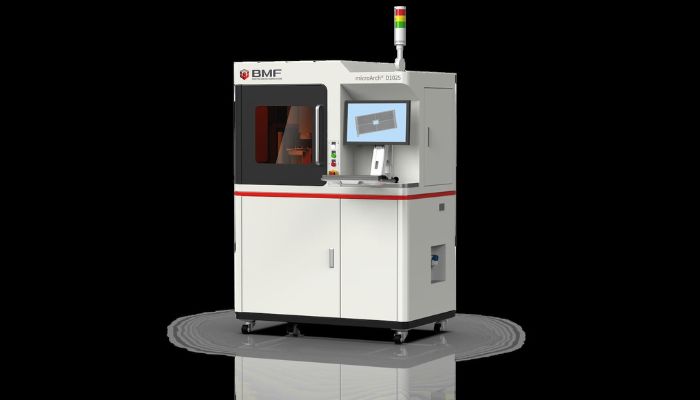
Photo Credits: BMF
Carbon: M3
Carbon, a manufacturer based in Redwood City, California, offers the M3 series for high-end prototyping and production, alongside the larger M3 Max. Built on the company’s Digital Light Synthesis (DLS) technology, the M3 improves on its predecessor, the M2, with throughput for dental models up to 2.5 times faster. Lower forces during printing and closed-loop control of force and temperature allow it to produce geometries that earlier models could not, especially elastomeric parts, while infrared resin heating means it can run all of Carbon’s engineering-grade resins by default. The M3 has a 189 x 118 x 326 mm build volume and a 75 µm pixel size, with layer thicknesses of 25, 50 or 100 µm. The M3 Max doubles the build area to 307 x 163 x 305 mm at the same pixel size. The printer also has a redesigned interface with a touchscreen and status lighting, and can be installed in a matter of hours. Pricing is available on request.
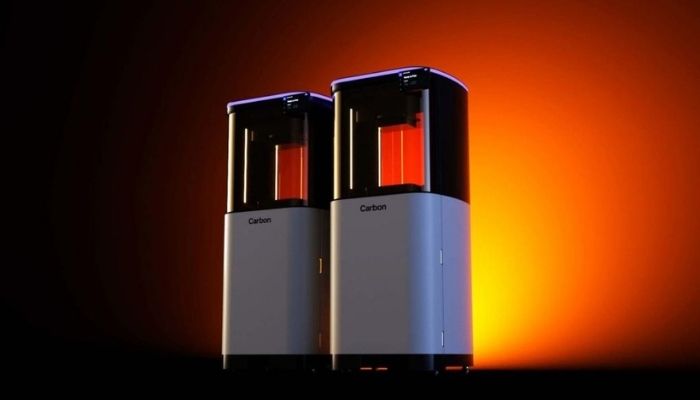
Photo credit: Carbon
Cubicure: Cerion
The Cubicure Cerion is a large-format system designed for series production. It offers a build volume of 1000 x 280 x 300 mm and uses a 405 nm DLP exposure system with a pixel size of 50 x 50 µm and layer heights from 25 to 200 µm. The printer is characterized by its speed, as each layer is produced in under 90 seconds regardless of how many parts are on the platform. The Cerion relies on Cubicure’s Hot Lithography technology, a heated process running at up to 100 °C that can handle highly viscous materials. The result is robust, precise parts that Cubicure says are often indistinguishable from injection-molded components. The parts are also temperature-resistant and durable, making them well suited to electronics and medical technology. Pricing is available on request.
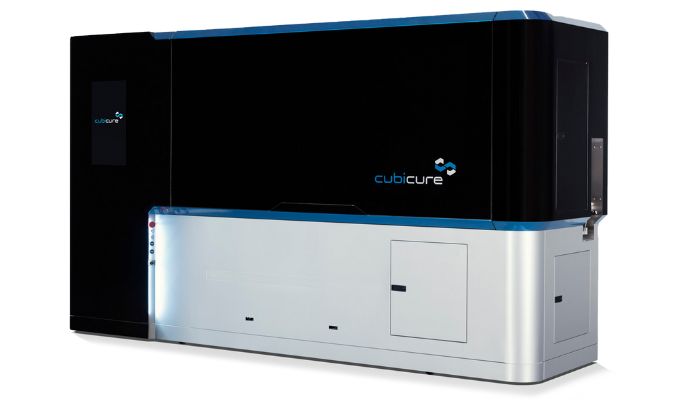
Photo Credits: Cubicure
Creality: HALOT-X1
Creality has established itself as a leader not just in extrusion solutions but also in resin 3D printing. Its HALOT-X1 is a 16K resin printer designed to be ready to use out of the box: the build platform arrives pre-leveled, so no calibration is needed. It uses a 10.1-inch 16K monochrome LCD (15,120 x 6,230 pixels) with an XY resolution of 14 x 19 µm, supports layer thicknesses from 0.01 to 0.2 mm and reaches print speeds of up to 170 mm/h. The build volume measures 211.68 x 118.37 x 200 mm. Its Honeycomb Matrix light source uses 92-zone intelligent exposure, activating the light only where it is needed on each layer. The printer recognizes resin parameters via RFID, works with HALOT BOX and Chitubox slicing software, and accepts files over USB or Wi-Fi. An optional AFU resin management unit, sold separately, adds automatic resin feeding with real-time level and weight monitoring. The HALOT-X1 retails for $599.
DWS Systems: XCELL900S
For a long time, vat photopolymerization and large build volumes were considered mutually exclusive. That has been changing over the past few years, as shown by DWS Systems’ XCELL line and notably the XCELL 900S, which caught our eye at Formnext 2024. The printer offers a build volume of 900 x 300 x 550 mm, and rather than being tall like most large vat photopolymerization machines, it is wide. Combined with DWS’ Blue-Edge triple-laser engine, which uses three lasers and three galvanometers, this allows high-resolution prints on an ultra-wide platform, making it suited to high-volume production of large quantities of parts or unusual shapes. The XCELL project was created to take DWS’ stereolithography toward large-scale production, and its “light engine-agnostic” design means the platform can offer different irradiation solutions depending on manufacturing requirements. The 900S also integrates Smart Coating, a proprietary technology that optimizes the viscosity, quantity and displacement of the resin in the printing area, enabling unmanned operation over several days. It is compatible with a portfolio of over 100 DWS materials, with quick material changes. Pricing is available on request.
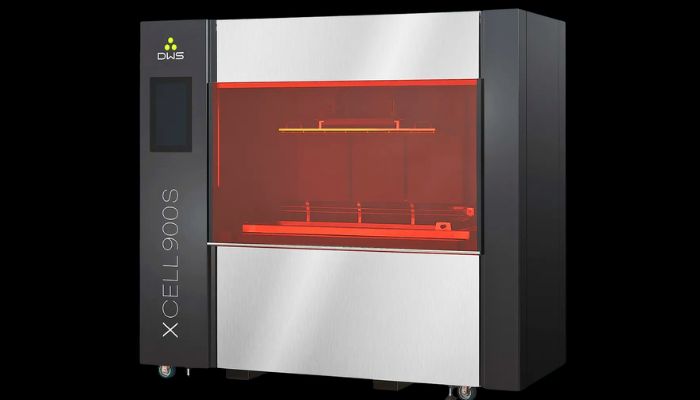
Photo Credits: DWS – Digital Wax Systems
Elegoo: Saturn 4 Ultra 16K
ELEGOO’s Saturn 4 Ultra 16K is an upgraded version of its Saturn 4 Ultra MSLA resin 3D printer, now equipped with a 10-inch 16K monochrome LCD (15,120 x 6,230 pixels) offering an XY resolution of 14 x 19 µm for highly detailed prints. It has a build volume of 211.68 x 118.37 x 220 mm and reaches print speeds of up to 150 mm/h, helped by a tilt-release mechanism that peels each layer away quickly. A smart tank heating system keeps the resin at a constant 30 °C, while auto-leveling means the printer is ready to use out of the box. An AI camera detects an empty build plate or warping during printing, and built-in dual-band Wi-Fi allows users to manage several printers remotely. The printer can also resume automatically after a power outage, making it reliable for long print jobs. The Saturn 4 Ultra 16K retails for $649.99.
Formlabs: Form 4
Formlabs has been a specialist in resin 3D printing since the company was founded, and its famous orange-hooded 3D printers are used worldwide in a wide variety of sectors. Unveiled in April 2024, the Form 4 is a fast and precise LCD-based 3D printer built around the company’s Low Force Display™ (LFD) print engine. Formlabs says most prints are completed in under two hours, with vertical print speeds of up to 100 mm/h, two to five times faster than the Form 3+, while its 50-micron pixels use anti-aliasing for smoother surfaces. The build volume measures 200 x 125 x 210 mm, 30% larger than the Form 3. The printer also has intelligent control systems, including force sensing and debris detection, to help avoid print failures. It is equipped with an automatic resin dispensing system that fills the tank 5 to 10 times faster than the previous generation. The Form 4 starts at $2,625, and for larger parts Formlabs also offers the Form 4L.
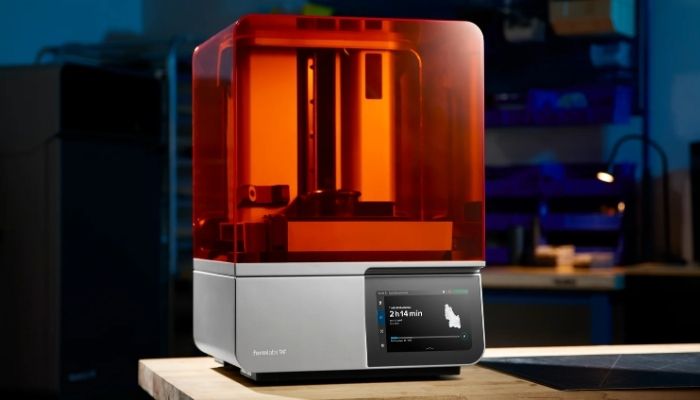
Photo Credits: Formlabs
HeyGears: Reflex RS Resin 3D Printer
Earlier this year, we had the opportunity to test the UltraCraft Reflex RS 3D printer from HeyGears. The 3D printing solution provider has been working in resin additive manufacturing for the dental sector for over 9 years, but more recently has been moving into the consumer market. The Reflex RS is actually the second consumer 3D printer to come from the company with a similar print quality as its predecessor but at a lower price, and it aims to provide a rapid and precise printing for every user. Not only that, but thanks to the 8K resolution on its highly calibrated LCD screen, allowing for excellent detail reproduction and a printing tolerance of ≤0.05 mm as well as a COB LED source and uniform light intensity with a variation within ±3%, the printer showed itself to deliver on its promise for superior performance in our testing. Other notable features include assisted calibration and residue detection for consistent high accuracy and successful printing as well as auto leveling, automatic resin refill and optional automatic resin heating. Usually available starting at $999, the company has announced a Black Friday sale, going from Friday, November 22nd through Monday, December 2nd, where customers can purchase the machine for an even more affordable price. Find the deal HERE.
GENERA: Genera G3
The Genera G3 from the Austrian manufacturer of the same name based in Vienna combines the company’s flagships – the G2 and F2 – in one compact machine. With the G3, you can print, wash and cure with one system. Post-processing is integrated directly into the system, which also simplifies handling. The G3 is equipped with a 4K 385 nm DLP light module and allows pixel sizes of 70 or 100 µm. Depending on the setting, a different print volume can be implemented. At 70 µm this is 268 x 153 x 320 mm, at 100 µm it is 384 x 216 x 320 mm. Printing takes place at a speed of up to 3 mm/min. After printing, parts are cleaned with GENERA’s non-flammable Clear3d fluid and cured in a temperature-programmable UV LED chamber with optional inert atmosphere, while an active carbon filter reduces odors. Pricing is available on request.
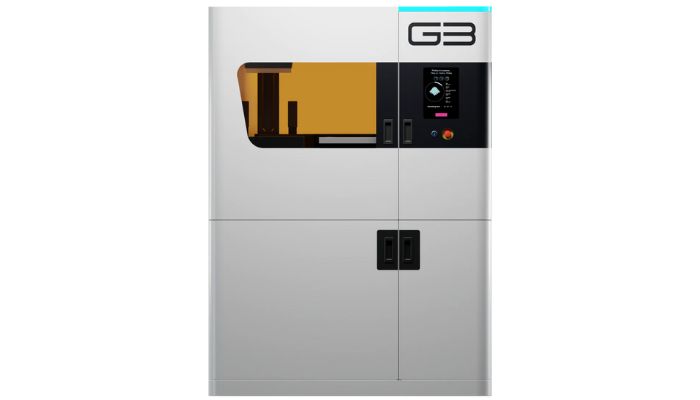
Photo Credits: Genera
micro factory: Automated MSLA 3D Printer
At Formnext 2023, the German startup micro factory presented its first 3D printer to the world. Its desktop MSLA printer is unique because it combines the three steps of the process (printing, washing and curing) in the same machine. The proprietary technology is fully automated, and the printing process is fully enclosed, protecting users from contact with the resin. Users can manage their prints through cloud-based software, allowing them to monitor print jobs from anywhere, while closed-loop sensor monitoring ensures process reliability. Compatible with specialized resins for engineering, dental and medical applications, the micro factory printer is designed to handle everything from prototyping to series production. Pricing is available on request.
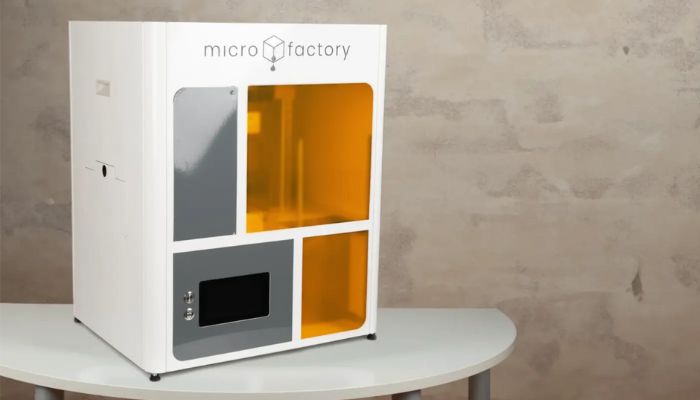
Photo Credits: Micro Factory
NOVA3D: Whale4 Ultra 16K
NOVA3D’s Whale4 Ultra 16K is an MSLA LCD resin 3D printer and the successor to the Whale3 Ultra. It uses a 10-inch 16K monochrome LCD with a resolution of 15,120 x 6,230 pixels, delivering an XY resolution of 14 x 19 µm for highly detailed prints, and offers a build volume of 211.68 x 118.37 x 220 mm. It also includes a resin heating system and an air purifier. The printer features a one-step leveling design and a sealed Z-axis with a 12 mm lead screw and dual limit switches. The Whale4 Ultra retails for $799.
Photocentric – Liquid Crystal Magna
The LC Magna is a large-format resin 3D printer from the British manufacturer Photocentric. It uses the company’s LCD-based technology and offers a build volume of 510 x 280 x 350 mm (around 50 liters), with a 137 µm pixel pitch. Photocentric’s patented Blow Peel technology helps release each layer, allowing print speeds of up to 86 mm/h at 350 µm layers. The printer is an open system that works with a wide range of functional resins, including elastomeric and flame-retardant materials, and is used for applications ranging from automotive parts and tooling to dental models, orthotics and props. The LC Magna is priced at $17,000. For mass production, Photocentric has also developed JENI, an autonomous platform that combines multiple LCD 3D printers with robotic post-processing.
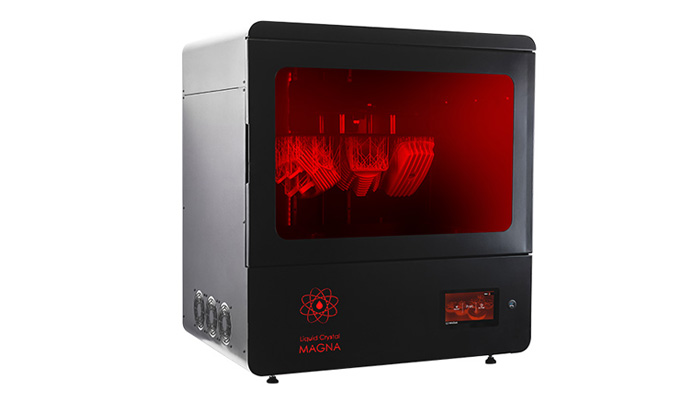
Photo credit: Photocentric
Phrozen: Sonic Mighty Revo 16K MAX
The Phrozen Sonic Mighty Revo 16K MAX is a large-format MSLA resin 3D printer designed for creators, studios, and small production teams that need high-resolution resin printing at a larger scale. Built around a 14-inch 16K monochrome LCD with a 20 x 26 µm XY resolution and a 302.4 x 161.98 x 300 mm build volume, it supports detailed output for prototypes, collectibles, miniatures, display models, and batch production. Rather than focusing only on bigger size or higher resolution, Phrozen’s approach with the Revo MAX is to make large-format resin 3D printing more practical for real workflows. That focus shows most clearly during long, demanding prints: the 2L resin vat reduces the need to pause and refill, a built-in chamber heater, which can be paired with an optional heated vat, helps maintain a steadier resin environment, and built-in monitoring through a 1080p camera with AI color correction gives users more visibility while the job is running. When maintenance is needed, tool-free film replacement helps teams return to printing faster. Combined with Phrozen GO app control, the Revo MAX is positioned as a more complete workflow solution for users exploring what photopolymer 3D printing can achieve at production scale. Get it for $1,300 with limited Super Early Bird pricing, $300 off the $1,600 retail. Find the deal HERE.
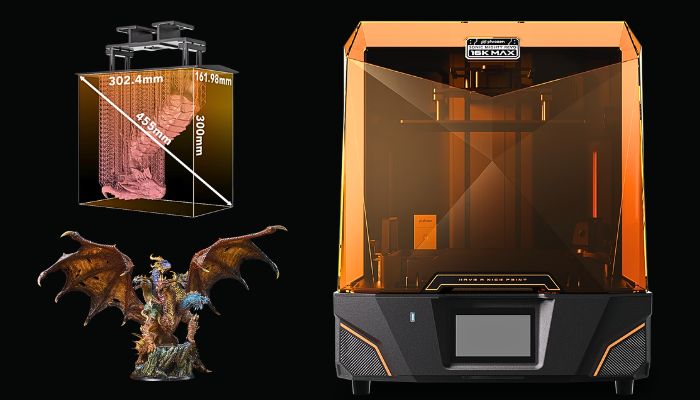
Photo Credit: Phrozen
Prusa: SL1S SPEED
The Prusa SL1S SPEED works with MSLA technology. Unlike the manufacturer’s filament printers, it uses a monochrome LCD screen and UV light to cure the resin layers. Compared with its predecessor, the Prusa SL1, its 5.96-inch monochrome LCD (2560 x 1620 pixels) delivers vastly improved print quality, according to Prusa. It offers a print area of 127 x 80 x 150 mm, with layer exposure times of 1.3 to 2.4 seconds depending on the material and layer height. A motorized tilting vat gently separates each layer from the film while mixing the resin, and a sensor measures the resin level before each print. The printer connects via Wi-Fi or LAN for remote control, and is delivered pre-assembled and ready to use. It is available on its own for $2,159, or in a bundle with the CW1S washing and curing station.
Raise3D: DF2+
Raise3D, known for its FDM printers, entered resin printing with its DF2 DLP 3D printer, and the DF2+ is an upgraded version that we had the opportunity to test in the 3Dnatives Lab. It offers a build volume of 200 x 112 x 300 mm, a projector resolution of 2560 x 1440 and layer heights from 50 to 200 microns. Compared with the DF2, it doubles the light source intensity for faster curing, reaching up to 100 mm/h with draft resin at 200 µm layers, or 50 to 60 mm/h in general use at 100 µm. RFID technology confirms the correct resin is loaded before printing and, combined with the optional DF Wash and DF Cure stations, simplifies post-processing. During our testing, the DF2+ delivered excellent print quality with crisp detail and no failed prints. Through Raise3D’s Open Material Program, it is also compatible with engineering resins from Henkel LOCTITE and Forward AM. It starts at $4,999.
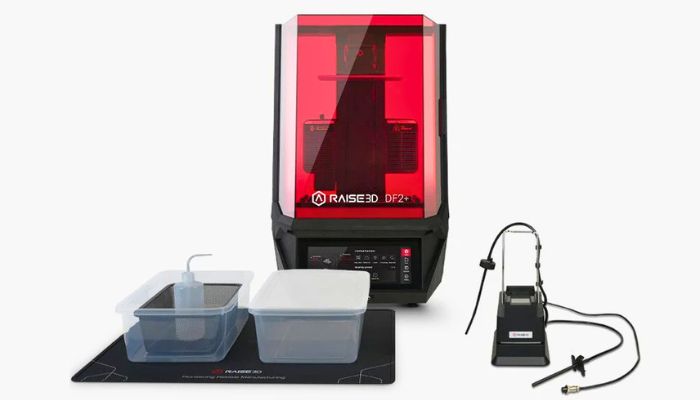
Photo Credit: Raise3D
Stratasys: Origin® Two
In September 2024, Stratasys presented the Origin Two, a new version of its Origin DLP 3D printer based on its P3™ technology. Designed for producing end-use parts, it achieves ±50 µm accuracy for validated applications and an injection molding–like surface finish. The printer uses a 5K projector with a 38.5 µm pixel size and offers a build volume of 192 x 108 x 370 mm. Its chamber is heated to up to 60 °C, allowing it to process high-viscosity and high-temperature resins, and it is an open system: alongside Stratasys-validated materials, users can print third-party resins through the OpenAM™ license. The Origin Two is well suited to connectors, tooling and industrial components in sectors such as automotive and aerospace. Pricing is available on request.
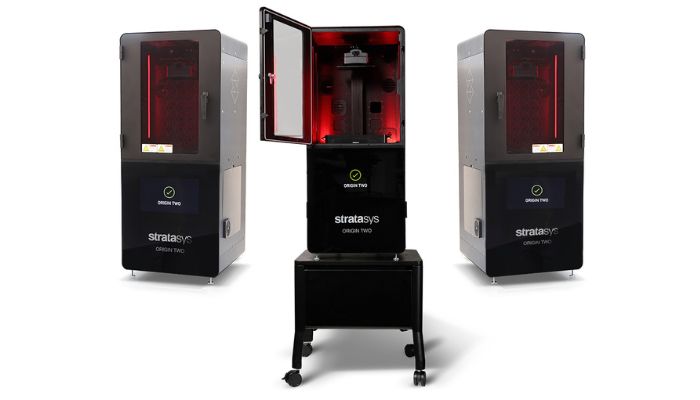
Photo Credits: Stratasys
Supernova: Plus One
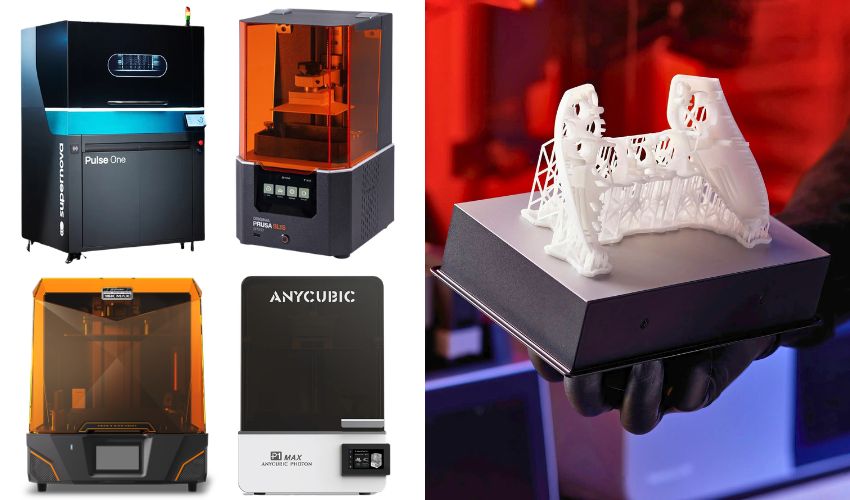
Supernova’s Pulse One resin 3D printer is an advanced solution for manufacturing high-viscosity parts using VLM (Viscous Lithography Manufacturing) technology. In addition to being part of Supernova’s Pulse Production Platform, the machine is designed to work with Viscogels, a proprietary line of high-viscosity photopolymer resins that offer superior mechanical properties and can incorporate a higher concentration of solid additives than conventional resins. The Pulse One has an XY resolution of 46 µm and a build volume of 350 x 200 x 300 mm. In addition, it is capable of printing with two materials simultaneously, enabling the creation of two-component parts or the use of a secondary support material. With a production capacity of up to 5 kg per hour, it is designed for producing end-use parts at volume. The platform also includes the Pulse Postprocessing Cell, which automates the post-processing of parts, and the Pulse Control Center software, which ensures quality control throughout the manufacturing process. Pricing is available on request.
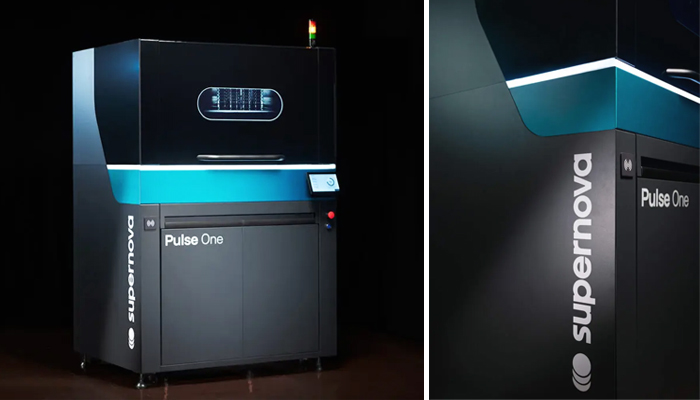
Photo Credits: Supernova
UniFormation: GK3 Ultra
The GK3 Ultra from UniFormation is a large-format LCD resin 3D printer built around a 13.5-inch 16K monochrome screen (15,120 x 6,230 pixels) with an XY resolution of 20 x 26 µm and a light uniformity of at least 88%. It offers a build volume of 300 x 160 x 300 mm and prints layers in 2 to 4 seconds at 0.05 mm. A smart heating system keeps the resin at 25 or 30 °C, and an automatic resin refill system with level detection tops up the vat during printing. The printer uses an industrial-grade motion module on the Z-axis, includes an activated carbon filter, and connects via USB, Wi-Fi or Ethernet. It is compatible with UniFormation’s own slicer as well as Chitubox and Lychee. The GK3 Ultra is priced at around $1,200.
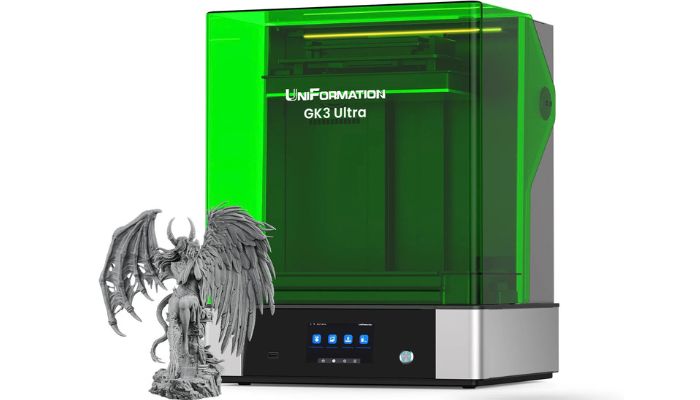
Photo Credit: Uniformation
Do you have any of these resin 3D printers? Let us know in a comment below or on our LinkedIn or Facebook pages! Plus, don’t forget to sign up for our free weekly Newsletter to get the latest 3D printing news straight to your inbox. You can also find all our videos on our YouTube channel.
*Cover photo credit:





Hello Alexandrea, thanks for your article, but it is out dated. Some companies such as B9Creations (that lauched the fastest and precise DLP 3D Printer Core Series), XYZPrinting with new Nobel have printers much better than you show. Formlabs is far from being the first one, although the marketing from Formlabs is amazing.
It would be great to have a real review with test and not just some generic comments on the specs.
You had no mention of EPAX company which has hands down in multiple comparisons blown out the Anycubic, while still being in the price range. And it has parallel lighting as a option for dental quality prints, all for $529 no counting any current sales.
You stated the IBEE by UNIZ to be priced at (~$450). Where are you getting this sales price from?
I am seeing it being sold for around double that. And I believe UNIZ website it selling it for around 749 Euros*?
For tabletop gaming minis, resin seems like the obvious choice. @spend elon musk money