





Support-Free 3D Printing with 90° Overhang Angles? A New Study Reveals How Standard FDM Printers Can Do It
For a long time, standard 3-axis fused deposition modeling (FDM) printer operators have followed a general rule: if you want to print a horizontal overhang, you need to print a sacrificial support structure underneath it, otherwise the hot plastic will sag. But a new breakthrough is aiming to turn that assumption on its head. Researchers have developed a novel path-planning strategy that allows these printers to create cantilevered horizontal overhangs without needing any support structures. Their research, titled “Wave-inspired path-planning strategy for support-free horizontal overhangs in FDM” was published in the July volume of Additive Manufacturing Letters.
The secret to this “impossible” feat is wave propagation theory. Instead of laying down traditional, straightforward lines of plastic, the system generates continuous toolpaths that act like radiating waves. Because these paths feature a diffraction-like behavior, they can naturally bend and navigate around complex geometric shapes. When researchers put this to the test by printing standard PLA plastic on a regular, open-frame 3D printer, the new wave paths dramatically outperformed traditional arc-based toolpaths. They showed significantly less sagging, vastly improved coverage, and fewer gaps, even when the shapes got complicated. In a LinkedIn post, author Janis A. Andersons spoke to the approach’s potential, “The 45° rule was never really an inherent limitation of the FDM process. It’s a side effect of how we’ve always told printers to move. Change the slicing, and the limits move with it.”
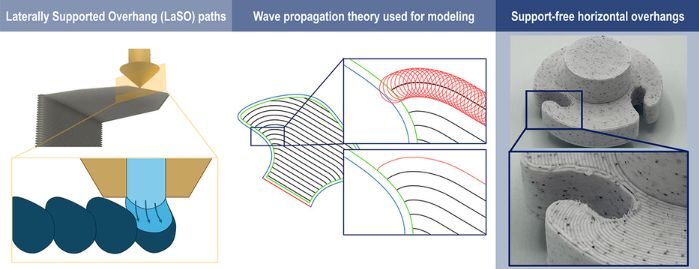
The study proposes that using wave propogation theory can help makers print overhangs without supports.
To further establish the theory, the team printed a multilayer demonstrator. They proved that once that initial, unsupported wave path base is laid down, you can reliably deposit subsequent layers right on top of it. Their measurements also showed dimensional deviations comparable to those of conventionally supported parts for the geometry tested, though some thermal warping was observed near overhang edges.
Furthermore, the team printed four other 3D geometries, representing common industrial overhang configurations, to show just how versatile the strategy really is. Ultimately, the study demonstrates that unsupported horizontal overhangs can be printed successfully when toolpaths are modeled according to wave propagation theory.
The Impact of Support-Free 3D Printing
For anyone who uses a 3D printer, this is practical news, because implementing this method means saving a significant amount of material. Plus, you could skip the tedious post-processing step of snapping and scraping off support structures. The research puts it simply: “Unsupported horizontal overhangs need not be treated as inherently unprintable geometries. In many cases, their manufacturability is governed by toolpath design instead of angle thresholds. By eliminating the need for sacrificial supports, the approach reduced material consumption by as much as 39% in the presented example.”
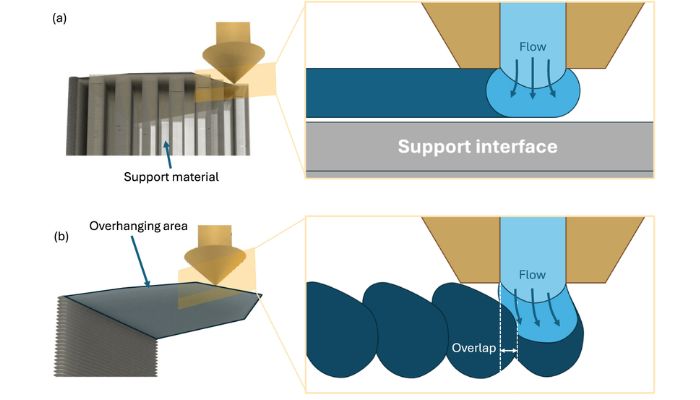
The top (a) shows a typical overhang printing with deposition on support structures. The bottom (b), depicts Laterally Supported Overhang (LaSO) printing, showing teardrop bead shape.
While the researchers note they still need to test the exact limits of this strategy across different materials and printing conditions, this new method is already challenging what we thought we knew about the limits of standard 3D printing. If you want to dive deeper, you can read the paper here, which Andersons published with Salomé Sanchez and Tom Vaneker. Better yet, try the strategy yourself: it is already implemented in forks of PrusaSlicer and OrcaSlicer.
If you test this method, let us know in the comments below or on our LinkedIn and Facebook pages. Plus, sign up for our weekly Newsletter to get the latest 3D printing news straight to your inbox. You can also find all our videos on our YouTube channel.
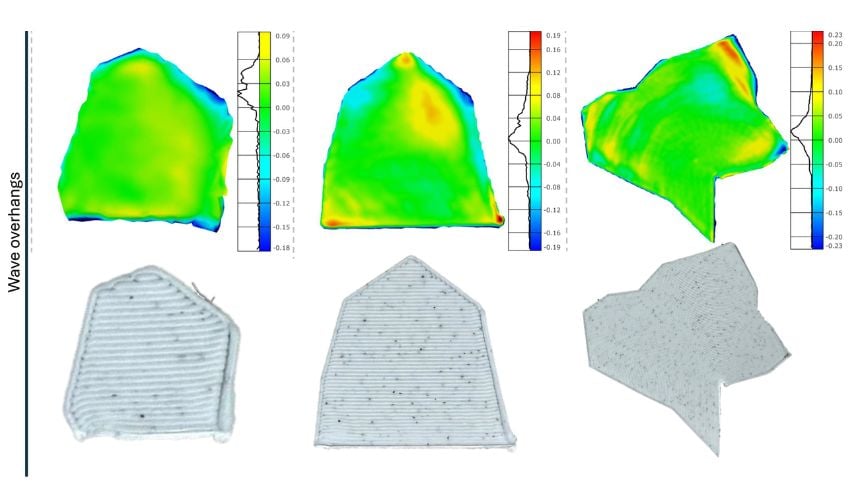
*Cover: Heatmaps showing the spatial distribution of surface deviation in the gravity direction (sagging) for wave-overhang strategies across three shape difficulties, with photographs of the corresponding printed samples. The wave overhangs show a uniform deviation distribution. (All Image Credits: Janis A. Andersons, Salomé Sanchez and Tom Vaneker)