



SUNLU and INSLOGIC Unveil the FilaDC i10, a Filament Cabinet That Dehumidifies Without Heat
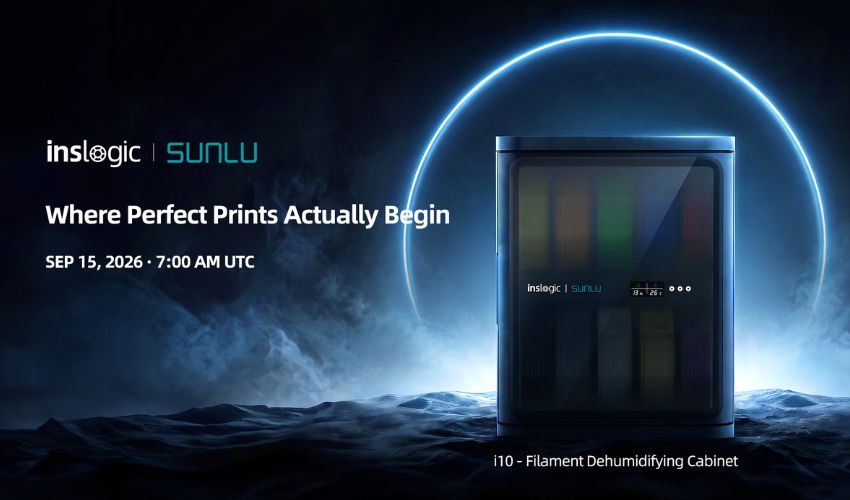
Damp filament is a familiar problem in FDM printing. Hygroscopic materials such as PA, PETG and TPU pull water out of the air, which shows up as popping during extrusion, stringing, weak layer adhesion and inconsistent surface finish. The usual answer is a heated dryer. That works for reconditioning a spool before a print, but is less suited to running continuously, since prolonged heat can soften spools or the filament itself.
A dried spool returned to an open shelf starts reabsorbing moisture straight away, and that is the gap the i10 targets. Rather than drying a spool for hours before each print, filament stays in the cabinet between jobs and comes out ready to use.
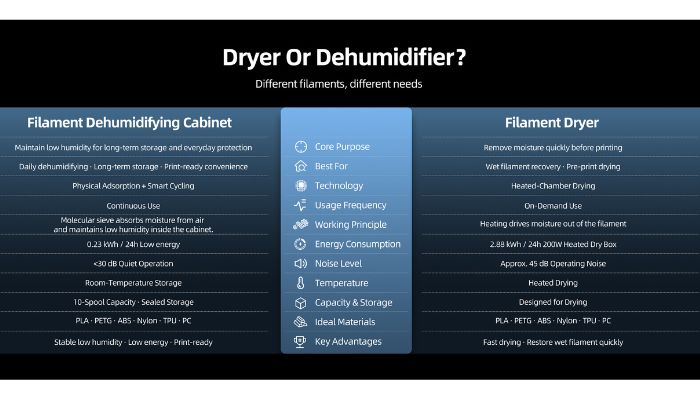
Dehumidifier, not dryer
Where a dryer works on the filament itself, the i10 works on the air around it, circulating chamber air through a bed of molecular sieves that trap the moisture in it. Humidity sensors monitor the chamber, and when the sieve approaches saturation, a PTC heating element warms it to drive the trapped water out of the unit before the assembly cools and returns to absorption. The manual documents this as a three-stage cycle on the touch display: absorbing, exhausting and cooling. There is no consumable desiccant pack to recharge or replace.
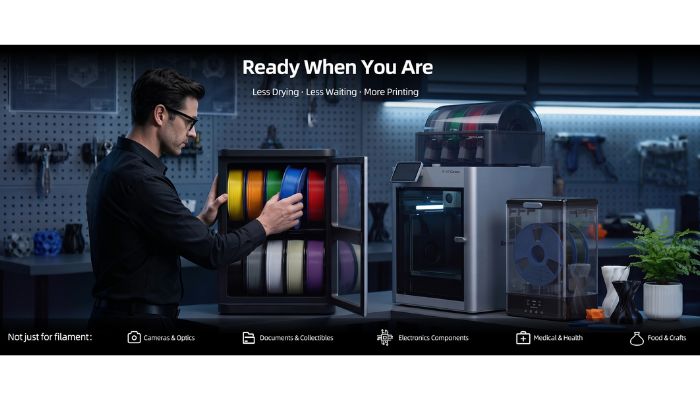
The unit dehumidifies only, with no heating or humidification function, and the temperature on screen is simply the chamber reading. Filament that has already absorbed significant moisture still needs a dryer first. Because the cabinet controls humidity rather than heating its contents, the manual also lists target ranges for storing electronics, precision instruments and camera optics.
Specifications
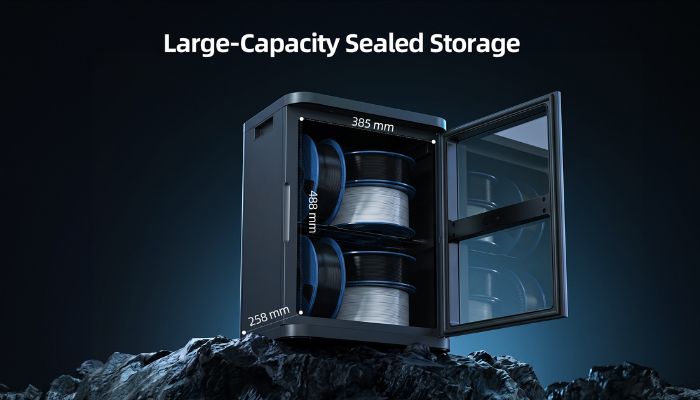
The cabinet measures 395 mm × 300 mm × 508 mm externally and 385 mm × 258 mm × 488 mm internally, and weighs 6.3 kg. Ten spools sit on two internal shelves, at a maximum of ø200 mm × 67 mm each. SUNLU and INSLOGIC say units can be stacked, though the manual warns against placing heavy objects on top. The door seals against a rubber gasket with a magnetic catch.
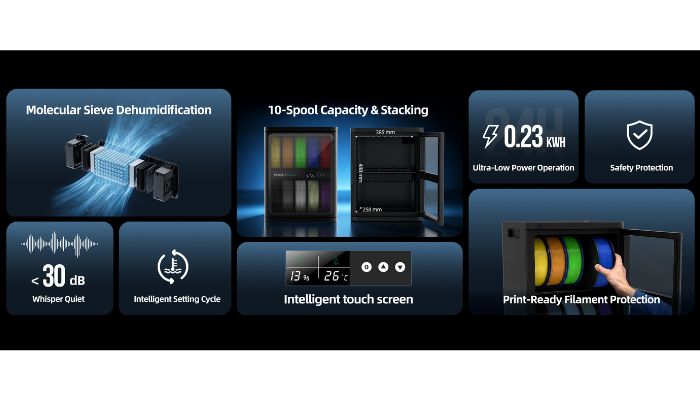
The humidity setpoint ranges from 10% to 45% RH, with ±5% accuracy and a display range of 10%–90%. It applies to the whole chamber, so the entire load sits at the same target.
The manual lists 1 W for dehumidification and 100 W for regeneration, with standby at 0.2 W or below. Input is AC 110 V 60 Hz or AC 220 V 50 Hz. SUNLU and INSLOGIC state noise of 30 dB or below, external surface temperature of 30 °C or below, and consumption of 0.23 kWh per 24 hours, against 2.88 kWh for a 200 W heated dry box on their own comparison. The 1 W headline covers circulation only, so real-world draw depends on how often the sieve cycles. The unit carries a one-year warranty.
Pricing and availability
Official sale prices are $199.99 in the United States, €199.99 in Europe, £179.99 in the United Kingdom, and 289.99 in Canadian and Australian dollars. SUNLU has not disclosed the pre-order price, which will be lower; its product page masks a digit and says the figure will be announced before September 15.
Until then the company is running a $1 Early Access Pass, available from August 14 to September 14, 2026 and capped at the first 5,000 reservations. The $1 is non-refundable and secures a $10 discount code emailed before pre-orders open. SUNLU ships to the US, Europe, Canada and Australia.
SUNLU will take pre-orders through its official store.
Would a dedicated storage cabinet change how you handle filament? Let us know in a comment below or on our LinkedIn or Facebook pages! Plus, don’t forget to sign up for our free weekly Newsletter to get the latest 3D printing news straight to your inbox. You can also find all our videos on our YouTube channel.
*All Photo Credits: SUNLU and INSLOGIC