



A South Korean Team Is Turning Sulfur from Refineries into Self-Repairing Soft Robots
Every year, the oil industry generates a surplus of sulfur that no one quite knows what to do with. Removing it from crude oil is required by environmental regulations, but its main industrial use (the production of sulfuric acid) is already at capacity. In 2024 alone, global production reached 85 million metric tons, according to the U.S. Geological Survey. A team from KRICT, Hanyang University, and Sejong University in South Korea has found a solution: converting it into a polymer suitable for 4D printing to manufacture soft robots capable of moving, grasping objects, and repairing themselves.
The material, called PSN, is a poly(phenylene polysulfide) network that until now had posed an obstacle to 3D printing. Its internal structure was too tightly intertwined to flow properly through an extruder. The team managed to stretch that network enough to print complex geometries without losing the material’s properties.
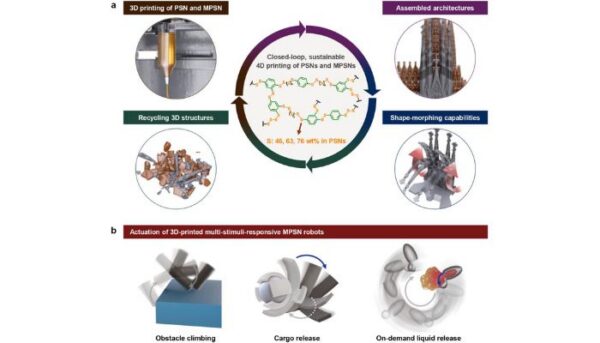
Diagram of the circular 4D printing cycle using PSN and its magnetic version, MPSN. A) The process of printing, shaping, recovering, and recycling the material. B) Soft robots in 1D, 2D, and 3D that move in response to heat, light, or magnets. (Credits: J. H. Hwang, S. Won, J. M. Lee, et al.)
The result is a shape-memory structure that reacts to heat or light, without the need for motors, wiring, or an external power source. By incorporating 20% iron powder, they have created a magnetic version with which they have built robots less than one centimeter in size that respond to an external magnetic field. The robots climb over obstacles, drop a payload at a specific point, or release a catalyst to trigger a chemical reaction when needed.
One of the study’s most notable features is the assembly system. By applying a near-infrared laser for eight seconds, it is possible to fuse two printed parts together without using adhesives. The heat breaks and reconnects the polymer’s internal bonds, joining the parts in a manner similar to how LEGO pieces fit together.
Furthermore, once a part has fulfilled its function, it can be melted down and reprinted from scratch. The researchers themselves describe the process as a closed-loop system, in which the material is continuously recycled without generating additional waste.
Dong-Gyun Kim, one of the project leaders, noted that this is the first documented case of recycling industrial sulfur into advanced robotic materials capable of moving autonomously and even being completely recycled.
The study, published in Advanced Materials in November 2025, solves two problems at once. On the one hand, it addresses what to do with industrial waste that keeps piling up. On the other, it explores how to manufacture parts capable of changing shape without relying on electronics or motors. This is still a laboratory development, and it remains to be seen whether the process is viable on a larger scale outside of a university setting, but the logic of printing, using, melting, and reprinting points to an interesting direction for the future of 4D printing. You can find the full article here.
What do you think about using sulfur in 4D printing? Share your thoughts in the comments section of the article. Let us know in a comment below or on our LinkedIn and Facebook pages! Don’t forget to sign up for our free weekly Newsletter here, the latest 3D printing news straight to your inbox! You can also find all our videos on our YouTube channel.
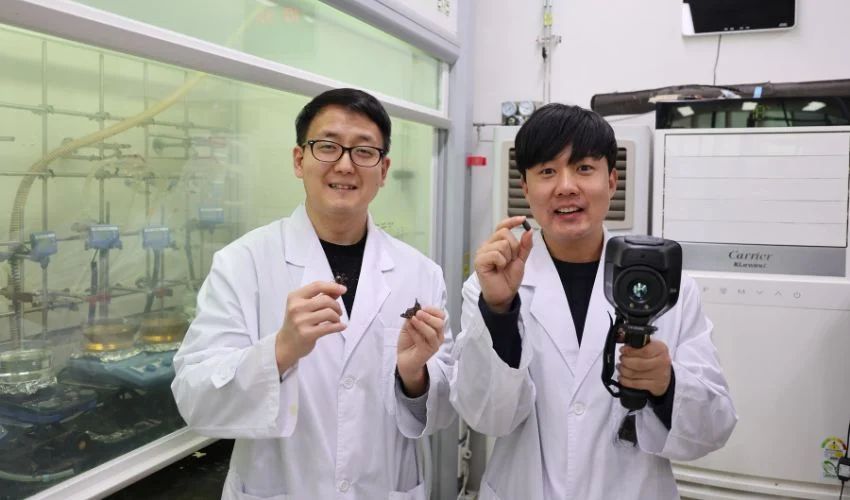
*Cover photo: Dr. Dong-Kyun Kim and Dr. Jae-hyuk Hwang (credit: KRICT).




Wow, I love the idea of turning sulfur into soft robots! It’s fascinating how materials we often overlook can lead to such innovative solutions. Reminds me of my college days when we repurposed old electronics for art projects—finding new life in something discarded always feels rewarding! By the way, I sometimes play Freecell Solitaire to unwind after brainstorming sessions.