

Can Recycled Titanium 3D Printing Secure the UK’s Defense Supply Chain?

British defense leader QinetiQ has reached a milestone in “circular” defense manufacturing with the successful maiden flight of a 3D-printed structural component made from recycled titanium. The test, conducted by QinetiQ’s Flight Test Organisation at MOD Boscombe Down in Wiltshire, featured a 3D printed hinge mounted on a QinetiQ-owned A109S helicopter.
The aircraft is currently being developed for the world-renowned Empire Test Pilots’ School (ETPS). The printed part serves as a critical attachment point for an Air Data Boom: a high-precision external probe used to measure airspeed and angle of attack. In flight testing, the structural integrity of this hinge is significant. A failure could trigger severe aerodynamic vibrations or lead to the boom snapping, which would compromise the sensitive instrumentation data required for pilot training. Designed by QinetiQ and fabricated by Additive Manufacturing Solutions Limited (AMS Ltd.), the hinge was produced using titanium recycled from a decommissioned aircraft. This flight marks a significant step in proving that flight-critical hardware can be successfully salvaged from scrap and returned to the sky through additive processes.
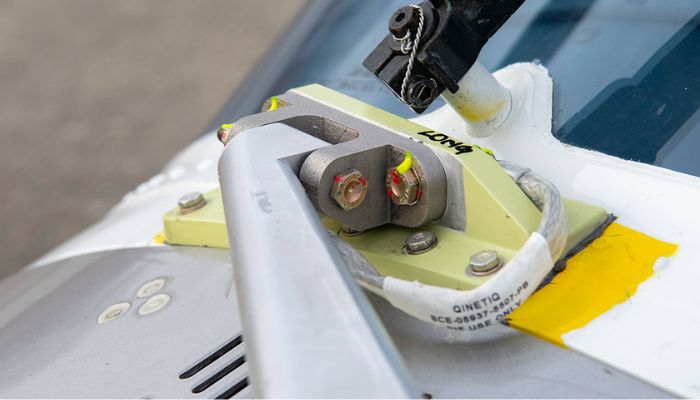
The hinge is a flight-critical component. (Photo Credit: QinetiQ)
Why 3D Print the Hinge?
AMS Ltd. has a proprietary atomization process that creates powder out of recycled scrap metal. According to QinetiQ, this process acheives 97& efficiency and minimizes material loss. While it wasn’t revealed which powder bed fusion process specifically was used to create the hinge, AMS has in-house laser and electron beam powder bed fusion capabilities, so it was likely one of those processes. QinetiQ also reported that AMS’s manufacturing process uses 93.5% less CO2e compared to traditional supply chains.
Recycling Titanium
Titanium is a strong, low-density, and highly corrosion-resistant metal, which is why it’s commonly used in defense applications. Although titanium ores aren’t rare, the high reactivity of the metal with oxygen, nitrogen, and hydrogen in the air at elevated temperatures means that production processes are complicated and expensive. That’s part of what makes recycling titanium so attractive. It’s costly and difficult to source.
The material is also in high demand, as its used for not just aerospace, but infrastructure and urbanization projects across the world. China and Russia are currently the largest suppliers of aerospace grade titanium globally. So, by recycling titanium, the UK could reduce its dependency on imported titanium. AMS Ltd. estimated that the UK could become self-sufficient, if all the titanium held in scrap aircraft was extracted for recycling.
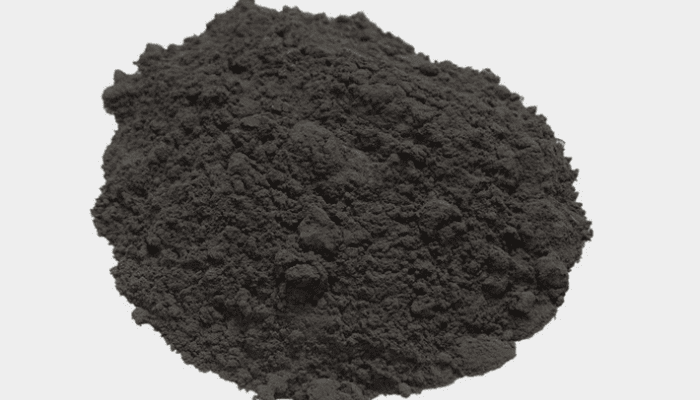
Titanium in powder form (Photo credit: AM Material)
“Our testing and engineering expertise is helping to prove the technology which will reduce the UK’s dependency on other nations for aerospace grade titanium,” Simon Galt, Managing Director Air, QinetiQ, said.
“AMS has tirelessly built momentum and expertise within the additive powder market, with a sharp focus on providing recycled feedstocks,” Rob Higham, AMS Director & CEO, added. “This milestone reflects the dedication of our team and QinetiQ’s commitment to a more resilient and sustainable future.” To learn more, click here.
What do you think about recycling titanium for 3D printing? Let us know in a comment below or on our LinkedIn or Facebook pages! Plus, don’t forget to sign up for our free weekly Newsletter to get the latest 3D printing news straight to your inbox. You can also find all our videos on our YouTube channel. For more 3D printing news in the aerospace and defense sectors, check out our dedicated page HERE.
*Cover Photo Credits: QinetiQ