


5 Real-World Applications of 3D Printing We Saw at RAPID + TCT 2026
One of the most common questions surrounding additive manufacturing is also one of the simplest: what is 3D printing actually being used for today? Not in research labs or concept demonstrations, but in real-world applications delivering tangible results.
To answer that, the 3Dnatives team headed to RAPID + TCT 2026 in Boston. What we found was a technology no longer looking for validation. Across industries, from music to mobility to healthcare, additive manufacturing is already being deployed by those willing to push its limits.
Here are five applications that stood out, and what they tell us about where 3D printing stands today.
A Drum Kit Designed From the Inside Out
At first glance, a drum kit might seem out of place at an industrial manufacturing trade show. But Voxel Percussion, based in Ohio, is using 3D printing in collaboration with Polymaker to create drum kits that traditional manufacturing cannot match.
This is not about speed or efficiency. The kick drum alone takes six days to print, and a full set averages around 80 hours. Each drum is built with a system of internal funnels and inserts that disrupt the column of air as it moves through the instrument. That control over internal geometry changes the acoustic response in ways wood or metal cannot achieve, producing a tonal profile that sits between metal and wood, with enhanced mid-range resonance.
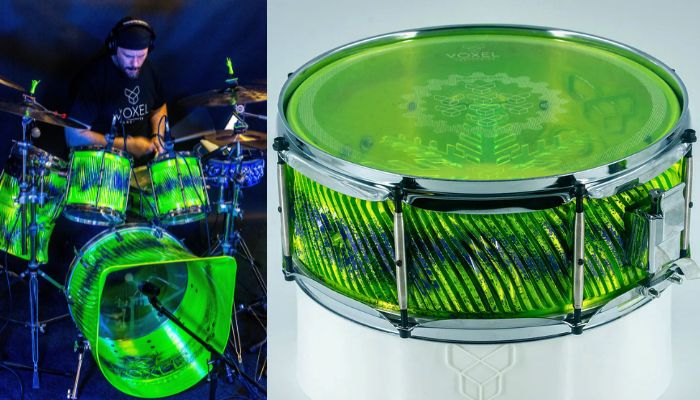
Photo Credit: Voxel Percussion
Because every component is printed, Voxel Percussion can also offer full customization. Each drum can be produced as a one-off, with a player’s name printed directly into the shell, something previously reserved for top-tier artists.
A Fully 3D Printed Motorcycle Built for the Road
Pantheon, a Vancouver-based company currently relocating to San Francisco, builds composite 3D printers focused entirely on end-use structural parts. To prove the point, they built the Pantheon Combo, a fully 3D printed motorcycle inspired by the Honda Moto Compacto, and rode it onto the show floor.
The build includes around 100 pounds of printed parts, produced on a single printer over ten days. Structural components are made in carbon-filled nylon, aesthetic parts in glass-filled nylon, water-exposed components in carbon-filled PETG, and the seat in TPU.
These machines are not just demonstrators. Most of the Pantheon team rides them to work every day. That is not a marketing claim. It is a materials validation in real-world conditions.
The HS Pro printer is priced at $35,000. According to the company, large orders may come with a motorcycle included as a bonus.
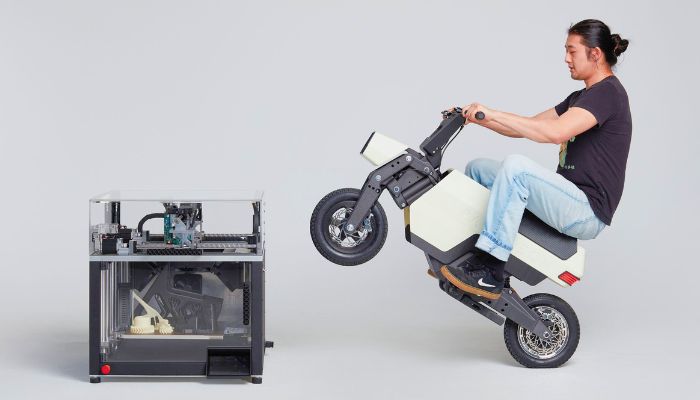
Photo Credit: Pantheon
Surgical Planning Models With a Process Nobody Has Seen Before
Healthcare was a major focus at RAPID + TCT this year, which made Boston an especially fitting location given its position as one of the world’s leading life sciences hubs. Sailner is a medical technology company from Zhuhai, China, and the Medical J401 is built specifically for surgical planning models. Seven materials can be processed simultaneously, combining full color with both soft and rigid components in the same part, at a resolution of up to 600 x 600 x 1800 DPI. The system also holds National Class II Medical Device Certification.
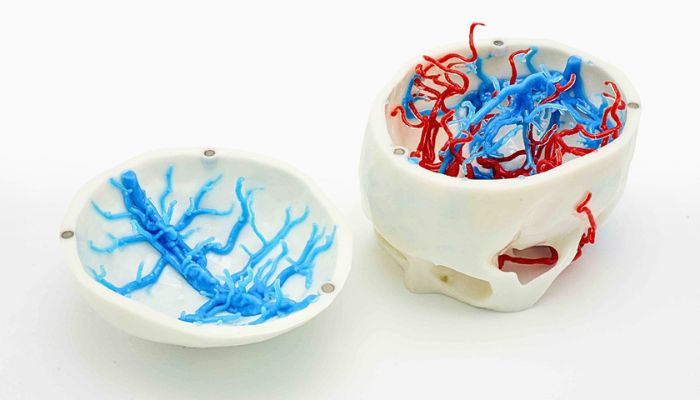
Photo Credit: Sailner
The technology is called White Jet Process, or WJP, and the patent is not yet public. What stood out in person was how familiar the output looked. Visually, it is remarkably close to PolyJet. But it is not PolyJet. It is a separate process achieving similar results through a different approach, and for many on the show floor, RAPID + TCT 2026 was the first time seeing it in person.
For surgeons, this means anatomical models with a level of color accuracy and material differentiation that can significantly improve how complex procedures are planned.
A Prosthetic Liner Fitted in an Hour
Rapid Liquid Print, or RLP, is a process we have been following closely at 3Dnatives. The technology prints inside a gel, which acts as a support medium, holding silicone in place as it builds layer by layer in suspension. This eliminates the need for support structures and reduces material waste. The material itself is not a silicone substitute, but a real, skin-safe, non-toxic silicone designed for direct contact with patients.
A specific application drew us to their booth in Boston: prosthetic liners. A prosthetist scans the patient’s residual limb, sends the file to RLP, and a custom liner fitted precisely to that anatomy is printed in around one hour and fifteen minutes. Cure time is approximately five hours, meaning the patient can receive it the next day.
For context, traditional custom prosthetic fabrication can take weeks. These liners are already being used by patients worldwide, and the company is currently working with a vascular partner on future applications.
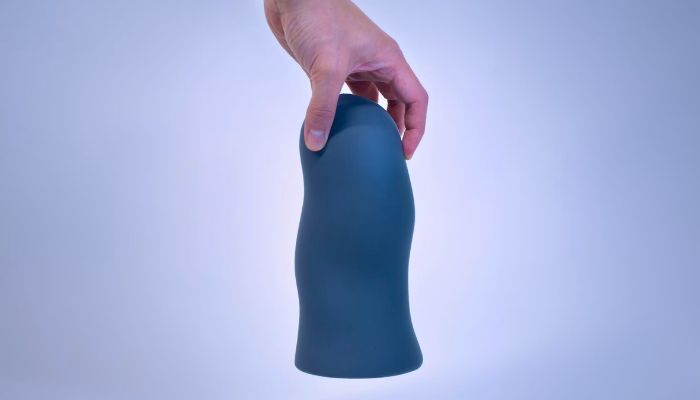
Photo Credit: Rapid Liquid Print
A Surgical Robot, 80% Printed in Titanium
We saved the most ambitious, and perhaps the most perplexing, for last: a surgical robot called the Centaur. It comes from PanAm 3D, a Pennsylvania-based company. According to the company, around 80% of it is printed in titanium using their own polar coordinate metal 3D printer, a system that prints along a spiral path rather than a traditional Cartesian build volume, allowing it to scale up to eight or ten feet in diameter.
The Centaur is designed to assist or eventually replace existing surgical robotic systems. What PanAm is describing is genuinely ambitious. The startup is combining a proprietary metal printing process with surgical robotics while actively seeking investment.
While we saw the model at the show, we did not see it in action. Whether the technology delivers on everything they are claiming remains to be seen. But the vision is clear. And at a show like this, the most interesting booths are often the ones asking the biggest questions.
What RAPID + TCT 2026 Made Clear
A drum kit engineered for acoustics. A motorcycle built to commute. Surgical planning models produced through a process the industry has not seen before. A prosthetic liner fitted to a patient in an hour. A titanium surgical robot still finding its footing. These are not concepts waiting for the right moment. They are what additive manufacturing looks like when it is already in use, across industries, by teams that decided the technology was ready. RAPID + TCT 2026 did not ask whether 3D printing had arrived. It showed what happens when you assume it already has.
What is your favorite application? Let us know in a comment below or on our LinkedIn or Facebook pages! Plus, don’t forget to sign up for our free weekly Newsletter to get the latest 3D printing news straight to your inbox. You can also find all our videos on our YouTube channel.
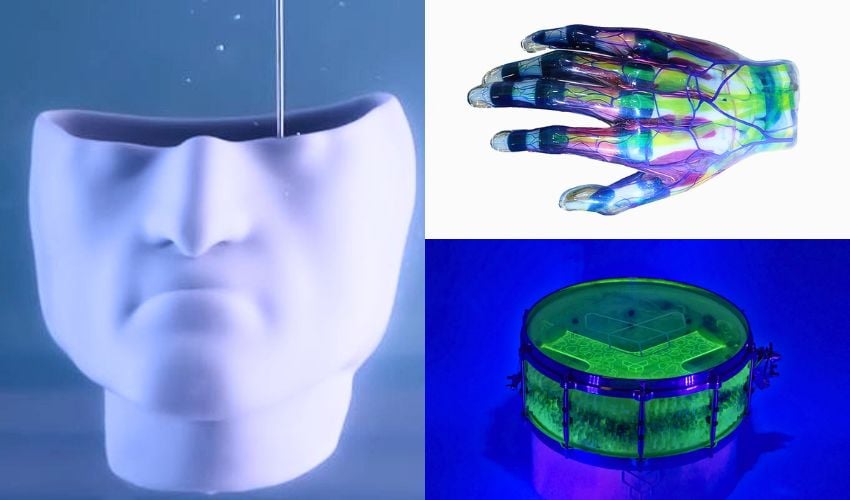
Cover photo credits: Rapid Liquid Print (left), Sailner (top right), and Voxel Percussion (bottom right).