


From Prototype to Full-Rate Production at RAPID + TCT: Garrett Hawkins on Scaling Additive in Aerospace
In aerospace additive manufacturing, you expect the story to start with rockets. This one starts with an ink cartridge.
Years before working on aerospace antenna systems, Garrett Hawkins was a high school student measuring a printer cartridge with calipers, recreating it in CAD and sliding the printed replica back into the machine to see if it would be recognized. It was. That experiment eventually led him to Optisys, where additive manufacturing is no longer a classroom exercise but a production technology for defense and space applications.
At this year’s RAPID + TCT, this April in Boston, Hawkins will present Bringing Aerospace-Rated Product to Full-Rate Production, tackling one of the industry’s hardest problems: not proving additive works, but making it repeatable. We spoke with him ahead of the event about changing perceptions in aerospace, why documentation matters as much as hardware and the scaling mistake companies still make.
From a classroom experiment to repeatable aerospace production, Hawkins’ path mirrors the evolution of additive manufacturing itself. What once needed proof now demands process, and at RAPID + TCT, the teacher who first handed him a cartridge will be there to see where that experiment led.
3DN: Could you briefly introduce yourself and tell us how you first became involved in additive manufacturing and eventually joined Optisys?

I was first introduced to 3D printing in high school during a CAD class. We had one of the early Stratasys machines, and my teacher challenged me to reverse engineer an ink cartridge using calipers and CAD. That was my first real exposure to additive manufacturing.
In college I continued using it in mechanical engineering projects and eventually joined a research team working on 3D-printed microfluidic devices for point-of-care diagnostics. The goal was to run tests like PCR analysis directly where patients are treated instead of waiting weeks and paying high costs.
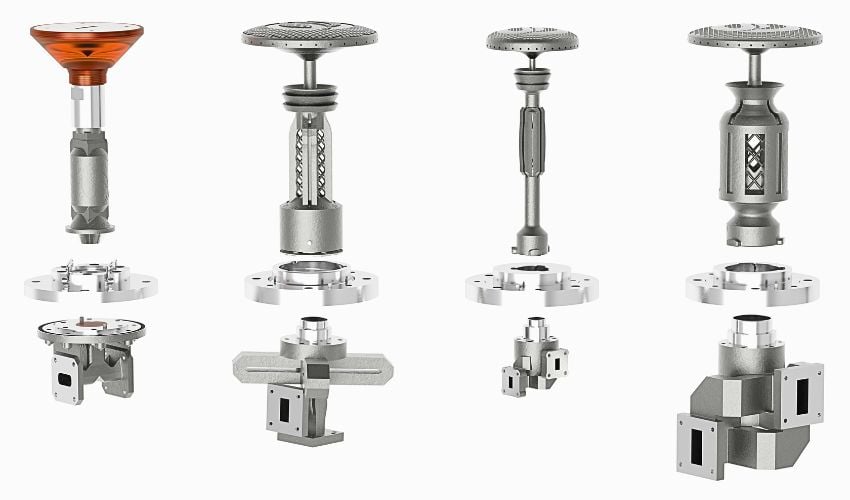
After graduating, I joined Optisys, where we design and manufacture 3D-printed antenna systems for defense, aerospace and space applications.
3DN: You’ve participated in RAPID + TCT before. How has the conversation around additive manufacturing in aerospace evolved?
When I first started at Optisys, we could present full technical validation including mechanical testing, vibration data and RF performance, and still lose opportunities because decision-makers did not trust 3D printing for space.
Today the biggest change is openness. Once a few successful flight parts exist, it becomes much easier for the next program to accept the technology. Each validated application lowers resistance across the industry.
3DN: Was there a discussion or moment at a previous RAPID + TCT that influenced how you approach additive manufacturing at Optisys?
One RAPID + TCT conference presentation connected lean manufacturing principles to additive manufacturing. That stood out to me because it is an area I have studied for years, and it reinforces that efficiency matters just as much as innovation.
Another major topic was depowdering. We can design extremely complex geometries, but production is often limited by post-processing. Last year there were discussions around different approaches to depowdering and blending technologies together to achieve better results, which changed how I think about production readiness.
3DN: From an aerospace perspective, what makes RAPID + TCT particularly valuable for aerospace professionals?
In aerospace and defense there is often a tendency to say a process cannot be used because it was not originally designed for aerospace. In reality, the difference is usually not the process itself but the level of documentation and validation behind it.
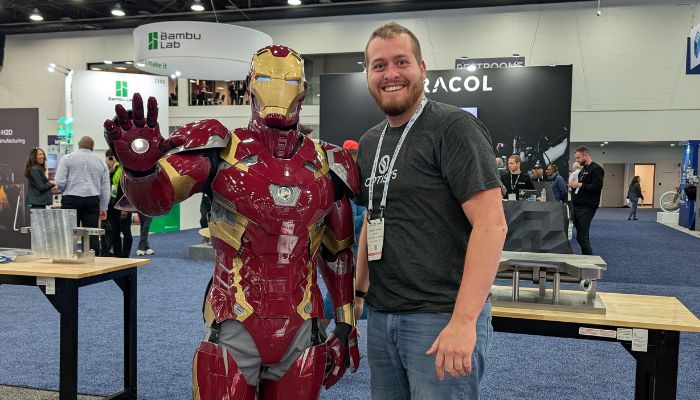
The RAPID + TCT conference is valuable because you learn how technologies from many industries could benefit aerospace applications. The question becomes whether we can take those processes and develop the documentation needed to qualify them. Walking the show floor, you see materials, machines and designs from across manufacturing, and that is often where innovation starts.
3DN: At Optisys, you’re not just prototyping but manufacturing flight-ready RF hardware. What changes technically and organizationally when a company commits to production rather than qualification or demonstration?
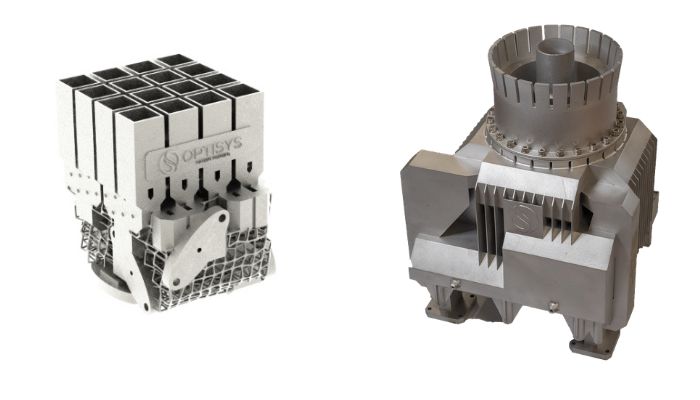
There is a saying in the aerospace and defense industry that the customer is not really buying the part, they are buying the documentation behind it.
Optisys started as a prototype shop, and the biggest shift was cultural. In a prototype environment, engineers can pick up a part, measure it and test it freely. In aerospace manufacturing, everything must be controlled and documented. Parts are signed out, calibration records are tracked and processes are recorded.
The technology itself does not necessarily change, but the rigor around documentation increases dramatically.
3DN: Your session is titled “Bringing Aerospace-Rated Product to Full-Rate Production.” In practical terms, what does “full-rate production” actually mean in an aerospace AM context?
It depends on the application, but for us it means producing thousands of units reliably year after year.
This presentation is the third step in a series I have given over time. First was applying aerospace standards, then preparing a shop to meet those requirements. The final step is bringing it all together and taking a part from quantity one to recurring production volumes of around 2,000 units.
3DN: Without giving too much away, what’s one misconception about scaling additive manufacturing in aerospace that your presentation will address?
Many companies think scaling means buying more machines to reach full-rate production. My focus is Lean Six Sigma optimization, improving output with what you already have and growing responsibly. If you purchase equipment for a single large order and the demand disappears, you create financial risk. We see that mistake repeatedly in the industry.
3DN: Who should attend your talk this year, and what key takeaway do you hope they leave with?
Anyone looking to build a more sustainable manufacturing environment in their AM facility would find value.
As part of the presentation, attendees will receive my simplified aerospace standards cheat sheets, along with a new guide for transitioning a facility to production capability. The goal is practical information they can apply directly to improve their business.
Register for RAPID + TCT 2026 as 3Dnatives’ guest. Click HERE to claim your free Expo Pass, save 20% on Conference Passes and discover the latest additive manufacturing technologies, exhibitors and conference sessions across the industry. Will you be attending the event this year? Let us know in a comment below or on our LinkedIn and Facebook pages. Plus, sign up for our free weekly Newsletter to get the latest 3D printing news straight to your inbox. You can also find all our videos on our YouTube channel.
*Cover Photo Credit: Optisys

