



Printed in Seconds: Six Volumetric 3D Printing Projects to Know in 2026
One of the cornerstones of additive manufacturing is the principle of “layer by layer.” Well, there’s one 3D printing technique that disagrees with that completely: volumetric 3D printing. Instead of building an object slice by slice, it cures an entire object at once inside a vat of photosensitive resin, more like a hologram materializing in three dimensions than anything we’d normally call printing.
The concept only took shape in 2019, when researchers at UC Berkeley and Lawrence Livermore National Laboratory published their research on “computed axial lithography.” It’s still a maturing technology today, with most systems confined to research labs and early-stage startups. Just last year, the volumetric 3D printing company PERFI Technologies won the Formnext’s Startup of the Year award; watch our interview with them below.
What makes volumetric 3D printing worth watching is speed and precision. Objects that would take hours to print layer by layer can be cured in seconds, with no visible layer lines and virtually no support structures needed. That’s opening doors in bioprinting (gentle curing preserves living cells), optics and microfluidics (where sub-layer precision matters), and rapid prototyping.
The six following projects, spanning multiple continents and mostly rooted in university and government-funded labs, show just how far volumetric printing has come in the last year.
DISH at Tsinghua University: Record-Breaking, Sub-Second Printing with a Rotating Light Field
In 2026, after five years of research and development, scientists at Tsinghua University in Beijing published DISH (digital incoherent synthesis of holographic light fields) in Nature. It’s a technique that ditches the usual spinning vial in favor of spinning the light itself. A high-speed rotating periscope projects holographically shaped patterns from a 405 nm laser at up to 10 rotations per second, curing an entire object in a stationary bath of resin.
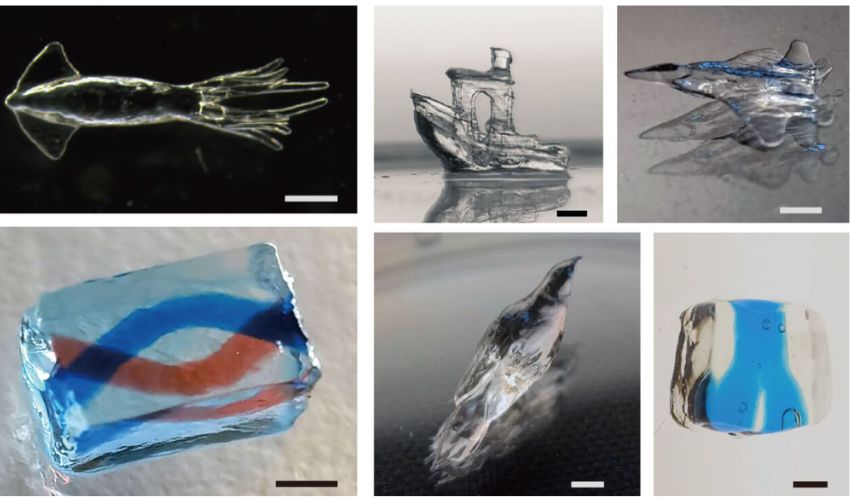
The results are striking. The team completed millimeter-scale, complex objects in 0.6 seconds, at a 19-micrometer resolution across a 1 cm depth range, with a volume printing rate of 333 mm³/s. Because the technique doesn’t need to spin the print itself, it also works with far thinner resins than conventional volumetric printers require, which helps keep prints sharp.
The team demonstrated DISH across a wide range of materials, from engineering components and photonic devices to bioprinting scaffolds made with GelMA, hinting at a technique that could span both industrial and biomedical use cases as it matures.
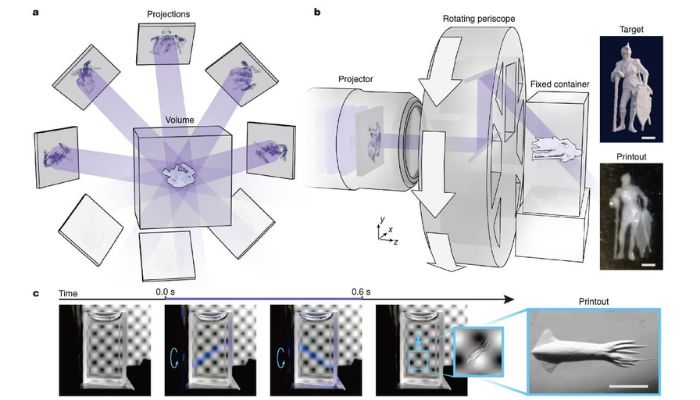
Image Credit: Tsinghua University
MTV at TU Eindhoven: Modeling Volumetric Printing for Predictable Results
Volumetric printing has speed covered. Predictability, on the other hand, is still tricky. The MTV project (Multiphysics Modelling of Tomographic Volumetric Additive Manufacturing Processes for Predictive Product Properties), running from January 2026 through December 2030, brings together the Materials Innovation Institute (M2i), Eindhoven University of Technology, and imaging company Motion Imager to tackle that.
Backed by just over €1 million in funding through the Dutch PPS-I Strategic Programmes scheme, the team is building computational models and software tools that predict how a print will actually turn out before it’s made, accounting for how material variations affect resolution, mechanical properties, and precision. The goal is to replace today’s trial-and-error approach with a reliable, repeatable process. They plan to demonstrate the project’s achievements through industrial use cases.

Image Credit: TU Eindhoven
TVAM at EPFL: A Life-Sized Printed Ear
Published May 21, 2026 in Light: Science & Applications, the latest breakthrough from EPFL’s Laboratory of Applied Photonic Devices (LAPD) in Lausanne tackles one of volumetric bioprinting’s toughest constraints: living cells can’t survive much light exposure before they’re damaged.
The team’s fix was to modulate the phase of the laser light rather than its brightness, a holographic approach that delivers the same sculpting precision using 70 times less optical power than earlier techniques. Working with just a 150 mW laser diode, they solidified millimeter-scale objects in seconds and centimeter-scale ones in minutes, culminating in a 64 mm³ construct: a life-sized human ear made of gelatin-based resin, embedded with living human cells. Six days later, the cells hadn’t just survived; they had begun forming organized networks.
It’s a step toward bioprinted implants for reconstructive medicine, with future work focusing on sharper projection fidelity, testing the technique’s limits with denser cell populations, and eventually printing directly onto existing tissue or objects.
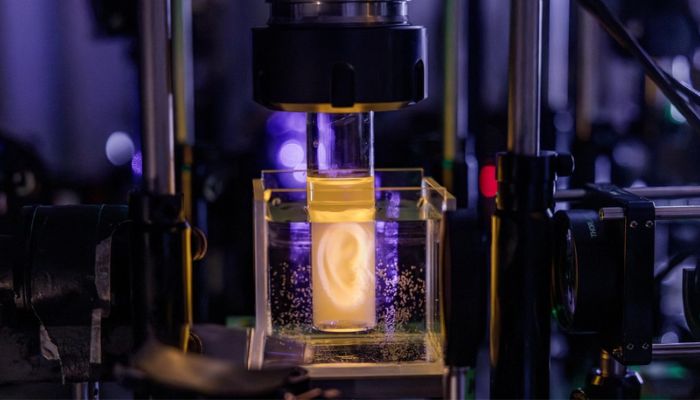
Photo Credit: EPFL
SONOCRAFT in Barcelona: Building Beating Heart Tissue
Running from April 2025 through March 2029, SONOCRAFT is a Horizon Europe project coordinated by the Universitat de Barcelona, backed by nearly €3 million from the EIC Pathfinder Open program. It brings together seven partner institutions across Spain, Sweden, Germany, Portugal, and Switzerland, including ETH Zurich and the University of Bern, to tackle one of tissue engineering’s hardest problems: building heart tissue that behaves like heart tissue.
The project’s twist on volumetric printing is combining it with ultrasonic particle manipulation, using sound waves to precisely position and align cardiac cells while the volumetric process builds the surrounding structure. This lets them build centimeter-scale cardiac constructs with integrated artificial vasculature for oxygen and nutrient flow, a level of structural fidelity that’s hard to achieve with conventional bioprinting. With this approach, the project aims to transform tissue engineering, drug testing, and regenerative medicine for heart disease.
Bioxolography at ETH Zurich: Engineering Skeletal Muscle Tissue
Conventional bioprinting has a structural blind spot: it can place cells, but it struggles to control how those cells are oriented as they’re printed, a problem for any tissue whose function depends on architecture, like muscle. Since 2023, a Sinergia project funded by the Swiss National Science Foundation has been tackling exactly that with bioxolography, a high-resolution, light-based volumetric printing technique designed to give researchers control over cell orientation during the print itself.
Led by ETH Zurich’s Soft Robotics Lab, alongside Humboldt University Berlin, the University of Basel’s Biozentrum, the Regenerative Medicine Technologies Lab in Bellinzona, and volumetric printing spinout xolo as a project partner, the consortium’s target is skeletal muscle: engineering 3D tissue models that replicate the cellular heterogeneity, architecture, and performance of native muscle. The work spans photochemistry, muscle physiology, tissue engineering, and soft robotics, with machine learning guiding the biofabrication pipeline.
Beyond regenerative therapies and drug screening, functional muscle actuators built this way could feed into bio-hybrid robotics and even cultured meat production, making this one of the more unusual crossover points for volumetric printing’s next act.
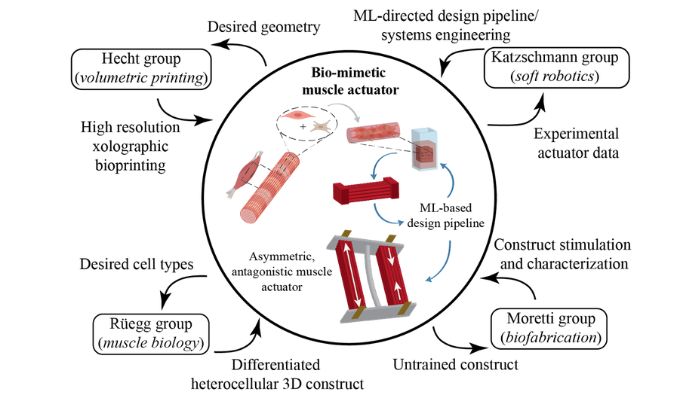
The researchers are working toward the development of a machine learning-based biofabrication pipeline for controllable and contractile muscle actuators. (Image Credit: Hecht, Rüegg, Moretti, and Katzschmann).
OpenCAL: Bringing CAL Printing Out of the Lab
Volumetric printing has mostly stayed locked inside university labs and well-funded research programs, out of reach for anyone without institutional access to a custom-built machine or the chemistry knowledge to mix their own resin. OpenCAL, launched in 2025, is an open-source project working to close that gap for Computed Axial Lithography (CAL).
With contributions from more than 40 people, the project soft-launched OpenCAL V2.0 in June 2026, publishing a complete build, installation, and working guide for the printer itself, with files hosted on Printables through a collaboration with Prusa that includes plans for a design competition. Just as important, OpenCAL partnered with Formlabs to manufacture a ready-to-use photopolymer resin formulated for CAL, distributed through MatterHackers. That resin partnership removes what had been one of the biggest barriers to entry, since without it, builders would otherwise need to mix their own chemistry.
The team is candid that this is early-stage: expect a build process closer to desktop 3D printing’s early days than its polished present, with plenty of failed prints along the way. But with full documentation, source code on GitHub, and an active Discord community steering ongoing development, OpenCAL is betting that an open, community-driven approach can do for volumetric printing what RepRap once did for FDM.
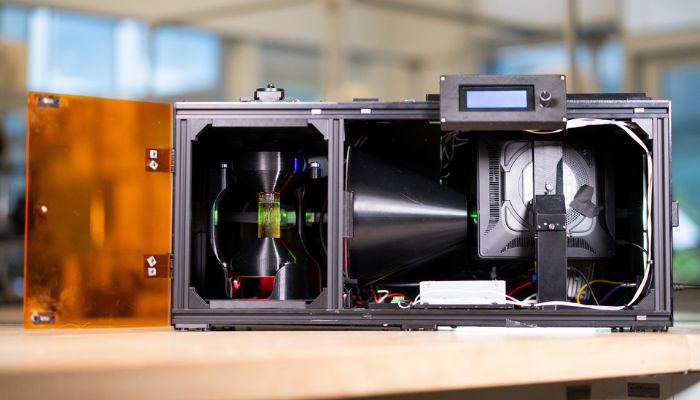
The OpenCal V2 setup while printing. (Photo Credit: OpenCal)
What do you think of these volumetric 3D printing projects? Let us know in a comment below or on our LinkedIn and Facebook pages! Don’t forget to sign up for our free weekly Newsletter here, the latest 3D printing news straight to your inbox! You can also find all our videos on our YouTube channel.
*Cover Image: 3D printed models from Tsinghua University’s DISH project. (Photo Credit: Tsinghua University.)