

Maximizing Nitinol Flexibility Through Algorithm-Driven Design and L-PBF
In the world of smart materials, nitinol stands out for its unique functional properties. This nickel-titanium alloy is known for its shape memory and superelasticity. While these capabilities are highly valued in biomedical and aerospace applications, processing nitinol through powder bed fusion (L-PBF) often compromises its mechanical performance. Until now, additively manufactured nitinol parts have shown only about half the recoverable strain compared to components produced by traditional methods.
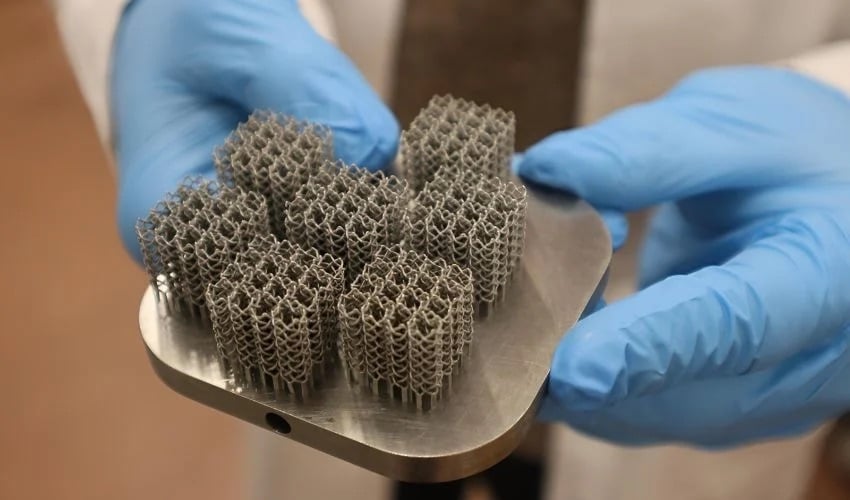
To overcome this technical limitation, a team from the IMDEA Materials Institute and the Polytechnic University of Madrid (UPM) decided to stop trying to “fix” the material itself and instead optimize its architecture. Their approach focuses on designing intertwined metal structures, or metamaterials, that behave like a textile. Here’s how they achieved it.
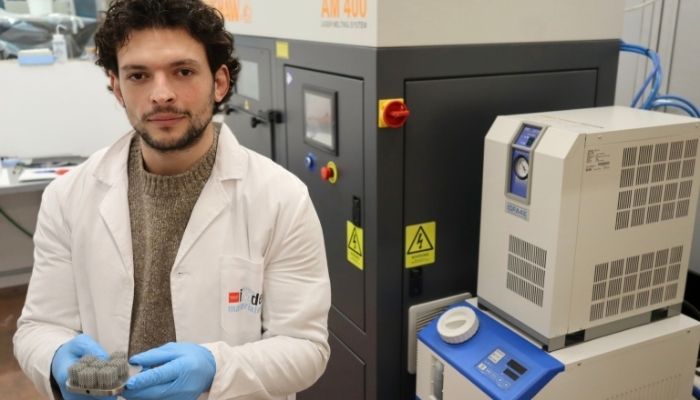
Carlo Aguilar holding the 3D-printed metamaterial.
The central problem addressed by the study, published in Virtual and Physical Prototyping, is the mechanical limitation of nitinol after printing. When nitinol is printed, the microstructure of the part often does not match the resilience of conventionally produced material. Instead of searching for a new alloy, the researchers adopted an algorithm-driven design framework to create interlocking metamaterials.
The research stands out for its geometric complexity. The team successfully printed woven structures, including meshes, spheres, and rings, that are fully self-supporting. This was made possible in part because the L-PBF process uses surrounding powder to stabilize the part during fabrication, eliminating the need for additional support structures. As a result, post-processing becomes comparatively simpler.
Design Strategies to Achieve Nitinol Superelasticity with L-PBF Technology:
Algorithm Optimization: The team developed two design families: tubular networks and interlocking cylindrical architectures.
Parameter Control: Through design, the researchers were able to modulate stiffness and energy absorption capacity across several orders of magnitude without altering the chemical composition of the powder.
Digital Model Validation: To ensure printing fidelity, they combined computed tomography (CT) with the slicing software’s digital build data. This allowed them to compare, micron by micron, whether what the software specified matched what the L-PBF system actually produced.
Why Is This Important for Industry?
By designing materials that can bend and recover their shape through an interlocking architecture, the researchers open the door to a wide range of applications in sectors such as healthcare, aerospace, and robotics. Carlos Aguilar, one of the study’s authors, explains:
This work represents the first demonstration of design-driven optimization in additively manufactured superelastic nitinol. It shows that the mechanical limitations inherent to current additive manufacturing processes can be effectively mitigated through architectural design.
What do you think about additive manufacturing with nitinol? Let us know in the comments below or on our LinkedIn and Facebook pages. Plus, sign up for our free weekly Newsletter to get the latest 3D printing news straight to your inbox. You can also find all our videos on our YouTube channel.
*All Photo Credits: IMDEA Materials Institute