


NASA Deploys 3D-Printed Titanium Spring in Orbit
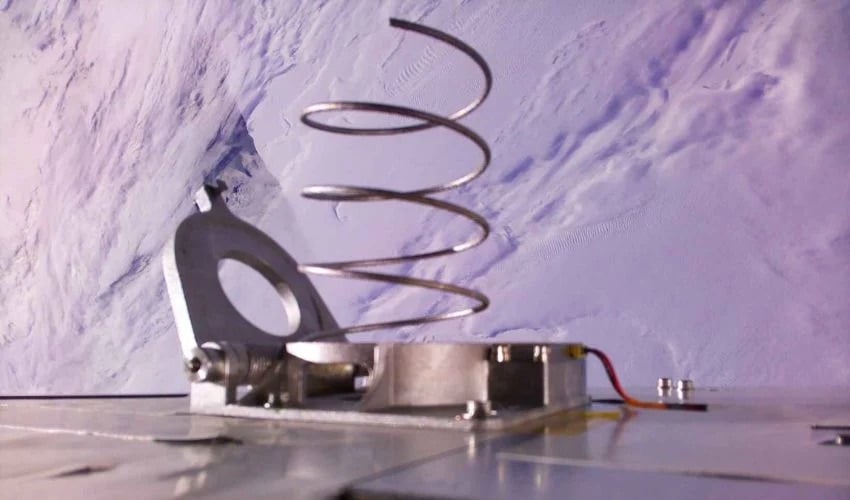
On February 3, as the Mercury One satellite passed over Earth, a small box released a titanium spring with a simple yet disruptive movement. This was the JPL Additive Compliant Canister (JACC), a technology demonstration developed by NASA’s Jet Propulsion Laboratory showcasing the potential of additive manufacturing.
JACC is a new compact spring system designed to precisely deploy antennas on future orbiters. These spacecraft circle a planet or moon for long periods of time to study it from space. NASA chose to test additive manufacturing under real operating conditions, and the results were successful.
The JACC spring is an excellent example of Design for Additive Manufacturing (DfAM). It uses three times fewer components than comparable structures, combining a hinge, a panel, a compression spring and two torsion springs into a single part. The spring design is inspired by communication antennas commonly used on satellites.
Deployment of the JACC over the Pacific Ocean. Credits: NASA / JPL
Key figures for the component:
Material: Titanium
Weight: 498 grams
Size of the entire system: ~10 cm per side
Spring deployment range: From 3 cm (compressed) to 15 cm (full deployment height)
Development time: Less than one year
JACC was printed entirely in titanium, taking advantage of the metal’s high strength-to-weight ratio and good elastic response. NASA’s Jet Propulsion Laboratory stated in a press release: “The success of JACC demonstrates that 3D-printed mechanisms can be built faster, cheaper and with less complexity than traditionally manufactured space hardware.”
The JACC did not travel alone. It is part of the PANDORASBox experiment, which also includes the SUM deployable antenna. What is most striking for the industry is the speed of execution, as both devices were designed, manufactured, tested and delivered for flight in less than a year with minimal budgets. You can read the Jet Propulsion Laboratory’s statement here.
What do you think of this 3D-printed spring that NASA has deployed in space? Let us know in a comment below or on our LinkedIn or Facebook pages! Plus, don’t forget to sign up for our free weekly Newsletter to get the latest 3D printing news straight to your inbox. You can also find all our videos on our YouTube channel. If you are interested in more 3D printing news in the automotive and transportation sector, visit our dedicated page HERE.
*Cover photo: The JACC mechanism as the spacecraft flew over Antarctica. Credits: Proteus Space / Jet Propulsion Laboratory.