


Everything You Need to Know about Multi-Axis 3D Printing
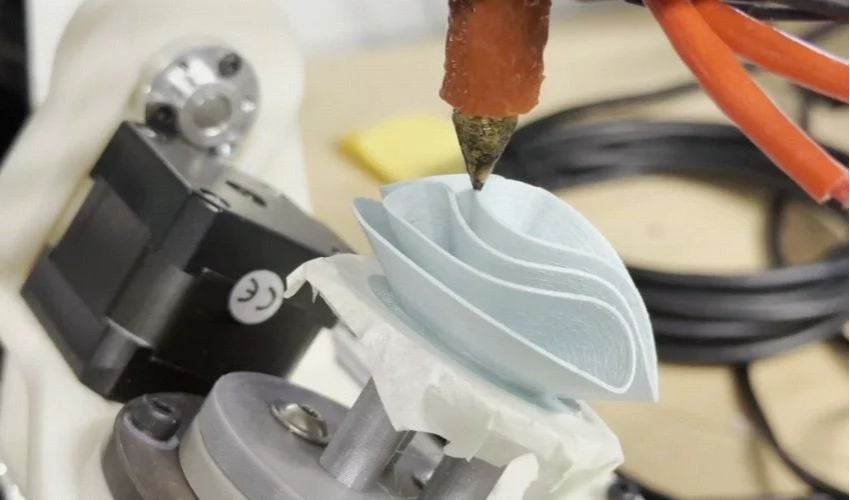
In the world of technology, 3D printing can sometimes feel like science fiction. But while we’ve grown used to watching printers lay down layer after flat layer, a new technique has been catching our attention: multi-axis 3D printing. By breaking free from the traditional XYZ axes, this approach could shift additive manufacturing, allowing for new shapes and strengths we never thought possible. Whether you’re an industry veteran or a curious newcomer, this guide breaks down how multi-axis printing works, why it matters, and the cutting-edge solutions leading the charge.
In simple terms, multi-axis 3D printing has a motion system that gives the printer more “joints” than standard machines. While a conventional printer—whether Cartesian, CoreXY, or Delta—moves in three directions (forward-backward, left-right, and up-down), multi-axis systems add rotation and tilt, reaching 5, 6, or more axes. This freedom of movement isn’t limited to the nozzle; depending on the machine’s architecture, rotation can occur in the print head, the build plate, or both in a coordinated manner. This allows the print head to rotate along the curves of the part, depositing material perpendicularly, rather than printing stepped layers. This process is also known as conformal or non-planar manufacturing.
Advantages of Multi-Axis 3D Printing
The ability to orient the contact point between the nozzle and the part addresses the most common limitations of fused deposition modeling:
- No supports required: By tilting the part or the print head during printing, overhanging structures can rest on already printed material, eliminating material waste and the need for manual post-processing.
- Structural integrity and isotropy: in standard printing, parts can be weak between layers (anisotropy). The multi-axis system allows material layers to be aligned with the direction of the forces the object will receive, multiplying its strength and achieving nearly uniform behavior in all directions.
- Better surface finish: by eliminating the “stair-step effect” on curved surfaces, roughness is drastically reduced from values close to 38 µm to just 12 µm, achieving smooth textures that rarely require sanding. This is according to various tests conducted in the field of research.
For this motion system to function properly, perfect synchronization between hardware and software is essential. As for the hardware, there are gantry systems, which offer stability, and robotic arms, which stand out for their flexibility. The software, meanwhile, acts as the system’s brain: tools such as ADAXIS’s AdaOne or 5 Axis Slicer manage path planning to prevent collisions between the arm and the part and optimize material flow in real time.
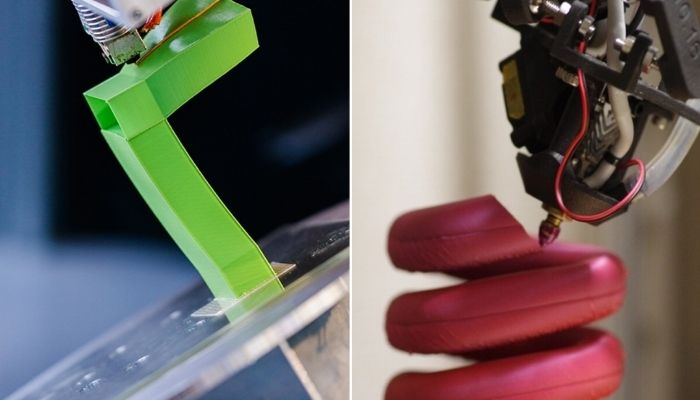
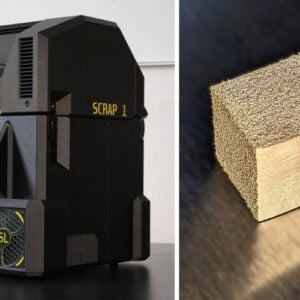
In multi-axis 3D printing, the material follows the actual geometry of the design (photo credits: University of Stuttgart [left], MAGE Printing [right]).
Multi-axis 3D Printing Applications
Thanks to this control over space and materials, multi-axis systems are already being used in critical sectors such as:
- Aerospace: manufacturing of turbine blades and lightweight supports with optimized internal cooling channels.
- Construction: printing concrete walls and facades with overhangs of up to 60 degrees using robotic arms.
- Repair and maintenance: reconstruction of worn areas on metal parts without the need to manufacture them anew.
- Electronics: printing conductive circuits directly onto curved or organic surfaces.
Finally, the current market is led by manufacturers of hybrid systems such as DMG Mori, Meltio, and Mazak, who have succeeded in integrating metal 3D printing with the precision of milling into a single machine. Multi-axis systems, in general, were long reserved for industrial environments. However, there is increasing research and development of this kinematics in the field of 3D printing. A recent example is the partnership between Aibuild and Generative Machine Company, which resulted in a 5-axis desktop printer for professional use.
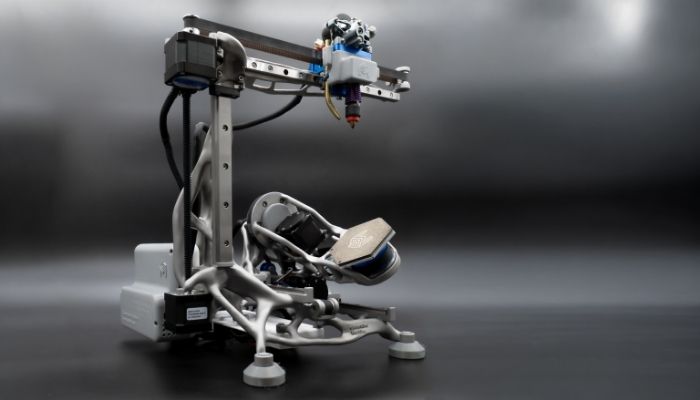
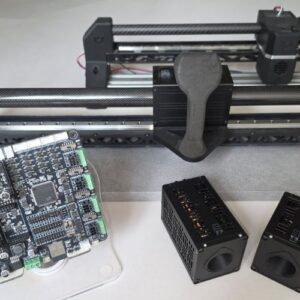
The FFF GenerationOne 5-Axis printer from Aibuild and Generative Machine Company (photo credit: Generative Machine).
Multi-axis 3D printing is a clear testament to how the industry is evolving. The limitations that once existed have given way to an improved motion system, proving that in 3D printing, the only constant is change.
What do you think of multi-axis 3D printing? Let us know in a comment below or on our LinkedIn or Facebook pages! Plus, don’t forget to sign up for our free weekly Newsletter to get the latest 3D printing news straight to your inbox. You can also find all our videos on our YouTube channel.
*Cover Photo Credit: Ivan Revenga Riesco