

Rethinking the AM Workflow: Montana Mixers on Solving Problems Before the Printer
As additive manufacturing moves into production, the conversation is starting to change. Instead of asking whether a part can be printed, manufacturers are asking whether they can print it the same way every time. More often than expected, the answer has less to do with the machine and more to do with the material going into it.
Material preparation has quietly become one of the decisive steps in repeatable AM. Montana Mixers develops resonant mixing technology aimed at that stage of the workflow. We spoke with Dr. Peter Lucon, Chief Innovation Officer and co-founder, about where material processing limits additive manufacturing today and how to recognize when the bottleneck is the powder rather than the printer.
3DN: Could you introduce yourself and explain where Montana Mixers fits in the additive manufacturing workflow?

Dr. Peter Lucon, CIO of Montana Mixers.
My name is Dr. Peter Lucon, Chief Innovation Officer and co-founder of Montana Mixers. I have a PhD in Mechanical Engineering from Montana State University and have focused most of my career on resonant system technologies.
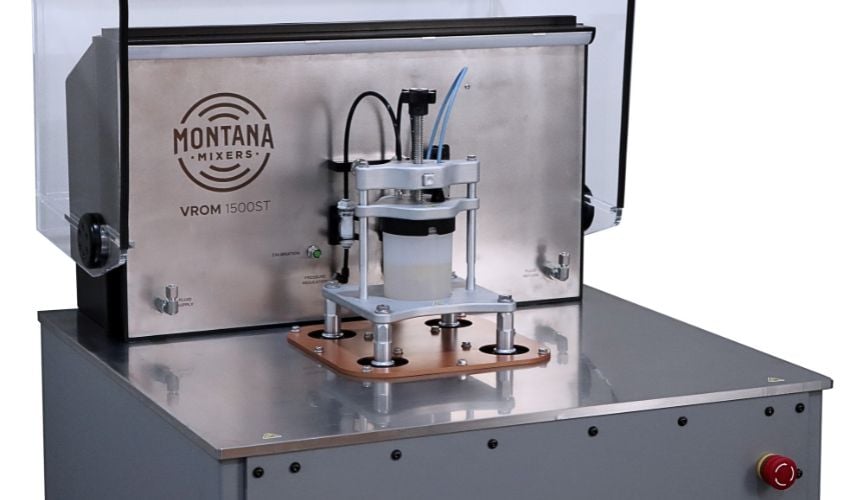
Montana Mixers manufactures vertical resonant oscillatory mixers (VROM™). At a basic level it is similar to shaking a sealed jar by hand, but at 60 times per second. The vessel vertically oscillates about a half-inch at accelerations up to 100 g, driven by carefully controlled mechanical resonance. The effect is remarkably fast and effective mixing of powders, liquids, and pastes with additional capabilities such as milling and particle coating.
Unlike many other mixing methods, resonant mixing scales well, so processes developed in the lab can transition to production volumes while maintaining the underlying physics and power density applied to the materials.
Resonant mixers have proven applications across various industries, including pharmaceuticals, advanced battery materials, energetic materials, and more. In additive manufacturing, resonant mixing has enabled the development of new oxide dispersion-strengthened (ODS) alloys for aerospace due to its ability to rapidly disperse and coat particles.
3DN: Your technology replaces traditional mixing methods with resonant technology. What manufacturing risks does removing moving mixing hardware actually eliminate?
Like tumble blenders and planetary mixers, VROM technology is bladeless. Removing internal mixing hardware eliminates a common source of contamination, wear debris, and difficult cleaning validation. As production volumes increase, those factors become more significant.
Resonant mixers differ from those other bladeless mixers in three key ways:
- Resonant mixers tend to be much faster than other methods, often drastically reducing processing time while also improving mix quality. In part, this is because energy is imparted into all the mix material every oscillation, and at a much faster rate than tumble blenders.
- Resonant mixers are versatile. While tumble blenders are designed for solids and planetary mixers work best with pastes, our VROM systems can process powders, pastes, and liquids with equal effectiveness. They are also highly effective at milling and particle-coating applications.
- Users can mix in their vessels of choice, even in final packaging in some cases, reducing instances of cross contamination and simplifying cleanup.
3DN: In practice, when do manufacturers discover their bottleneck is material consistency rather than the printer itself?
During print parameter optimization for a given material and geometry, material inconsistencies can be difficult to detect, even when they are causing issues. Operators tend to blame the immature print parameters, make adjustments, and try again.
Material consistency issues tend to become more obvious during process repeatability and validation testing. In my experience, LPBF printers are generally very consistent. At that stage the print parameters are fixed, but the measurement scatter increases, mechanical properties widen, and random print failures occur.
When this happens late in development, the cost is not limited to scrap. Development timelines extend, and previous parameter work may need to be revisited.
If variability in material preparation is the root cause, addressing it upstream can accelerate both parameter development and validation. Changes in variables begin to produce predictable results rather than noise.
3DN: What’s a misconception decision-makers still have that slows adoption of proper material preparation workflows?
One misconception is that these changes are not worth the risk in cost and time. Companies have the costs associated with their current method well established, and if there is not a clear pain point, need or incentive, they continue doing things the same way. We see this in the slow adoption of additive manufacturing across industry. Even when the advantages of AM make business sense, entrenched processes are difficult to change, especially when the newer technology is poorly understood.
Additive manufacturing itself has similarly relied on traditional materials processing, despite new technologies such as resonant mixing demonstrating significant improvements in capability and resulting quality. In other well-established industries, such as pharmaceuticals and energetics, established processing protocols, government regulations and safety requirements can create additional barriers to adopting new technology.
That said, resonant mixing adoption is accelerating, and we are seeing more companies move from lab or pilot-scale development toward production.
3DN: As additive manufacturing moves toward serial production, how does material preparation need to evolve compared to prototyping workflows?
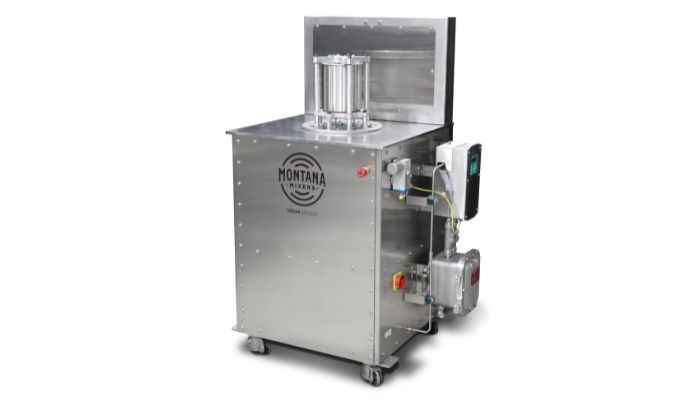
VROM 6000XP by Montana Mixers, engineered for mixing up to 20kg of energetic materials in hazardous environments.
Inconsistent materials will naturally result in parts with inconsistent mechanical and surface properties. In a serial production environment, that variability complicates qualification, documentation, and customer confidence.
VROM enables high-speed mixing and processing that delivers unmatched homogeneity with a high level of repeatability. We can often batch process in minutes or seconds what may have taken hours with other methods.
We have seen what happens when an advanced alloy moves beyond laboratory validation. Once performance is proven, attention shifts quickly to throughput. The question is no longer whether the material works, but whether it can be produced in meaningful quantities without compromising quality. At that stage, mixing capacity becomes a determining factor in whether a material remains limited to research volumes or transitions into sustained production.
Resonant mixing scales by increasing the total power supplied to the system while maintaining energy density in the material. In practice, that means processes developed in R&D can transition to larger batch sizes without changing the underlying mixing physics. There is no need to redesign the workflow, thereby reducing the risk typically associated with scale-up.
When demand begins to outpace single-batch capacity, automation becomes the next lever. By automating batch sequencing and material handling, production can move toward sustained, high-throughput output while preserving the same validated mixing physics. This allows manufacturers to increase supply without introducing new process variables.
3DN: You’re attending Rapid + TCT this year. What conversations are you hoping to have?
In general, we want to hear about material mixing and processing challenges. Resonant mixing performs particularly well with difficult-to-mix materials, delicate or sensitive materials, and processes that are time- or labor-intensive with other methods. From there, we typically segment potential customers into two main groups: those familiar with resonant mixing and those who have never heard of it.
For the first group, who already understand the benefits, we want to present our latest advancements of the technology, a significant step forward in the state of the art. VROM systems were engineered from the ground up with value in mind. They are simple to operate, efficient, highly reliable, and easily serviceable. Our MixOS control system also outputs dozens of data points, enabling novel process insights during development and production validation.
For those new to resonant mixing, we look forward to highlighting the capabilities of VROM mixers through our in-booth demonstrations. We will be mixing regularly throughout the show.
Resonant mixing is still relatively new and often counterintuitive, so it can be daunting for some. It is typically taught as a possible solution. While presence in academia is growing, it is still unknown to many.
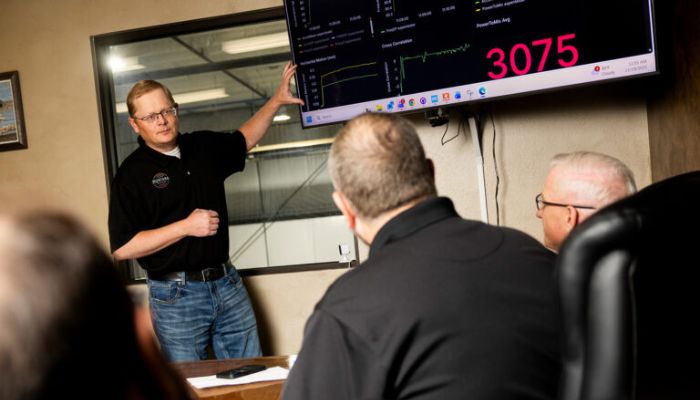
Montana Mixers COO Brian Seaholm discusses processing data captured by MixOS, the VROM operating software.
3DN: When a manufacturer leaves your booth, what should they understand differently about their process?
I hope they walk away with a clearer understanding of whether variability in their process may be rooted upstream in material preparation and whether addressing it could reduce development time, scrap, and uncertainty.
3DN: Any last words for our readers?
I want readers to know that Montana Mixers is more than just a machine manufacturer. We have a highly specialized and experienced team of engineers, scientists, and technicians focused on solving our customers’ mixing and processing challenges, from lab through production scale. We view it as a partnership from day one. Our clients’ success is our success.
We welcome conversations with material developers and powder producers working on advanced alloys, recycled powder conditioning, or high-uniformity coating applications. Obviously, demonstrations and mix evaluations can be scheduled regardless of Rapid attendance.
Will you stop by the Montana Mixers booth at RAPID + TCT? Let us know in a comment below or on our LinkedIn or Facebook pages! Plus, don’t forget to sign up for our free weekly Newsletter to get the latest 3D printing news straight to your inbox. You can also find all our videos on our YouTube channel.
*All Photo Credits: Montana Mixers


Obviously, demonstrations and mix evaluations can be scheduled regardless of Rapid attendance.