



The Fashion Designer Who Never Wanted to Study Fashion: Maya Kaplan, Formnext Design Award Finalist
I first came across Maya Kaplan’s work through a short video of an experiment. She had rigged a 3D printer to work with yarn, and instead of building up layers, it followed a digital path around a set of pegs to form a design. It was a familiar tool doing something it wasn’t made for, and I wanted to know who had thought to try it.
When we spoke, it turned out she had never planned to be a fashion designer at all.
“I never wanted to study fashion,” she said. “I didn’t get into this field from thinking about fashion. I was thinking about how I can design for the body.”
Today, she is a fashion and textile designer and a researcher at the Coded Matter Lab at the Technion – Israel Institute of Technology, where she develops 3D-printed textiles and simulation-based workflows for fashion design. Alongside her research, she is building her own textile innovation studio, collaborating with brands on R&D concepts for the textile and apparel industry. But her journey began far from any design studio, on an acrobatics mat.
A Problem Worth Solving
Kaplan grew up in movement. She is an acrobat, a dancer and a yoga teacher, and spent years coaching acrobatic groups. During practice she kept running into the same problem: her clothes did nothing to protect her from the bruises she picked up training.
So she learned garment construction and began making her own. She worked with whatever fabrics she could find, tested the pieces in practice and refined them. Fellow acrobats wanted the same, people started buying, and almost by accident she had started a small brand.
When she went on to study fashion design formally at Bezalel Academy of Arts and Design, something shifted. Looking at the unsold inventory she was left with, she decided she didn’t want to keep adding to the pile. “I don’t want to be another brand that makes more clothes in the world,” she recalls thinking. She closed the brand.
Designing Around the Body
At Bezalel, Kaplan discovered digital fabrication and picked up 3D printing fast. What drew her in was freedom. “3D printing allows a very big design space for geometry,” she said. “It’s really unlimited, what we can do.”
Combined with 3D body scanning, it let her build objects shaped exactly to her body, designed for movement rather than for the runway. One was a shoe fitted to a scan of her foot, mounted on a wall so she could hang from it and explore new directions of movement. Another was a hand-balancing object that took weight off her wrists while working as a sculptural prop she could perform with.
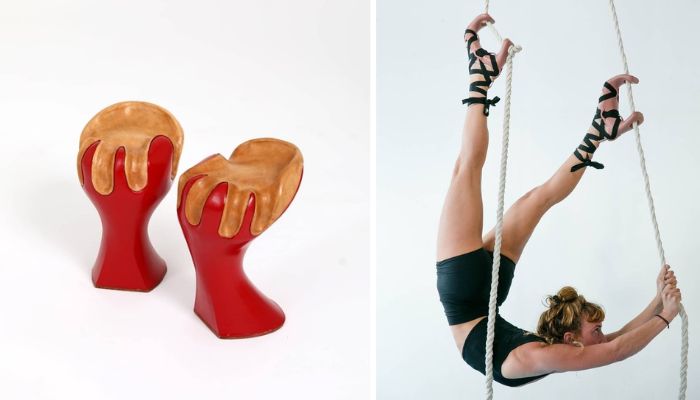
“Handstand shoes” and “Bound to move” shoes are both acrobatic accessories.
She exhibited and performed with these pieces internationally and taught her methods at the academy. The ideas behind her work are practical; it’s design that starts from what the body needs to do.
Into the Industry
Wanting to see how her ideas held up at scale, Kaplan joined the digital innovation and R&D teams of one of the world’s largest textile manufacturers, which produces for many of the biggest names in fashion. There she researched 3D printed components that could give textile products new performance properties, such as parts inside a bra that replace conventional components, while also specializing in engineered seamless knitting and developing innovative textile solutions from scratch.
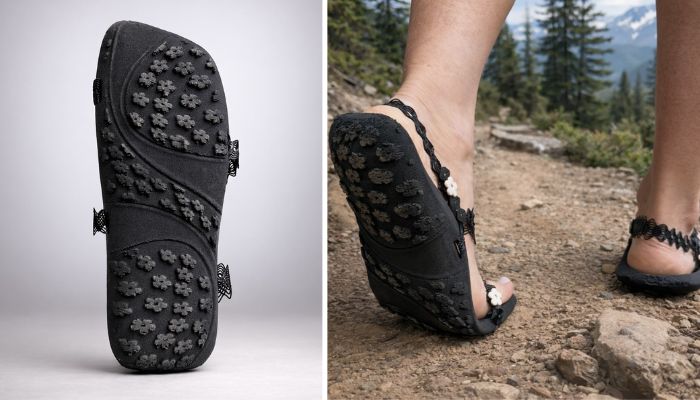
3D printed sandals designed by Maya Kaplan, inspired by the brand Source.
One Fabric, Many Behaviours
Now back in research, Kaplan is focused on a question most people skip. Printing textiles is not new, and it has been done for years now. What interests her today is exploring what the technology can enable that traditional textile techniques like knitting and weaving cannot. “If we can already 3D print textiles and garments,” she said, “how can we push this technology beyond its current capabilities to create real added value?”
Her answer starts with how she prints. Rather than modelling a shape and slicing it, she uses algorithms to generate the G-code that drives the printer directly. That gives her control at the micro level, over the structure of each part of the fabric.
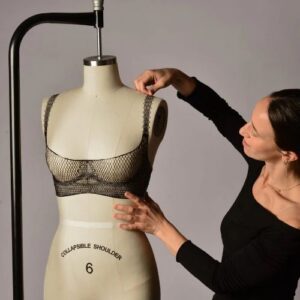
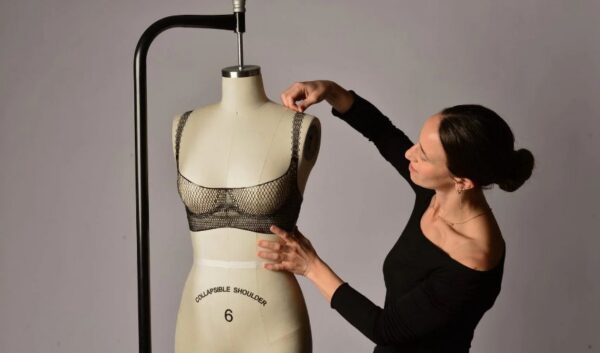
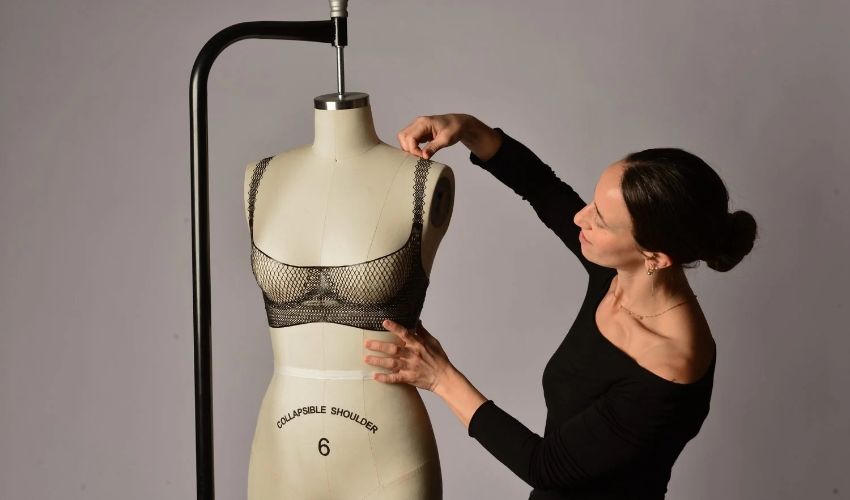
The clearest example is her computational bralette, which is now a finalist for the 2026 Formnext Design Award. Kaplan developed a family of textile structures ranging from flexible to fully rigid, then wrote an algorithm that maps each one to the areas of the garment that need it.
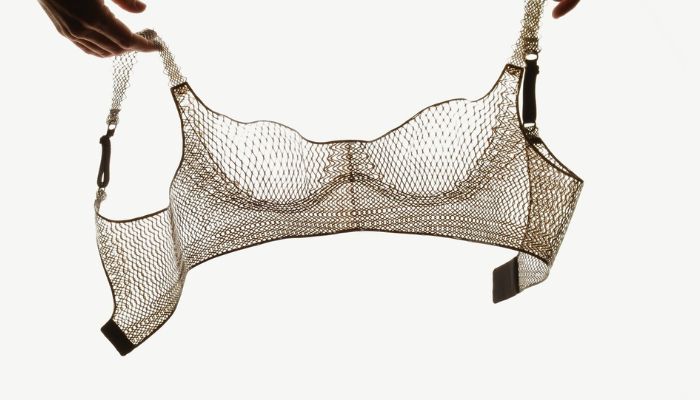
The computational bralette by Maya Kaplan.
She began by designing a bra because it is one of the most demanding garments there is: it has to lift, support, stretch and stay comfortable, and it usually relies on wires, pads, glue and straps to do so. “What if we can eliminate all these components and integrate the functionalities into the textile?” she asks. The result is a single printed piece where one zone stretches freely, another holds completely rigid, and the stretch can even be steered in a chosen direction.
In parallel, she is working on a direction she thinks could reach the market sooner: printing directly onto existing fabrics to add features such as better moisture management or airflow.
Closing the Material Gap
Kaplan believes 3D printed clothing can scale, with garments eventually printed on demand, perhaps at home. She points to footwear: when she was printing shoes in 2018 and 2019, few people were doing it. Once brands like Nike and Zellerfeld committed, the category took off.
The main obstacle for textiles, she says, is materials. The best filaments she has found drape and feel good, but they are not sustainable or compostable, and they can still feel like plastic. She has experimented with bio-based filaments, however they haven’t performed well enough as textiles. That said, she’s optimistic the industry will solve it, noting how far polyester has come through processing to feel like cotton.
Seeing it in person helps. On her last day at the textile company, Kaplan wore a 3D printed shirt to work. Colleagues were impressed, and some didn’t realise it was printed at all.
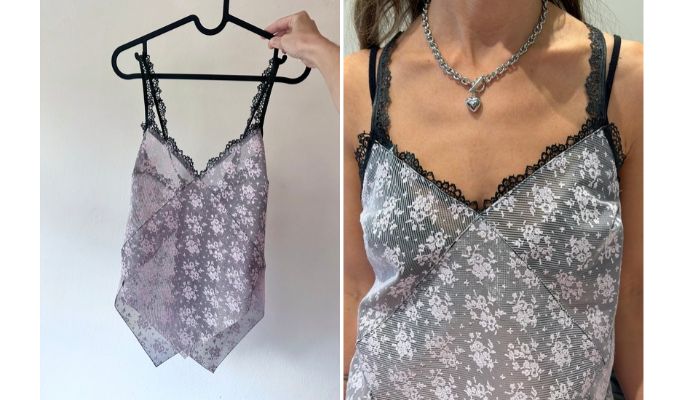
Believe it or not, this top was 3D printed.
If you want to learn more about Maya Kaplan’s work, see her website, here.
What do you think of 3D printing textiles? Let us know on our LinkedIn or Facebook pages! Plus, don’t forget to sign up for our free weekly Newsletter to get the latest 3D printing news straight to your inbox. You can also find all our videos on our YouTube channel.
*Photo Credits: Maya Kaplan Design