


IREC Launches World’s First Additive Manufacturing Plant for Hydrogen Technologies
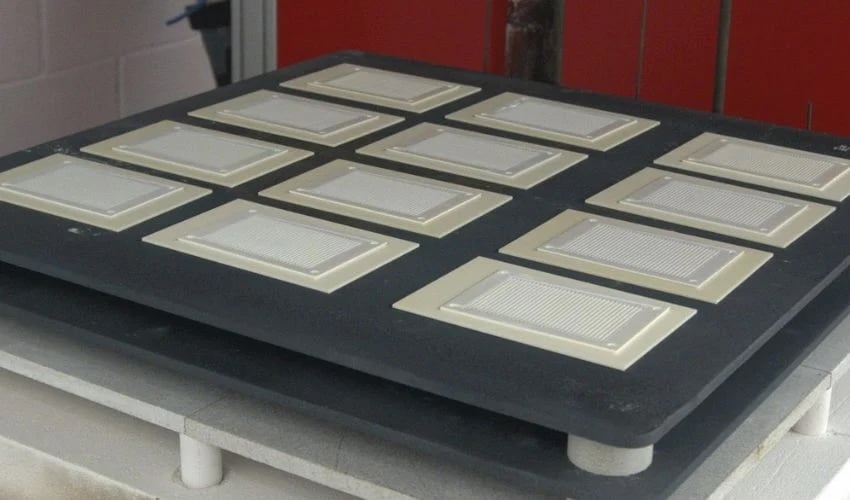
The Catalonia Institute for Energy Research (IREC) has launched Merce Lab, a one-of-a-kind pilot plant that will use ceramic 3D printing to manufacture hydrogen technologies. The project, primarily funded by H2B2 under the European Tecnopropia (IPCEI) programme, brings together industrial and scientific partners with a shared goal: to drive the development of new technologies that accelerate the transition to a clean hydrogen–based economy.
At the core of the project are Solid Oxide Cell (SOC) technologies. These ceramic cells can operate either as fuel cells, generating electricity from hydrogen, or as electrolyzers, producing hydrogen from renewable electricity. These cells operate at high temperatures, allowing them to make more effective use of thermal energy and achieve higher efficiencies than polymer-based technologies. Merce Lab aims to manufacture these SOCs at a pre-industrial scale using advanced 3D printing processes and high-tech industrial assembly techniques.

The interior of IREC’s pilot plant, where ceramic cells for hydrogen technologies are manufactured.
Production begins with the preparation of “ceramic inks.” These inks are then used to print the SOC cells, which are subsequently subjected to a sintering process, meaning they are fired at very high temperatures to compact the material and provide strength and stability. The process continues with the manufacture of interconnects, the stacking of the various components, and the final validation of the device. This combination of additive manufacturing and advanced ceramic processes allows the creation of complex geometries that offer better performance than polymer-based solutions.
Additive ceramic manufacturing offers significant advantages for the project. It reduces material usage and enables the creation of lightweight, compact designs. Additionally, by increasing energy density, these cells are particularly attractive for sectors such as maritime transport, aviation, and large-scale renewable energy storage. For industry, this translates into more efficient devices, potentially lower costs, estimated by the project at around $880/kW (€800/kW), and a more sustainable production process by avoiding materials like cobalt or nickel.
Merce Lab represents a decisive step forward for the development of the hydrogen economy in Catalonia and worldwide. By combining additive manufacturing with solid oxide technologies, the project lays the groundwork for industrial applications that did not previously exist. With the creation of a future spin-off, Oxhyd Energy, and collaboration with national and international companies, this initiative aims to drive industrialization and serve as a model for democratizing access to clean and sustainable energy.
What do you think of IREC’s new plant and its use of ceramic additive manufacturing? Let us know in a comment below or on our LinkedIn and Facebook pages. Plus, sign up for our free weekly Newsletter to get the latest 3D printing news straight to your inbox. You can also find all our videos on our YouTube channel.
*All Photo Credits: Catalonia Institute for Energy Research (IREC)
A great step forward for clean energy innovation. Using additive manufacturing for hydrogen technologies could significantly improve efficiency and scalability in this sector.