


Digitizing the Smile: Ben Wynne on the Future—and Ethics—of Automated Dentistry
Anyone who has swapped traditional braces for clear dental aligners knows the appeal: aligners are much more comfortable and inconspicuous, compared to wires in your mouth. As this consumer preference for a more discreet orthodontic experience drives a massive market shift, it is also fueling an explosion in dental 3D printing, a sector projected to skyrocket from roughly $3 billion today to more than $12 billion by 2032.
Scaling this consumer trend, however, presents a manufacturing challenge. Because no two smiles are identical, every single aligner must be custom-manufactured. To eliminate the friction of this high-volume customization, San Diego-based Intrepid Automation is stepping into the sector. The company leverages patented modular Digital Light Processing, advanced robotics, and AI-driven quality control, to serve high-stakes industries like aerospace, defense, and industrial casting. By introducing continuous manufacturing and automated post-processing, Intrepid aims to replace slow manufacturing lines with flexible, high-speed digital supply chains, equally applicable to the dental industry.
We sat down with Ben Wynne, CTO and Co-Founder of Intrepid Automation, to discuss how additive manufacturing is reshaping dental production, Intrepid’s automated approach to mass customization, and the complex ethical questions emerging alongside automated digital healthcare. This interview has been edited for length and clarity.
3DN: Intrepid Automation serves many industries: aerospace and defense, automotive, medical, industrial machinery. So, why dental, and why now?
Ben Wynne: Dental and additive have been a match made in heaven for a long time…You have this unique convergence where the geometry is complicated, it’s very organic, and every part that’s needed is different. The parts are relatively small. That has really enabled additive to be highly optimized and refined for that. Clear aligners is a hero use case for this, with millions of unique parts being produced every day. As 3D printing has continued to evolve, there’s this interesting tension between centralized production, which is what’s been done classically, and more edge production or chair side production of various dental indications.
3DN: Is Intrepid Automation selling printers for chair side production?
BW: Our core focus at Intrepid is centralized, highly automated industrial production. I think there’s definitely a market, and a space, and a need for edge manufacturing. But, I think there are a lot of other technology providers that have really robust solutions that can work collaboratively in that. I think there’s instances where egde manufacturing works, like how you can get glasses made in the opticians while you’re waiting. But if you really look at where things are going, they’re being centralized. Things are aggregating. Automation is being employed. I believe that, fundamentally, dentists want to be dentists. They don’t need to be manufacturers, too.
However, I see a lot of value in other indications, things like surgical guides for dental. Chair side makes a lot of sense there because the morning the patient is coming in for a surgery, you can print a surgical guide. I think for clear aligners, I’m not fully sold on whether edge makes sense. I think high volume, highly automated, leveraging things like Amazon and Walmart’s kind of infrastructure would be really interesting. There’s a market for both, and it’s really important to be very analytical about our approach and not assume that just because one indication in dental works chair side or centralized, that they all will.
3DN: We hear a lot about circular production with additive manufacturing. Is using AM to produce dental aligners more sustainable than what’s currently available?
BW: The way dental aligners are made today is using additive, but it’s a multi-step process. The majority of the parts that actually go into the human mouth are developed using a two-step process. First, you scan someone’s mouth and come up with a treatment plan, normally about 20 or more steps that would move the teeth slowly enough to not cause pain. You then 3D print all of the molds for all of that treatment at once, in a photopolymer resin durable enough to allow you to vacuform a thermoplastic sheet over the top. You print a mold to form something and then you throw away the mold. There is a fair amount of waste there.
What’s really interesting is when you look at innovations in additive where you’re skipping that forming step, where you start to actually print the aligners directly. It’s quite nascent because it’s very hard to get the mechanical properties you need from the material. It’s also got to be biocompatible, and it’s got to hold a low force for a long period of time, which is pretty challenging. It’s very exciting to see what that could do from a waste perspective, because instead of printing a mold, forming a flat sheet over it, and then trimming that sheet, you’re going straight to the end product. We see automating and centralizing the production of this as a very large opportunity. When it comes to the materials themselves, if we did have to focus on the molding process, the question is, how can we create a recyclability loop?
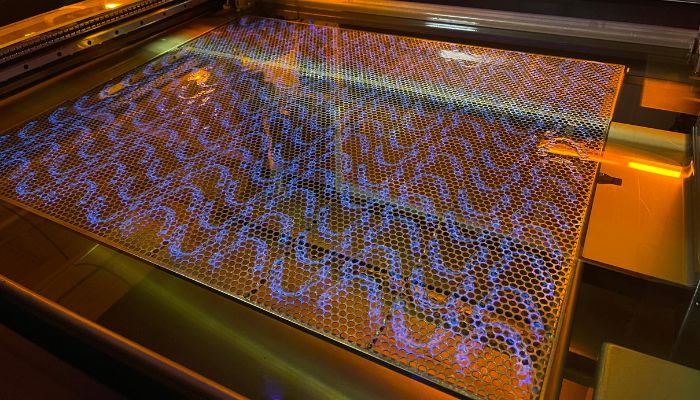
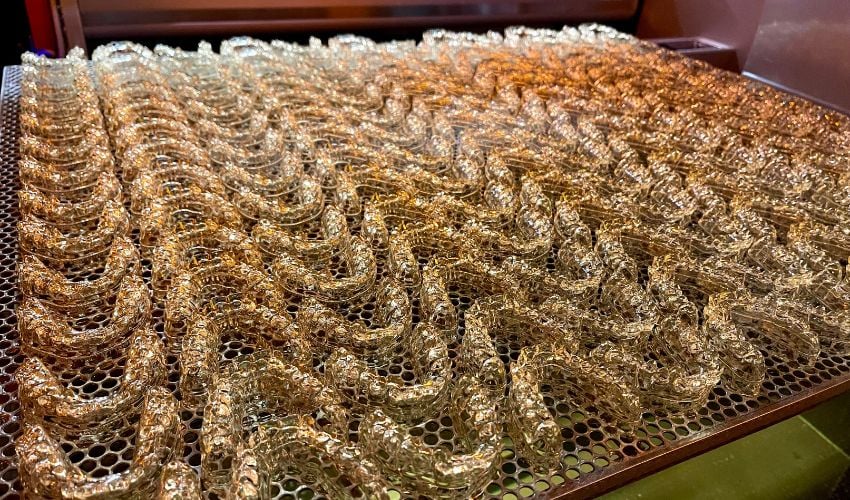
Printing clear aligners Forms via Multi Projection SLA enables entire layers to be printed at a time. Here, 148 aligner molds were printed in just 25 minutes.
We’ve seen some companies use thermoplastics, which can be recycled, as their molds, but they don’t quite have the same fidelity or surface finish or accuracy needed to really do something beyond simple occlusions. The dream would be that you can use photopolymer technology but actually uncross-link some of these bonds and go back to some kind of root chemistry that you can use in another way. That’s again very nascent, but an interesting area of potential.
3DN: What is the biggest challenge Intrepid is facing with the centralized production of dental aligners?
BW: There’s been a shift over the years within the industry. AlignTech and Invisalign have been the industry leaders globally. They developed and perfected this. And it was very dentist-led. You got your treatment by working with a professional dentist to move your teeth, help you with the planning, help you with other things you may need. We then saw a massive bubble around direct-to-consumer models. Smile Direct Club, Byte, all of these companies promising that they could send you a kit to your home, you’d do some impressions, and you’d get your teeth straight.
One data point we heard from working with some of these companies was that 80% of the clientele in direct-to-consumer models had never been to a dentist. So the question we need to ask is: just because you can grow a market, should you? Just because you can move teeth, should you? Or should clear aligners be part of a larger dental health journey? I think direct-to-consumer aligners are in a trough of disillusionment right now. But the bigger reason the industry is growing is that we’re seeing other geographies come online. We’re seeing people in emerging economies with more disposable income who are starting to care more about how they look. The market is growing. I’m not 100% certain that direct-to-consumer will deliver on what it originally promised.
I do believe in the centralized model, or if direct print can happen, an edge manufacturing approach that’s almost kiosk-like. We can also compare this to subtractive technologies that have been used in dental for forever. Dental crowns and bridges have been machined on five-axis mills out of zirconia and then sintered. Some of that’s edge and some of it’s centralized. I like to look at what’s happened with subtractive in dental as a way to predict the future. Also important is the pervasive use of intraoral 3D scanning. The days of the impression tray are kind of dead. It’s about X-rays, CT scanning, and high-resolution full-color intraoral scanning, which gives such a rich data set that a lot more products could be developed. Additive is one of the tools that can help deliver those products.
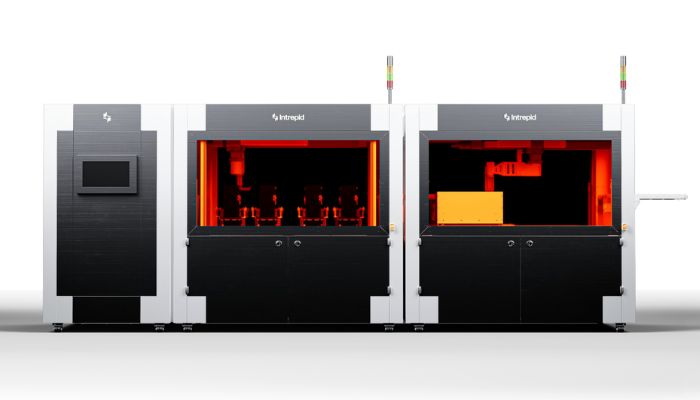
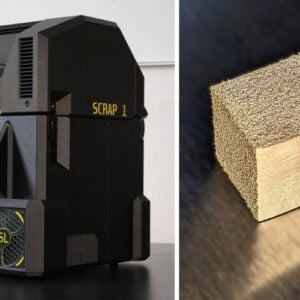
The EPIC Production System is based on patented modular Digital Light Processing (mDLP) technology and “solvent-free” internal post processing, optimal for applications like dental aligners.
3DN: How does Intrepid Automation integrate AI in its workflow?
BW: AI is touching everything. It’s used internally from an R&D and product development perspective. It helps existing roles be more effective, anything from coding and development of core technology. We can’t put the genie back in the bottle. When it comes to how AI is embodied inside our technology itself, it’s really about closing the loop on the print process and making sure that the parts produced are accurate and in spec.
The big challenge with additive is you’re going from nothing to something. If something momentarily changes in that process, your part’s not the same as the hundred that came before it. AI is about keeping things well-understood and controlled, while also helping a tech startup do more with less. We also have camera systems and monitoring systems inside our printers that use AI for computer vision, spotting when something’s not right. When you move into LLMs and agentic AI, it starts to get really interesting.
Advanced manufacturing, in general, has to adopt agentic AI. How factories run in the future with robotics and advanced technology, how AI stitches all of that together, how supply chains are managed, how regulatory is managed using AI, that could fill several other conversations. Use it, adapt, leverage it, or go the way of the dodo.
3DN: Is there anything else you’d like to share with our audience?
BW: Just because you can 3D print something doesn’t mean it’s the right thing to do or the right way to do it. We’ve seen boom and bust cycles in additive time and time again because expectations get set too high. The future I would love to see is a really pragmatic approach where we see additive as just another tool in advanced manufacturing that works with AI, with robotics, with subtractive, with whatever it may be.
What do you think of Intrepid Automation’s work in the dental sector? Let us know in the comments below or on our LinkedIn and Facebook pages. Plus, sign up for our free weekly Newsletter to get the latest 3D printing news straight to your inbox. You can also find all our videos on our YouTube channel.
*All Photo Credits: Intrepid Automation





That’s very interesting! Intrepid Automation’s focus on centralized, highly automated production for aligners instead of chairside sounds extremely logical, especially given the emphasis that dentists should focus on treatment rather than manufacturing.
A lot of great information is available on this topic.
This is a fascinating look into the future of dentistry! It’s incredible to see how automation and 3D printing are tackling the unique challenge of mass customization for aligners. The ethical considerations are definitely something to ponder as these technologies advance. Thinking about precision and strategic moves reminds me a bit of playing paper.io 2 – every decision counts! I’m curious to see how Intrepid’s approach will impact the industry.