


Indian Army Deploys Concrete 3D Printer for Mission-Ready Construction
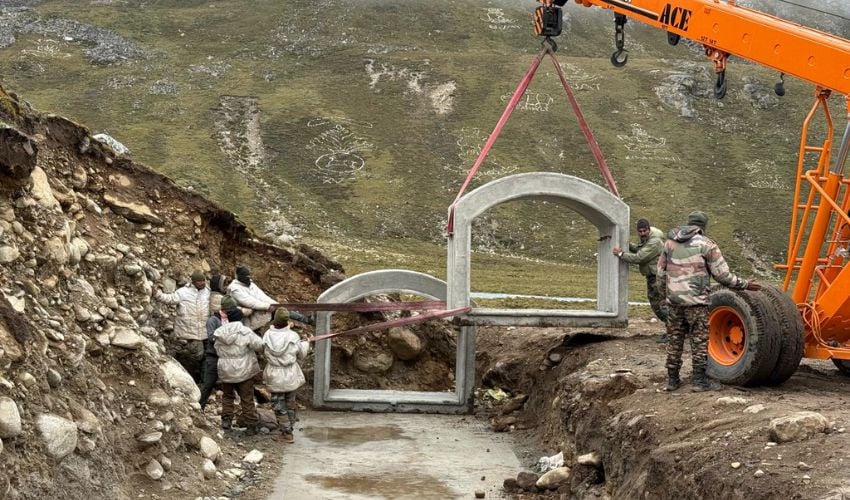
How often do you hear about 3D-printed structures undergoing live ballistic trials? In India, the Army’s Trishakti Corps has pushed construction 3D printing into defense terrain, deploying a robotic concrete 3D printer across forward areas in northern Sikkim and adjoining forward areas. Mounted on a vehicle for mobility, the system navigates rugged, mountainous ground while completing critical construction projects along the border. Equipped with a robotic arm, circular mixer, piston pump, and on-board generator, the machine can rapidly produce defense infrastructure such as bunkers, sentry posts, and protective structures. To validate their structural strength, durability, and real-world performance, these builds were subjected to live ballistic trials.
Globally, construction 3D printing has largely been associated with civilian projects: homes, commercial buildings, churches, mosques, and other architectural sites. These applications typically highlight the technology’s advantages: faster build times, reduced manual labor, lower costs, and the ability to produce curved walls and organic geometries that are otherwise expensive and time-consuming to fabricate. In defense scenarios, however, the priorities shift.
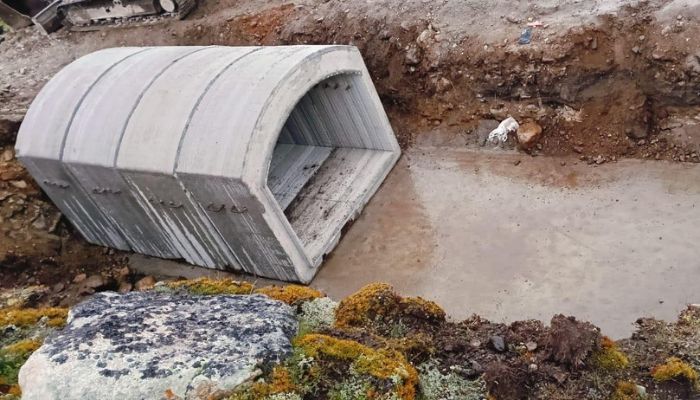
The printer had to adapt to difficult terrain.
Along the northern border, the Indian Army requires structures tailored to difficult terrain and potential combat conditions. The current effort, developed with IIT-Hyderabad under Project PRABAL (Portable Robotic Printer for Printing Bunkers and Accessories), reflects that need. The construction 3D printer enables custom designs adapted to local topography while supporting advanced camouflage requirements. The printed structures also incorporate features that enhance blast and ballistic resistance and deliver higher compressive strength. According to the Indian Army, via The Hindu, the approach maximizes the efficient use of local materials and significantly accelerates construction within tactically acceptable timelines.
This April, Project PRABAL also made headlines when, in collaboration with the Indian tech company Simpliforge Creations and IIT-Hyderabad, they completed India’s first on-site 3D printed military-grade protective structure. It was built at an altitude of 11,000 feet in Leh, and the team claims that it’s the world’s highest-altitude 3D printed structure built under high-altitude, low-oxygen conditions.
Ultimately, additive manufacturing is enhancing the Indian Army’s operational readiness, particularly in high-altitude regions where traditional construction methods are slow, labor-intensive, and hindered by harsh terrain. A December press release from the government of Sikkim states, “The continued adoption of on-site 3D printing represents a significant leap in the Army’s engineering and operational readiness, enabling fast, sustainable, and mission-oriented infrastructure development in challenging environments.”
What do you think of the PRABAL project? Let us know in a comment below or on our LinkedIn or Facebook pages! Plus, don’t forget to sign up for our free weekly Newsletter to get the latest 3D printing news straight to your inbox. You can also find all our videos on our YouTube channel. For more 3D printing news in the aerospace and defense sectors, check out our dedicated page HERE.
*All Photo Credits: Trishakti Corps via X