







Florida Atlantic University to 3D Print Seaweed Structures to Combat Harmful Algal Blooms
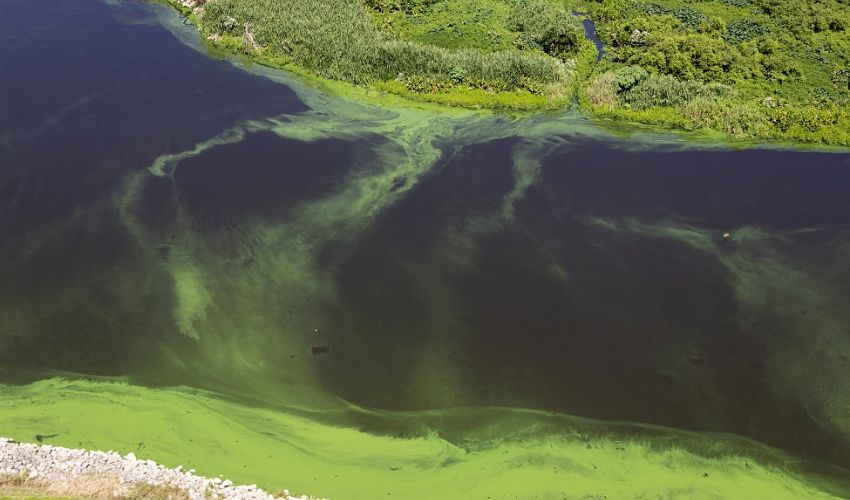
It’s a bad time to be a harmful algal bloom (HAB)! On August 6th, Florida Atlantic University announced that a team of its researchers were awarded an $800,475 grant from the Gulf of America Division U.S. Environmental Protection Agency to develop a technology to prevent HABs from growing. If the name doesn’t give it away, HABs are harmful, and they’re a common threat to lakes, rivers, and coastal waters across the U.S. They put drinking water supplies at risk, deplete oxygen that fish and other aquatic life need to survive, and produce toxins that are dangerous for public health. What’s more, this damage negatively affects local economies who depend on these water sources for tourism and recreation.
The three-year project, which began in July, will target the removal of phosphorus from water, a key driver of HABs. Excess phosphorus enters water via agricultural runoff, wastewater, failing septic systems and urban stormwater, and this can cause “explosive” algal growth. Lake Okeechobee, one of Florida’s most important freshwater resources, has been dealing with HABs for years, fueled by elevated nutrient levels. And because the lake sits at the headwaters of the Gulf of America watershed, phosphorus flowing downstream affects numerous rivers, estuaries and coastal ecosystems. This makes nutrient reduction in the lake vital, as it would improve water quality throughout the region.
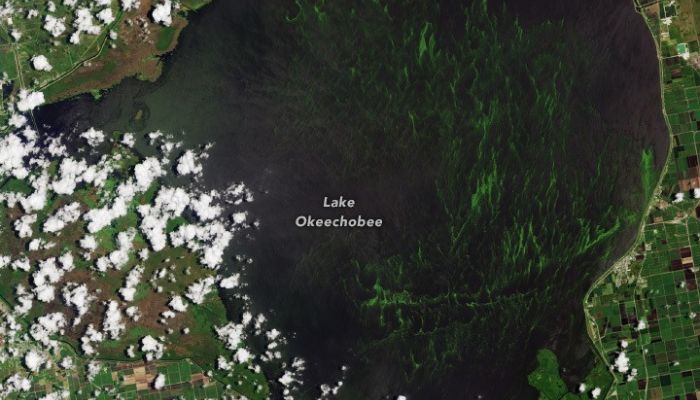
A satellite view of Lake Okeechobee on June 12, 2023, showing algae blooms covering about 380 square miles of the lake. (Photo credit:NASA Earth Observatory image by Wanmei Liang, using Landsat data from the U.S. Geological Survey.)
Today’s large-scale phosphorus removal methods are often expensive, wasteful, and environmentally challenging. Chemical treatments generate heavy sludge, while biological solutions demand tightly controlled conditions that are difficult to manage in natural bodies of water.
The FAU team is tackling this with an innovative method: 3D-printing durable, retrievable structures made from lanthanum and sargassum, a naturally abundant seaweed. While lanthanum effectively captures phosphorus, standard treatments apply it as a fine powder that settles into lake sediments and slowly leaks into the ecosystem. By combining lanthanum within solid, recoverable sargassum, the team minimizes chemical runoff while repurposing algae for a more sustainable solution.
“This award provides an exciting opportunity to transform how we manage one of the most persistent causes of harmful algal blooms,” said principal investigator Masoud Jahandar Lashaki, Ph.D., an associate professor in FAU’s Department of Civil, Environmental and Geomatics Engineering. “By combining sustainable 3D-printed materials with the power of AI, we can develop a smarter, more effective and environmentally responsible solution for removing phosphorus from our waterways. This funding allows us to accelerate the development and field testing of this technology while creating a model that can ultimately benefit freshwater ecosystems far beyond Florida.”
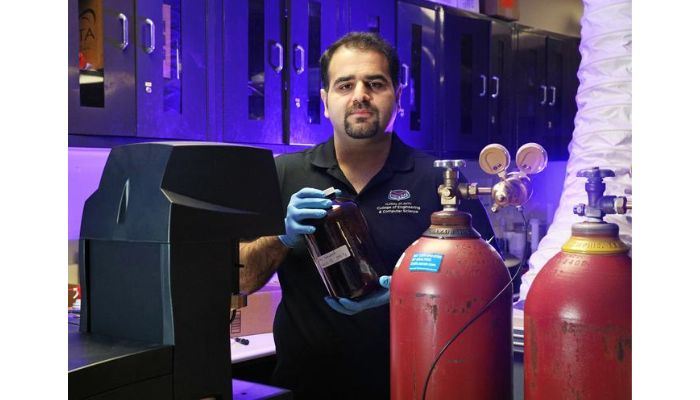
Principal investigator Masoud Jahandar Lashaki. (Photo Credit: Florida Atlantic University)
Using AI to Combat HABs
The team will use artificial intelligence to support many aspects of the project. First, they will use it to rapidly identify the most effective adsorbent formulations, and once the structures are printed, they’ll use AI again to figure out the optimal locations for deploying the structures. With integrated environmental monitoring data (including information on land use, weather patterns, fertilizer applications, livestock operations and septic systems) they’ll be able to predict where phosphorus removal will have the greatest impact on preventing HABs.
Testing will take place in Lake Okeechobee, where researchers will monitor improvements in water quality and clarity, as well as reductions in HABs. The team will collect this data with field sampling, publicly available environmental data and unmanned aerial vehicles. The resulting dataset will be shared through the U.S. EPA’s Water Quality Exchange to help other communities adopt similar approaches. The technology is meant to be scalable and transferable to lakes, reservoirs and watersheds around the world facing similar nutrient pollution challenges.
On a local level, the project is expected to
- reduce phosphorus levels in Lake Okeechobee,
- Improve water quality and clarity,
- Decrease the frequency and severity of HABs
- Reduce downstream nutrient pollution throughout the Gulf of America watershed,
- Demonstrate a reusable technology.
The project, titled “AI-Guided Use of 3D-Printed Adsorbents for Phosphate Removal,” is led by principal investigator Masoud Jahandar Lashaki, Ph.D., an associate professor in FAU’s Department of Civil, Environmental and Geomatics Engineering. Co-principal investigators are Yalan Liu, Ph.D., an assistant professor, and Mohammed Abdellatef, Ph.D., an assistant professor both from FAU’s Department of Civil, Environmental and Geomatics Engineering. Huichun (Judy) Zhang, Ph.D., of Case Western Reserve University, will serve as the project’s sub-awardee.
What do you think of the research project? Let us know in a comment below or on our LinkedIn and Facebook pages! Don’t forget to sign up for our free weekly Newsletter here, the latest 3D printing news straight to your inbox! You can also find all our videos on our YouTube channel.
*Cover Photo: Florida’s Lake Okeechobee. Credit: FAU






The use of retrievable seaweed-and-lanthanum structures is an especially thoughtful response to the waste created by conventional treatments. Pairing field monitoring with deployment planning makes the research feel practical rather than merely experimental.