




Tim Smith on GRX-810: NASA’s Breakthrough Superalloy for Additive Manufacturing
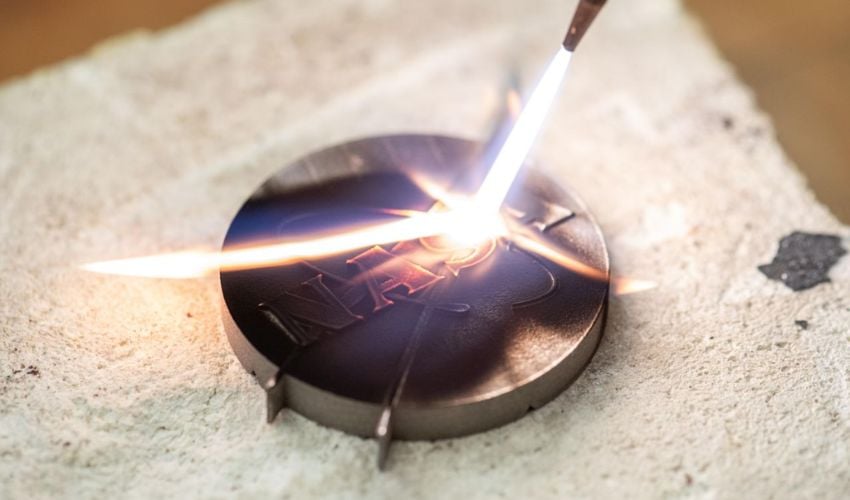
Jet turbine engineers need components that can survive some of the most extreme conditions imaginable, like emperatures exceeding 2,000 degrees Fahrenheit, and for years, no off-the-shelf alloy survived the task. The answer came from NASA Glenn Research Center in the form of GRX-810, a purpose-built oxide dispersion strengthened (ODS) superalloy designed for additive manufacturing. Capable of delivering creep lifetimes of over 6,000 hours in testing and requiring no special print parameters, GRX-810 is setting a new benchmark for what high-temperature metal AM can achieve.
Tim Smith, a Research Materials Engineer at NASA Glenn, was one of the minds who helped bring GRX-810 from a concept to a fully commercialized material, recognized as NASA’s Commercial Invention of the Year. To learn about the material’s development, 3Dnatives spoke with Tim, who will also be a panelist at the virtual ADDITIV Metals on June 10. Read the full interview below, and if you want to hear more from Tim, register for ADDITIV Metals HERE. This interview has been edited for length and clarity.
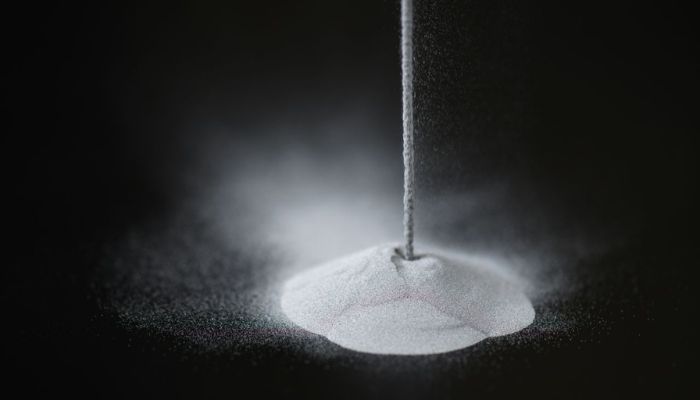
GRX-810 was designed specifically for 3D printing (Photo Credit: Jef Janis/NASA)
3DN: Can you tell us about the GRX-810 superalloy? Why it was created and what necessitated its development?
This was an alloy development project that started almost seven or eight years ago. It came about because engineers here at NASA Glenn wanted to use 3D printing to explore new geometries for a combustor dome used in jet turbine engines. The problem was that it had to operate at very high temperatures, around 2,000 degrees Fahrenheit, or 1,100 degrees Celsius.
Every time they used the best off-the-shelf high-temperature alloy they could 3D print, the component would fail during testing. They came to us, the materials researchers, and asked whether there was something they could buy and print that would survive those temperatures. We came back and said we didn’t think so, but we had ideas about leveraging additive manufacturing to develop new alloys that could. That’s what kicked off our alloy development project, which ultimately led to GRX-810.
3DN: Because this material can tolerate such high temperatures, does that make it more challenging to print? Does it require higher temperatures during the printing process?
It’s not difficult to print, as long as you have a reasonable starting point for your print parameters, you have flexibility to produce very dense components. One thing we were intentional about was not requiring anything unique or special to get it to print. We knew that would make it much harder for industry to adopt.
There is nothing special you have to do to print this alloy. It can be done with a non-heated build plate and typical print parameters. The only real change is that we’ve modified the feedstock to incorporate nanooxides. Otherwise, it prints just like any other nickel-base alloy.
3DN: Is GRX-810 exclusive to any specific type of metal 3D printing technology?
The highest TRL and MRL level for GRX-810 at the moment is in laser powder bed fusion. That’s where we’ve invested most of our effort in exploring and optimizing. We’re now branching out into a range of other techniques. There’s interest in larger components that go beyond what laser powder bed fusion can produce, so we’re currently exploring directed energy deposition and wire additive manufacturing. We actually did some hot wire builds of GRX-810 not too long ago.
3DN: In what cases would laser powder bed fusion not be the optimal method for this material? Why explore DED and wire additive?
The first reason is size. Laser powder bed fusion is constrained by the build volume of the machine. The other factor is deposition rate. If you want to make something large quickly, laser powder bed fusion probably isn’t the right approach.
We’ve also had industry interest in producing sheet stock of GRX-810, which creates a challenge because it’s a solely additive alloy. It can only be made with additive manufacturing. Producing something like sheet stock then becomes more complex, which is why we want to move toward higher deposition rate additive techniques like wire AM.
3DN: You mentioned this project started seven years ago. Why did it take that long, and what challenges did you face?
We actually arrived at the composition fairly quickly. We used a modeling-first approach to optimize the powder composition for this ODS alloy technique. Unfortunately, the pandemic sent everyone home from the labs for an extended period, so when our first batch of GRX-810 arrived, it sat on the shelf for over a year before we could print it.
There were also scaling challenges. We were making ten pounds at a time in the lab — which was fine for a small printer like an EOS M100 — but industrial printers need hundreds or thousands of pounds, so the entire process had to scale. Every change requires you to understand what you’re doing.
That said, I’d argue this actually didn’t take as long as you might expect for introducing a new material to industry. We went from our first report of GRX-810 properties in 2022 to full commercialization by 2025. I think that reflects how additive manufacturing is accelerating materials discovery.
3DN: Beyond NASA and aerospace, what other applications do you see for GRX-810?
Anytime you encounter an environment that’s corrosive or extremely high temperature, where typical superalloys aren’t holding up, GRX-810 could have a role. We’ve had interest from automotive applications, like turbochargers for F1 race cars. There’s also interest in using GRX-810 for grips and rods in high-temperature tensile testing, because the standard rods fail at very high temperatures. It also has potential for temperature probes and characterization instruments in corrosive environments.
I work primarily in the space and aerospace world, so it’s easier for me to name applications in that domain — but any extreme environment is a potential fit for this alloy.
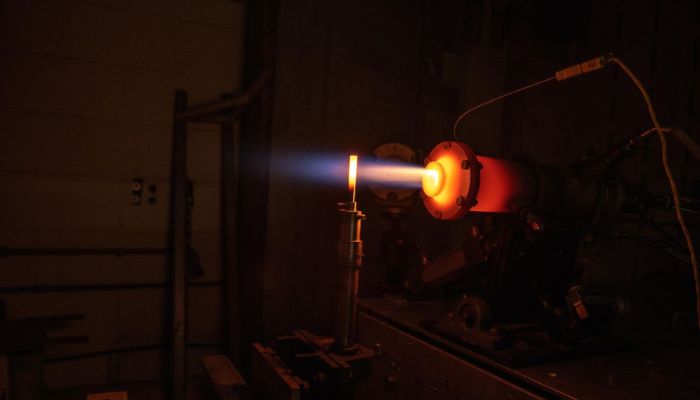
GRX-810 can withstand extreme conditions. (Photo Credit: NASA/Bridget Caswell)
3DN: GRX-810 won NASA’s Commercial Invention of the Year award. How did it feel to be part of the team that achieved that?
It was an incredible honor, honestly, something I still haven’t fully come to terms with. If I could go back and tell my younger self that something I worked on would become Invention of the Year at NASA, I’m not sure I would have believed it.
I’m just grateful to be surrounded by so many exceptional researchers. Something like this takes a large group to achieve. Being able to walk down the hall and get thoughtful answers to complex questions from colleagues — that’s a remarkable environment to work in. It was a dream come true, really.
3DN: Was there anything that surprised you or your team during the development of GRX-810?
The first test results were genuinely surprising. To screen the alloy, we ran low-stress, high-temperature creep tests. With our previous ODS alloys, we expected around 80 to 100 hours of life before failure — which was already five times longer than typical superalloys, so we were always satisfied with that.
Then the first GRX-810 results came in, and we were seeing lifetimes of 6,000 hours or more. That was far beyond what we anticipated. We’ve spent the last few years working to fully understand why we saw that level of improvement. It’s a fascinating alloy. We’re still learning new things about it. And those early models hit the composition essentially dead on. Whenever we try to change it, we usually just make it worse. It’s been a genuinely fun alloy to work with.
3DN: Are there common misconceptions in the metal additive manufacturing industry that you think need to be addressed?
From a materials standpoint, I see a lot of hesitation around adopting new materials. But I think it’s important for the industry to recognize that with additive manufacturing, you’re already producing a fundamentally different material, even if you start with a familiar alloy. So there’s a real opportunity to move past that hesitation.
Using materials that were specifically designed for additive manufacturing gives you the best possible properties, which then allows you to further optimize the components you want to build. Just because you’re working with a wrought or cast alloy that’s been around since the 1940s doesn’t mean you fully understand what you’ll get when you 3D print it. This new manufacturing technique opens the door to materials purpose-built for it — materials that will produce better components and better properties going forward.
And to add to that: even if you do use a familiar material, make sure you’re running the proper tests and characterization on what you’ve produced. You are changing the material when you print it — know what you’ve actually made.
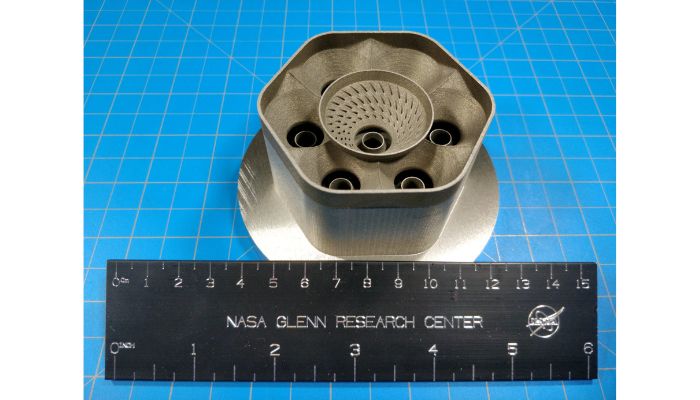
A turbine engine combustor that was 3D-printed at NASA Glenn, an example of a challenging component that can benefit from applying the new GRX-810 alloys. (Photo Credit: NASA)
3DN: You mentioned that if you could tell your younger self about winning this NASA award, you’d be amazed. Do you have any advice for young engineers who want to achieve something at that level?
My main advice is: don’t try to do it alone. I’ve always asked for help, and I’ve been fortunate to have great advisors at every stage of my education and career. I’ve had exceptional collaborators throughout, and GRX-810 simply would not exist if I had tried to build it by myself.
Use the people and resources around you. And when it’s your turn, make sure you’re also helping the next generation of researchers. Don’t be afraid to ask for help.
If you want more on metal AM, register for ADDITIV Metals HERE. What do you think of the material breakthrough? Let us know in a comment below or on our LinkedIn or Facebook pages! Plus, don’t forget to sign up for our free weekly Newsletter to get the latest 3D printing news straight to your inbox. You can also find all our videos on our YouTube channel.
*Cover Photo Credits: NASA/Jordan Salkin




Having the opportunity to read this remarkable essay has provided me with a great deal of information.
Great read with some truly exciting insights into innovation and advanced manufacturing. It’s inspiring to see how research continues to push technology forward. Thanks for sharing this informative article!
This GRX-810 superalloy sounds like a game-changer for high-temperature applications! It’s fascinating how they leveraged 3D printing to create something so robust. It makes you wonder what other incredible advancements are just around the corner. Sometimes, exploring new technologies feels like discovering a new level in an exciting round of io games.