







A Metal Alloy That’s Easier to 3D Print Thanks to AI

Washington State University researchers used artificial intelligence to 3D print a metal alloy more affordably and efficiently. The project shows how AI is beginning to change additive manufacturing workflows as the technology advances rapidly.
The alloy was GRCop-42, a material developed by the National Aeronautics and Space Administration (NASA). It is made from copper, chromium and niobium. It is mainly used to produce components for combustion devices because it offers good fatigue strength, very high thermal conductivity and excellent creep resistance.
Despite its considerable application potential, the alloy is very difficult to 3D print. The process requires very high laser power, specialized equipment and substantial resources.
Researchers have made numerous attempts, but the process remains costly and time-consuming. The Washington State University team used AI to test different print settings more quickly and at a lower cost.
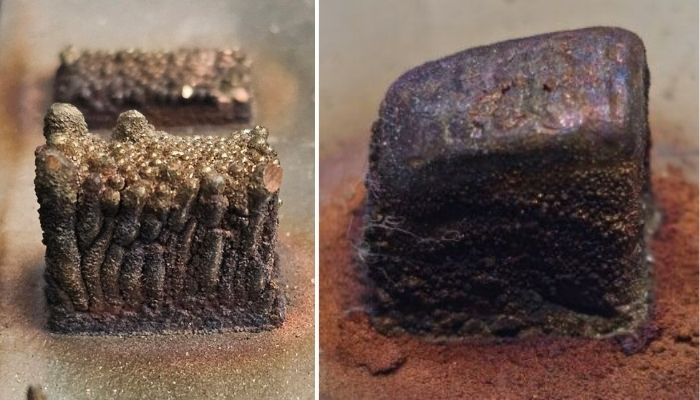
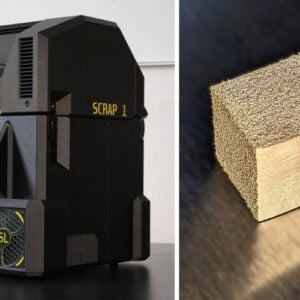
Left: an example of failed 3D printing. Right: a successfully printed sample (Photo credits: Nathaniel W. Zuckschwerdt/WSU)
3D Printing GRCop-42: How Does It Work?
The researchers began with 37 failed attempts from the School of Mechanical and Materials Engineering. They developed a model that could determine which settings would work and which would not. The team then tested every setting selected by the AI. Even when a test failed, the result provided useful data to train the model further.
Jana Doppa led the study and explained: “It’s a very challenging case for AI. Every time you try, you basically get a binary success or failure signal, and you are trying to minimize the number of tries that you have so that you get to those successful needles very quickly.”
The Results
The team conducted 40 experiments over three months. It identified six settings that could 3D print the alloy at different laser power levels. For the first time, GRCop-42 was successfully 3D printed using just 500 watts.
This advance could make the metal alloy more accessible to universities, companies and smaller laboratories while reducing energy consumption. The goal is to eliminate the need for heavy, expensive and specialized equipment. More information is available in the press release here.
What do you think about the role of artificial intelligence in developing materials for 3D printing? Let us know in a comment below or on our LinkedIn or Facebook pages! Plus, don’t forget to sign up for our free weekly Newsletter to get the latest 3D printing news straight to your inbox. You can also find all our videos on our YouTube channel.
*Cover photo credits: Stanford Advanced Materials