






The Common Kitchen Spice That Could Neutralize Light Scattering During Ceramic 3D Printing
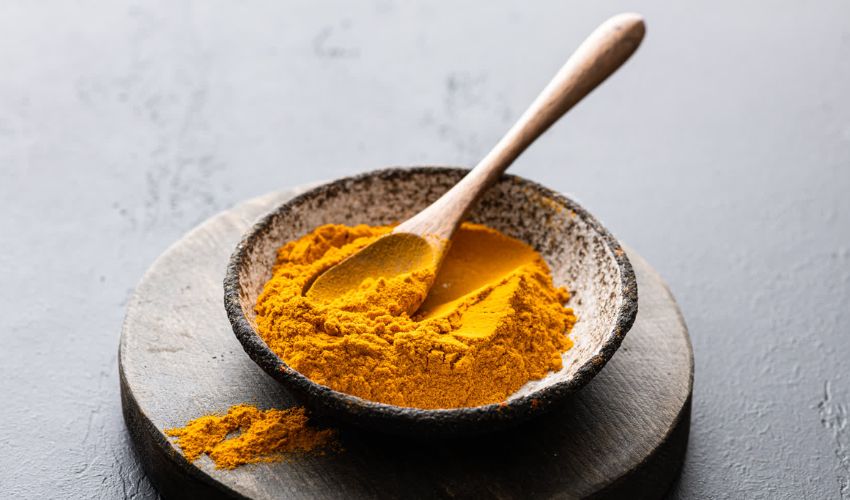
You might not be familiar with curcumin, but you certainly know turmeric: the vibrant spice native to Southeast Asia. Curcumin is the active chemical compound within turmeric responsible for giving it that iconic bright yellow hue. Extracted from the Curcuma longa plant, curcumin is widely used today in herbal supplements, cosmetics, and food coloring. Now, researchers from Hunan University have discovered a new application for it: stabilizing microscopic ceramic 3D printing.
The Challenge of Light Scattering in Ceramic AM
To understand the breakthrough, it helps to look at digital light processing (DLP), handles ceramics. Generally, ceramic 3D printing relies on vat photopolymerization, curing a liquid resin that is heavily packed with solid, microscopic ceramic powder. During the printing process, the machine projects precise light patterns onto the resin to cure it layer by layer.
However, these solid ceramic particles act like tiny mirrors, scattering the incoming light randomly off-target. This stray light causes unintended areas of the resin to harden, leading to printing defects and a loss of detail.
To combat this, industrial dyes are traditionally added to absorb excess light. The catch is that these dyes only passively block the light, and they can severely compromise the thermal and mechanical stability of the final ceramic part. As a result, users have always been forced to make a compromise: choose fine detail by using dyes, or prioritize structural strength by leaving them out.
Why Curcumin Works
This is where curcumin ceramic 3D printing changes the approach. The team at Hunan University discovered that curcumin does not just physically block excess light; it actively neutralizes the erratic chemical reactions that cause printing errors.
The researchers only needed a small amount to see results. Operating effectively at a mere 0.01 weight percent, curcumin prevents fine features from blurring together without slowing down the overall manufacturing process.
| Material Feature | Traditional Chemical Dyes | Curcumin Integration |
| Light Management | Passively dims and blocks stray light | Actively absorbs light and neutralizes free radicals |
| Feature Resolution | Low to moderate (clogs micro-holes) | Ultra-high (keeps 50-μm holes clear) |
| Post-Processing | Leaves residue; weakens final structure | Burns away completely; retains maximum strength |
Active Protection at a Molecular Level
To visualize the difference between curcumin and traditional blockers, imagine the printer’s light source as a precise laser trying to write a little message on a wall. The ceramic particles act like a dense cloud of dust, scattering the beam into a wide, messy blur. Traditional chemical dyes behave like sunglasses: they dim the room to hide the blur.
Curcumin tackles the problem at its root. Thanks to its natural yellow pigment, it absorbs the specific wavelengths of the stray light. On a molecular level, its chemical structure hunts down free radicals, which are the highly reactive chemical sparks generated by scattered photons.
According to the research team, curcumin neutralizes these free radicals before they can harden the wrong sections of the liquid resin. This ensures the light only cures the exact intended geometry. In laboratory testing, this method reduced blurring errors on printed parts down to just 26.1 micrometers. It also successfully kept microscopic 50-micrometer holes entirely open and free-flowing, whereas standard resins clogged them shut.
During the final high-temperature debinding and sintering phase, the curcumin burns away completely. This leaves the finished ceramic component with the maximum density and mechanical strength required for real-world applications.
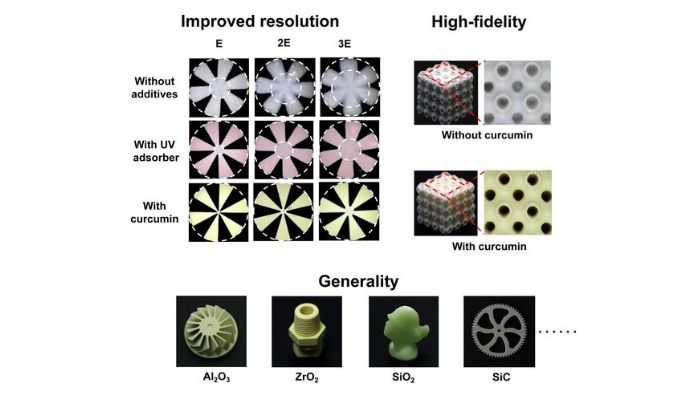
Compared with conventional light absorbers, this strategy substantially enhances the fabrication precision of ceramic components and enables high-fidelity forming of complex structures. (Figure Credit: By Mingyue Cao, Wenxin Wang, Xingyu Yang, Wei Zhu, Xiaolong Zhu, Yinfeng He, Feng Chen and Xiaoxiao Han)
What Are the Implications for the Industry?
The implications for the additive manufacturing industry are significant. By using curcumin in ceramic 3D printing, engineers could rapidly produce complex, lightweight components out of tough materials, without needing to worry as much about geometric distortions.
As ceramic 3D printing continues to expand across industries, including dental implants, aerospace components, electronics hardware, and advanced medical devices, this bio-based solution could pave the way for more reliable, commercial-grade production. We’ll be on the lookout to see whether this compound transitions from the research lab to commercial resin formulations in the future. Read the full study, published in the International Journal of Extreme Manufacturing, here.
What do you think of this solution? Let us know in a comment below or on our LinkedIn and Facebook pages! Don’t forget to sign up for our free weekly Newsletter here, the latest 3D printing news straight to your inbox! You can also find all our videos on our YouTube channel.









This is absolutely fascinating! As someone who loves both advanced tech and gaming, the first thing that came to my mind was printing high-detail tabletop miniatures of game characters. Imagine printing flawless, high-strength figures from strategy games, like the giant statues or characters from stick war legacy unlimited chest, without losing those micro-details! Traditional resins always ruin the sharp edges of custom models, so using curcumin to fix light scattering is a massive game-changer for DIY creators and gamers alike. Thanks for sharing this breakdown