

From Crops to Concrete: Turning Corn Waste Into 3D-Printed Construction Material
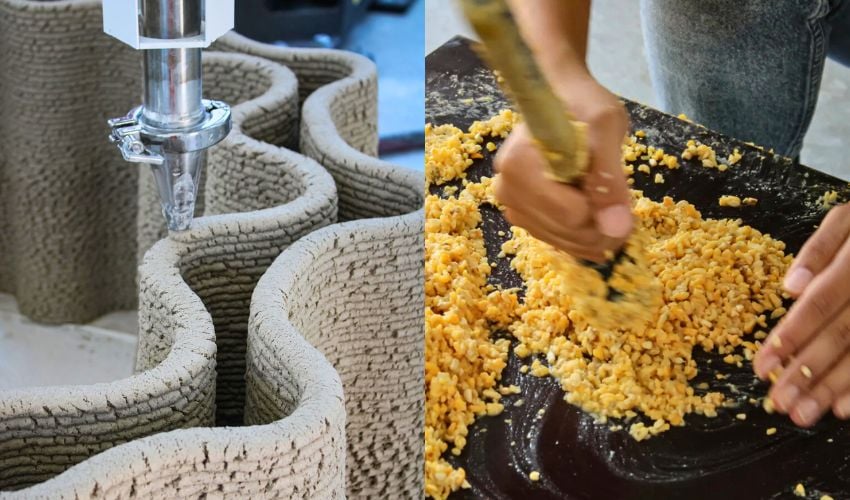
The promise of construction 3D printing has long focused on speed and automation. Increasingly, a new advantage is taking center stage. Instead of standardized, carbon-heavy cement, researchers are exploring bio-based and locally sourced alternatives.
The Mexico-based collective Manufactura is contributing to this shift with CORNCRETL, a 3D-printable composite made from agricultural by-products and designed for structural use.
Ancient Heritage Meets Robotic Precision
Founded in 2022 by Dinorah Schulte, Manufactura connects pre-Hispanic building knowledge with robotic fabrication. CORNCRETL (a portmanteau of “corn” and “concrete”) utilizes nejayote, a calcium-rich wastewater produced during the nixtamalization process practiced for millennia in Mesoamerica.
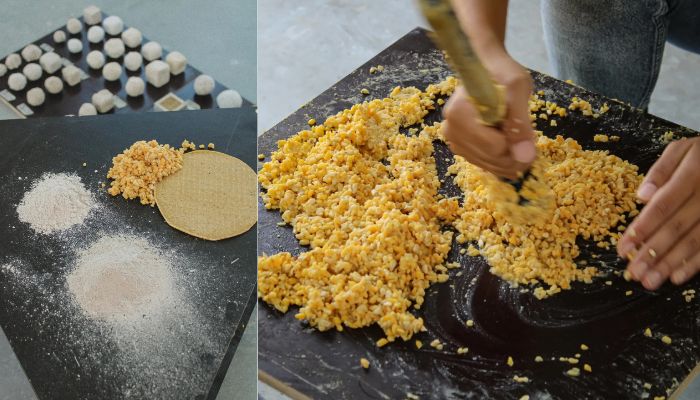
Rather than being discarded, the liquid becomes a key ingredient in the printable mixture. Because corn remains a daily staple in Mexico, the process generates significant volumes of organic residue, making the material both culturally rooted and locally abundant. By combining this liquid waste with dried corn husks and stalks, the team created a printable binder.
The Printing Process
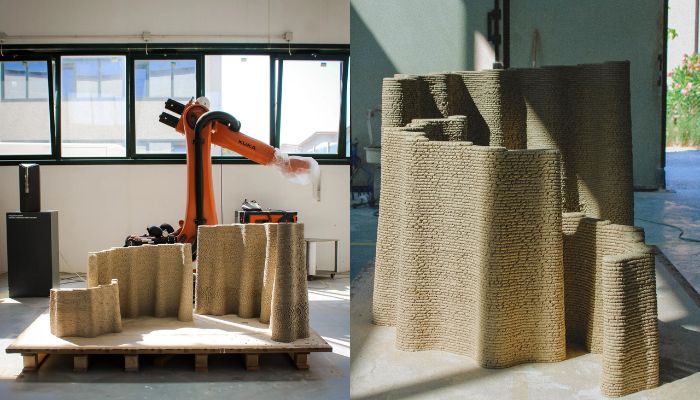
To produce CORNCRETL, the team used a KUKA robotic arm paired with a WASP Concrete HD Continuous Feeding System.
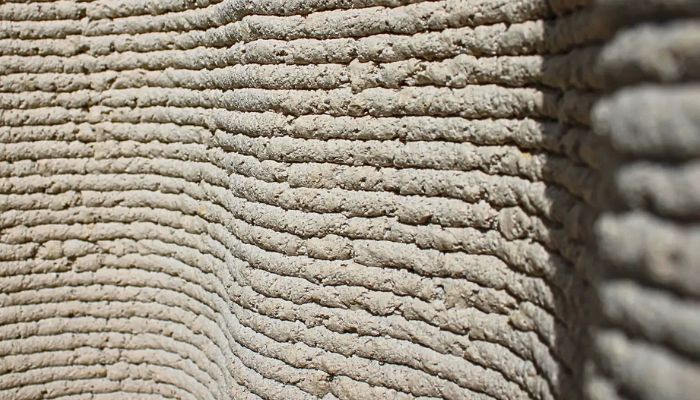
Corn residues are dried, shredded and milled to a controlled particle size before being blended with a natural hydraulic lime (NHL 3.5) binder and aggregates suitable for robotic extrusion. The mixture is then deposited layer by layer, eliminating traditional formwork and reducing construction waste by 90%.
The freedom of robotic motion enables curved surfaces and geometric textures inspired by terrazzo designs. After printing, the lime-based material hardens at room temperature within days, unlike traditional concrete, which requires energy-intensive curing.
Sustainability and Self-Healing
According to Manufactura, CORNCRETL can reduce carbon emissions by up to 70% compared with Portland cement due to its lime-based chemistry and low-temperature curing.
The material also exhibits self-healing behavior: when moisture enters micro-cracks, unreacted lime particles recrystallize and partially seal the gap, a known property of lime binders.
Scaling Local Solutions
The team validated the material’s structural potential by successfully printing modular wall prototypes up to 80 cm in height and conducting full-scale testing at the Shamballa open-air laboratory in Italy.
Rather than relying on standardized, carbon-heavy concrete mixes, CORNCRETL proposes a decentralized model. Using additive manufacturing, local waste streams can be processed in situ so the building material originates from the same place as the structure itself.
Would you trust a building material made from agricultural waste? Let us know in a comment below or on our LinkedIn and Facebook pages. Plus, sign up for our free weekly Newsletter to get the latest 3D printing news straight to your inbox. You can also find all our videos on our YouTube channel.
*All Photo Credits: Dinorah Schulte