

Could Bioprinted Liver Tissue Become an Alternative to Transplants?

A research team at Carnegie Mellon University in Pittsburgh received $28.5 million in funding from ARPA-H to carry out the LIVE (Liver Immunocompetent Volumetric Engineering) Project. The goal? To manufacture functional liver tissue for patients with acute liver failure using 3D bioprinting.
The liver is one of the most resilient organs of the human body. It’s capable of replacing its cells in response to acute and chronic injuries, something known as “liver regeneration.” Current literature tells us that liver regeneration is achieved through various means, such as liver cell activation or metabolic reprogramming. However, these solutions do not always work for everyone. The LIVE Project was created to address this major public health challenge.
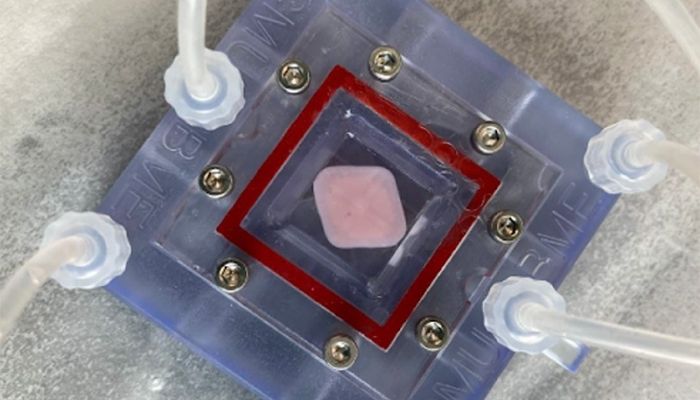
3D bioprinted liver tissue using FRESH technology (photo credit: Carnegie Mellon University).
The LIVE Project does not seek to create a permanent organ right away, but rather a temporary liver tissue that gives the organ time to regenerate. The team, led by Dr. Adam Feinberg, will use two technologies developed at the university. First, there’s FRESH (Freeform Reversible Embedding of Suspended Hydrogels) technology. This is a bioprinting technique that allows soft bioinks, such as collagen, to be extruded into a thermoreversible support hydrogel. This prevents the structures from collapsing under their own weight, allowing complex and precise vascular architectures to be created with structural proteins and human cells.
The second technology they will use is 3D Ice Platforms. This is a complementary technology that uses controlled freezing processes to create scaffolds with a specific internal porosity, which is essential for cell survival and nutrient flow. Thanks to these technologies, the team will be able to create tissue composed entirely of human cells and structural proteins, eliminating synthetic components that are often rejected by the body or cause inflammation.
One of the biggest obstacles in organ transplantation, whether bioprinted or not, is the immune system response. The LIVE Project addresses this by using hypoimmune cells. These cells have been genetically modified to act as a “universal donor,” allowing the printed tissue to be compatible with any patient without the need for immunosuppressive drugs, which are often toxic to kidney and liver function. “The goal is to create a piece of liver tissue that you can use as an alternative to transplant, specifically for acute liver failure,” explains Dr. Feinberg. “The liver we are creating would last for about two to four weeks. It would give patients time for their own liver to regenerate, and then, they would not need a liver transplant, freeing up those livers for other patients.”
The scale of the project has required a multidisciplinary team, including experts from the University of Washington, the Mayo Clinic, and FluidForm Bio, Inc. The timeline is ambitious: within five years, the team hopes to have adult-scale bioengineered livers ready for preclinical testing.
Although the initial focus is on acute liver failure, the biofabrication capabilities are scalable. In a press release published by Carnegie Mellon University about the LIVE Project, it was stated that if a functional and properly vascularized liver can be printed, the technology could be adapted to build hearts, pancreases, and kidneys, a solution that could reduce transplant waiting lists.
What do you think of this news? Let us know in a comment below or on our LinkedIn or Facebook pages! Plus, don’t forget to sign up for our free weekly Newsletter to get the latest 3D printing news straight to your inbox. You can also find all our videos on our YouTube channel. Interested in more medical and dental 3D printing news? Visit our dedicated page HERE.
*Cover Image Credit: News.VA