

The Different SLS 3D Printers on the Market
Once an exclusive tool for high-budget labs, selective laser sintering (SLS) has become a practical solution for modern manufacturing. The technology uses a laser to fuse plastic powder layer-by-layer, and historically, it was sidelined by high costs and operational complexity. However, breakthroughs in desktop solutions have made the process more accessible, and the library of compatible materials has grown to include high-performance composites, recycled polymers, and flexible TPUs. Today, SLS is widely used by the automotive, consumer goods, aerospace and medical industries.
Below, we examine the desktop and industrial SLS 3D printers currently on the market. Whether you’re looking for a more user-friendly, desktop option, or a high-volume industrial system, this guide (with machines listed in alphabetical order by manufacturer) explores the solutions defining the SLS landscape.
Desktop SLS 3D Printers
Fuse 1+ 30W – Formlabs
Founded in the United States in 2011, Formlabs develops professional 3D printers at accessible price points. The company built its reputation on stereolithography before launching the Fuse 1, its first SLS 3D printer, in 2021. Building on that launch, Formlabs released the Fuse 1+ 30W, a compact SLS machine suited to rapid prototyping and same-day production runs in-house. It uses a 30W fiber laser, with a build volume of 165 x 165 x 300 mm and a layer thickness of 110 microns. Compatible materials include Nylon 12, Nylon 11, Nylon 12 GF, Nylon 11 CF, and TPU 90A. The printer is designed to integrate with the Fuse Ecosystem, a suite of post-processing tools covering part extraction, powder reclaiming, and surface finishing.
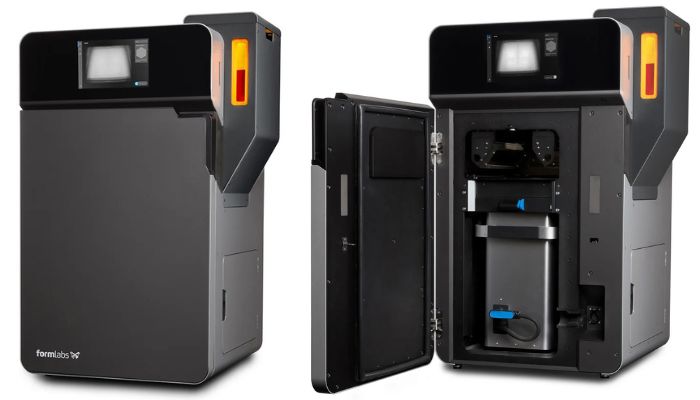
Photo Credit: Formlabs
SnowWhite 2 – Sharebot
SnowWhite 2 is a professional SLS 3D printer developed by Italian manufacturer Sharebot. Equipped with a 14W CO₂ laser, it has a build volume of 100 x 100 x 100 mm, fully open parameters, and an interchangeable powder distribution system. The machine can operate with as little as 300g of powder and supports nitrogen or argon atmospheres, making it particularly suited to material testing and R&D applications. Sharebot has since developed the SnowWhite 2 HT, a high-temperature variant with a build chamber reaching up to 350°C and a print volume of 50 x 50 x 50 mm, aimed at universities and research centers working on the development of new polymers and composites.
SUZY – Sinterit
Founded in Poland in 2014, Sinterit specializes in the development of SLS 3D printers, having introduced its first machine, the Lisa, in 2015. The company’s current entry-level offering is the SUZY, a compact SLS printer with a build volume of 130 x 180 x 330 mm and a layer height of 0.075 mm. It uses a 30W IR fiber coupled diode laser and reaches a build speed of up to 20 mm/h. Compatible materials include PA11.5 and PA12 Industrial. The machine runs on Sinterit Studio, the company’s in-house slicing and print management software.
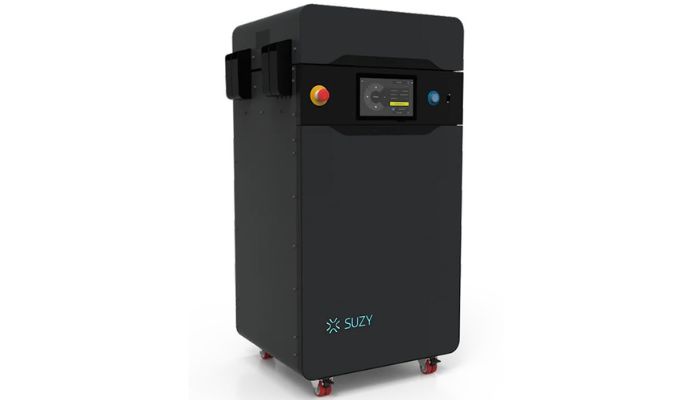
Photo Credit: Sinterit
The Inova MK1 Open-Source SLS Printer
We continue our list with an SLS printer that’s a bit different from the others. The Inova MK1 is an open-source SLS printer developed by SLS4All, a project founded in late 2020 by two Czech engineers. It’s aimed at small businesses, educational institutions, and makers. Its build volume is 177 x 177 x 200 mm, and it’s compatible with PA12, TPU, and generally any polymer powder with a melting point up to 200 °C. Being open-source, the user has full access to the machine’s design and can modify or experiment with it freely. It’s sold in two formats: as a complete kit ready to assemble for €6,490, or as a DIY kit for €3,480, which includes only the electronics, optics, and heating elements, leaving the buyer to manufacture the remaining components.
Industrial SLS Solutions
3D Systems’ SLS Solutions
3D Systems, a well-known name in the additive manufacturing industry, offers two SLS printers: the SLS 300 and the SLS 380. The former, with a build volume of 300 x 300 x 300 mm, is designed for space-constrained environments such as offices, laboratories, or small workshops, as it only occupies 0.45 m² of floor space. It uses a standard power outlet, generates minimal noise, and does not require a cooler or fume extractor. According to 3D Systems, it can be operated by non-specialized personnel. The powder is loaded using cartridges, which avoids direct material handling and eliminates the need for dedicated infrastructure. In exchange for this simplicity, material compatibility is limited to PA11 and PA12.
The second, the SLS 380, is larger, with a build volume of 381 x 330 x 460 mm, and works with seven materials, including PA11, PA12, medical-grade plastics, and flame-retardant materials. The machine also features several interesting functions, such as automated nesting of 3D printed parts.
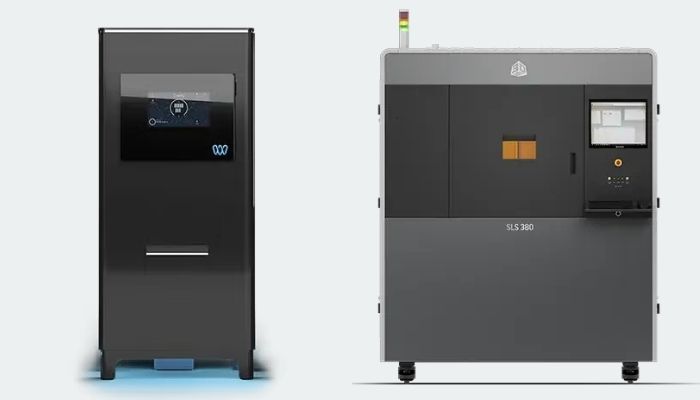
Photo: The SLS 300 printer (left) and the SLS 380 (right). (Photo credits: 3D Systems)
The AFS LaserCore 5300 Printer
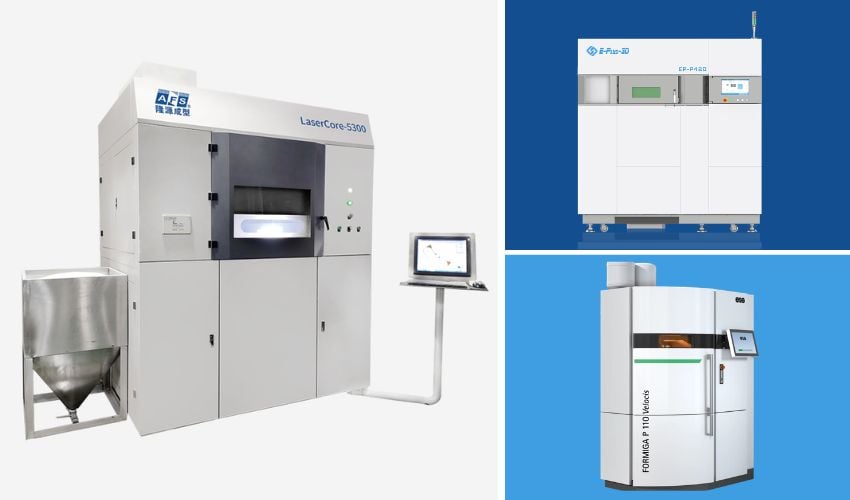
The AFS LaserCore 5300, from the Chinese manufacturer 3DPTEK, is a large-format SLS printer for industrial production. With a build volume of 700 x 700 x 500 mm, it’s a machine designed for manufacturing plants. The company has over 30 years of experience in foundry work, and this is evident in its selection of compatible materials: resin sand, foundry mold materials, and engineering plastics. This profile sets it apart from conventional SLS printers, which are generally focused on polyamides. The manufacturer highlights its low operating cost and recommends it for sectors such as automotive, aerospace, construction machinery, and shipbuilding.
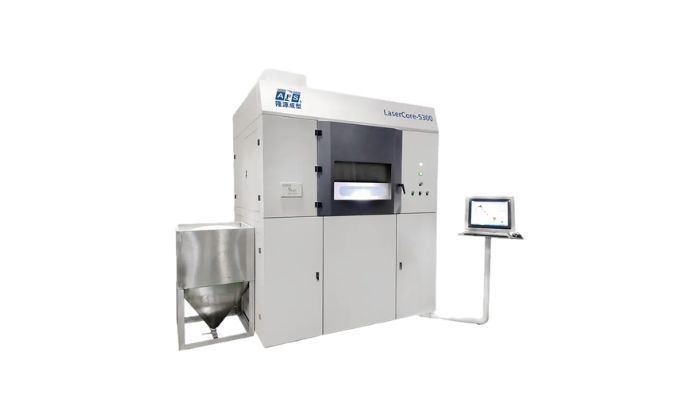
Photo credit: 3D Printing Technology, Inc. (3DPTEK)
Eplus3D’s EP-P420 Solution
Eplus3D is a Chinese manufacturer of industrial solutions. Among the machines it offers is the EP-P420, an SLS 3D printer with a build volume of 420 x 420 x 460 mm and a layer thickness between 0.06 and 0.2 mm. Suitable for custom production or small batches, it is compatible with PA11, PA12, and PA6. It features an optimized real-time temperature control system, heating up faster and more evenly. This SLS 3D printer has a large powder feeder to ensure sufficient powder supply during printing; in fact, the EP-P420 manages the material in real time to maximize powder efficiency.
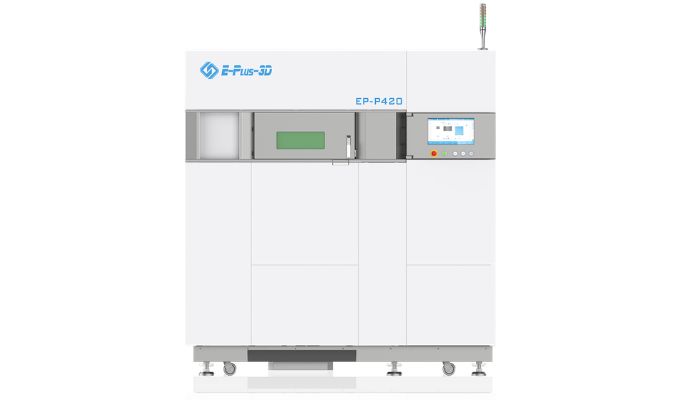
Photo Credit: Eplus3D
EOS FORMIGA P 110 Velocis
When discussing SLS, it’s hard to forget the German company EOS. It’s one of the leading manufacturers of SLS 3D printers on the market, and its portfolio is now very broad, with various solutions that meet specific needs. Among this range is the EOS FORMIGA P 110 Velocis, which offers a build volume of 200 x 250 x 330 mm. Equipped with a 30W laser, it boasts a scanning speed of up to 5.0 m/s. This industrial SLS 3D printer is compatible with nine polymer powders, including nylon, TPU, and alumide. The machine is integrated into a complete optional workflow system that includes an unpacking and sieving station, a sandblasting booth, and a mixing station.
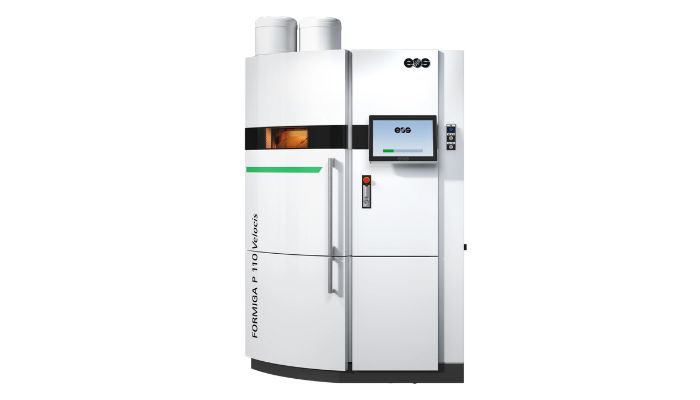
Photo Credit: EOS
Farsoon and Its Flight® HT601P-4 SLS 3D Printer
The Chinese manufacturer Farsoon also offers a wide range of powder-based additive manufacturing solutions, working with both polymers and metals. Among its SLS machines is the Flight® HT601P-4, designed for fast and efficient industrial-scale production. It features four 300W fiber lasers, enabling a scanning speed of 20 m/s. Its build chamber can heat up to 220°C, expanding the range of compatible materials – PA6, PBT, PA11, PA12, and TPU, among others. It also boasts a generous build volume of 600 x 600 x 600 mm.
The RMS220 from Raise3D
Known for its professional FDM printers, particularly the Pro3 and E2 series, and more recently for its DF2 and DF2+ resin systems, the Raise3D took a major step in 2025 with the release of its first SLS printer: the RMS220. With a build volume of 220 x 220 x 350 mm / 17L, this machine supports multi-part builds and high nesting efficiency. The RMS220 was designed for applications that require tight tolerances and fine details – that’s why, when thin wall mode is activated, it can achieve a 0.5 mm minimum wall thickness. The machine is compatible with Raise3D materials, including various polyamides and thermoplastic polyurethane (TPU). The 5W 1064 nm high-power fiber laser allows for strong, consistent sintering, and the scanning speed reaches up to 30,000 mm/s for accelerated production. Optimized for intricate prototypes and high-throughput batch production, the RMS220 is suitable for both commercial and industrial applications. To learn more, read our review of the RMS220 from the 3Dnatives Lab.
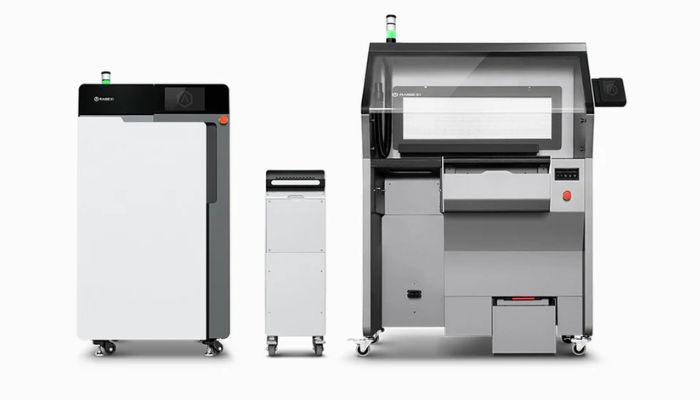
The Raise3D RMS220 Package includes (from left to right) the printer, build unit, and cleaning station. (Photo Credit: Raise3D)
The CF200 from TPM3D
TPM3D offers several industrial SLS 3D printers – large industrial printers, small high-precision printers, a high-temperature printer for PEEK and PEKK, and more. In 2025, the company released the Carbon Fiber 200 (CF200), positioning the machine as a clean, compact SLS 3D printer. Unlike their industrial line of SLS solutions, the CF200 is meant for R&D labs or offices, meaning that they come with fully enclosed powder management and limited complexity. The total size of the machine is less than 1 square meter, and it has a standard 220V plug-and-print operation. It has a 200×200×320 mm build volume, and is compatible with PA11, PA12, PA12 GF, PA12 CF, and TPU. The CF200 pairs with the PPS200, a depowdering solution, for a seamless, accessible workflow.
The Supermaker SLS 3540 Pro from Zonghen3D
This machine from Zonghen3D offers industrial-grade performance for large-scale production. Compatible with PA12, the SLS 3450 Pro has a build volume of 350x350x430mm, and has capabilities to integrate with existing manufacturing workflows. Plus, the solution features automated powder handling system for reduced downtime. The SLS 3540 is equipped with a 1*300W Fiber laser. Zonghen3D also offers a smaller machine for small-to-medium enterprises – the SLS 2030 – with a smaller build volume and a 1*40W fiber laser. Unlike the SLS 3540, the 2030 is compatible with PA11, PA12, TPU, and GF Nylon. Both machines have a 8-15m/s scanning speed, a maximum cabin temperature of 190℃, and a 0.1-0.3mm layer thickness.
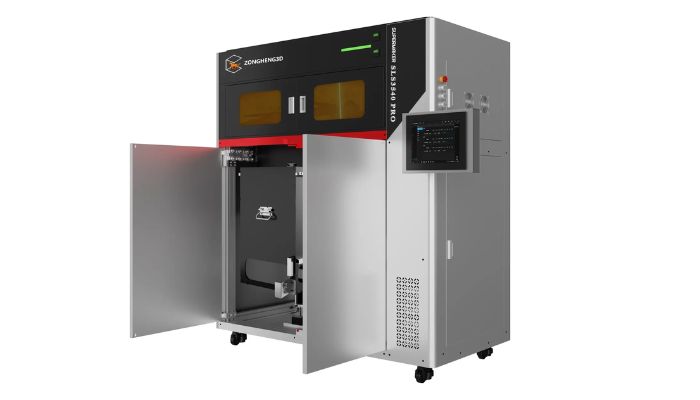
Photo Credit: Zongheng3D
What do you think of our selection of SLS 3D printers? Let us know in a comment below or on our LinkedIn or Facebook pages! Plus, don’t forget to sign up for our free weekly Newsletter to get the latest 3D printing news straight to your inbox. You can also find all our videos on our YouTube channel.
3d printed metals ,machines, do thy use conduction heat or can a laser be used ?