

4D Printing Replaces the Traditional Cast in Orthopedic Care
The Singaporean startup Castomize has developed a 4D-printed cast that addresses the drawbacks of conventional casts: itching, sweating, irritation, and the inability to get wet. Their solution leverages the properties of smart thermoplastics, allowing the cast to be molded precisely to each patient’s anatomy at the time of application, with no prior scanning required and no saw needed for removal.
The device originated from research at the Singapore University of Technology and Design and became a commercial product in 2022. It is aimed at clinics and healthcare professionals seeking a lighter, breathable, and waterproof alternative to fiberglass casts.
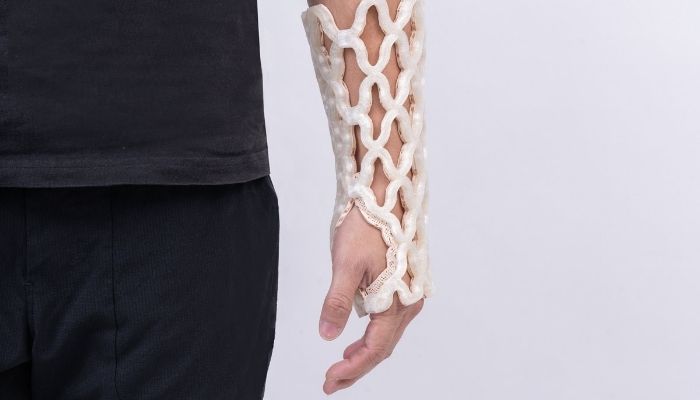
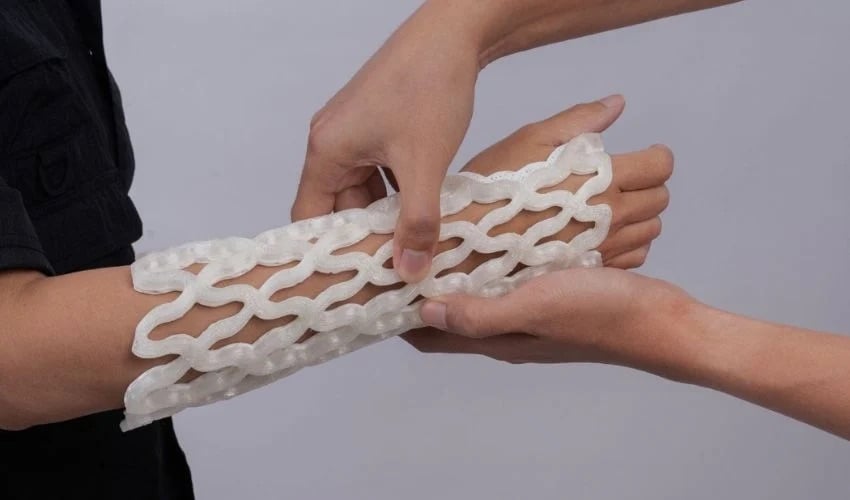
4D cast applied to the forearm. The open lattice structure allows for air circulation and makes the piece completely waterproof.
The concept of 4D printing is not new, but its translation into a viable commercial product remains rare. In short, it involves manufacturing structures that change when exposed to an external stimulus, in this case heat. The object is not customized during printing, but afterward: the cast comes out of the printer with a fixed geometry, softens when heated, and hardens when cooled. The clinician heats it, molds it over the patient’s wrist, forearm, or ankle, and waits for it to cool.
The network of perforations that characterizes these casts serves several functions at once: it reduces weight, ventilates the skin, makes the piece waterproof, and eliminates the need for a saw during removal. Castomize even claims that patients can swim while wearing it, provided they have medical approval.
The cast does not depend on individual patient scanning; instead, it comes in standard sizes that are adjusted during the appointment. And if, over the course of treatment, swelling goes down, the position needs correcting, or the patient requires an adjustment, the clinician simply reheats the piece and molds it over the same limb without needing to replace it.
Castomize already sells casts for the wrist, forearm, arm, and ankle. The company is now working on expanding its catalog with prosthetics and medical devices for pets, while continuing to develop pediatric sizes.
Would you trust a 4D cast for your own treatment? Let us know in a comment below or on our LinkedIn or Facebook pages! Plus, don’t forget to sign up for our free weekly Newsletter to get the latest 3D printing news straight to your inbox. You can also find all our videos on our YouTube channel.
*All Photo Credits: Castomize