


#3DStartup: Could nureo’s Automated Engineering Software Eliminate Manual CAD?
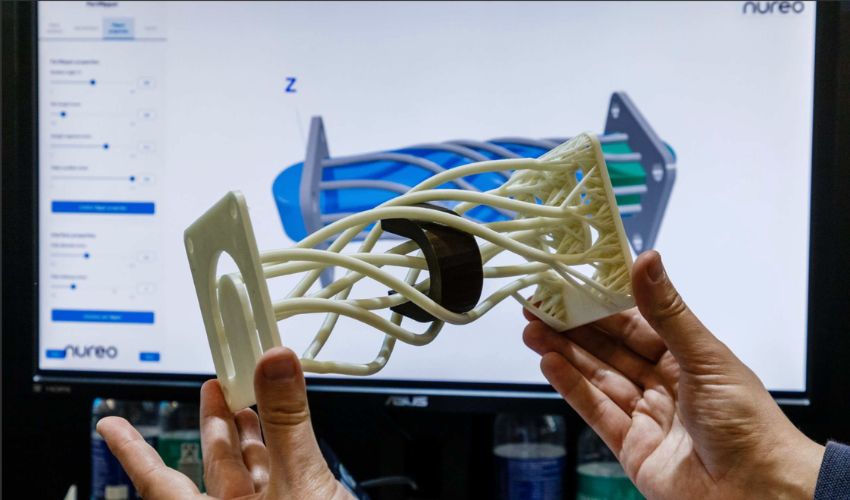
The promise of additive manufacturing has always been design freedom, yet engineers frequently face complex, manual design processes to turn a concept into a manufacturable part. The Zurich-based software startup nureo is changing this by bridging the gap between advanced artificial intelligence and practical manufacturing constraints. Born out of specialized PhD research at ETH Zurich, the company is developing an AI-powered platform that encodes deep engineering knowledge into validated, automated design modules. This approach recently earned the company industry recognition, securing a spot as one of the candidates for the 2025 Formnext Start-up Awards.
Instead of relying on generative AI that creates unmachinable shapes, nureo acts as an intelligent assistant that structures complex workflows while keeping the engineer fully in control. The platform reduces design timelines from weeks to mere minutes for demanding industrial applications, including fluid manifolds and production line packaging. In this interview, we speak with co-founder Manuel Biedermann to discuss how nureo bypasses industry buzzwords to build a scalable automation platform that preserves manufacturability and empowers engineering teams.
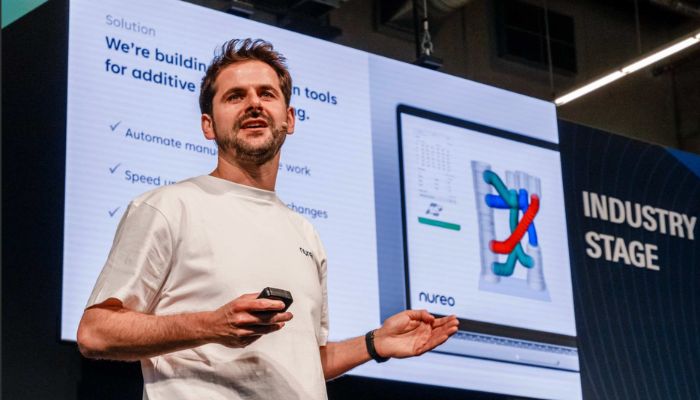
Manuel Biederman presenting on the Industry Stage at Formnext. (Photo Credit: Formnext I Mesago Messe Frankfurt GmbH)
3DN: Could you introduce yourself and share what led you to co-found nureo?
My name is Manuel Biedermann, and I’m one of the co-founders of nureo. I met my co-founders, Patrick Beutler and Urs Hofmann, during our PhDs at ETH Zurich, where we started working on design for additive manufacturing (AM) back in 2017.
Over the years, we worked on many different projects and applications related to design automation for AM. Each project gave us new insights into what works well in practice and where the real challenges lie – especially when trying to fully leverage the design freedom of AM while still ensuring part manufacturability.
As we continued working on these problems, it became clear to us that there was a strong need for better software tools to automate design tasks for AM. This realization ultimately led us to found nureo, with the goal of making automated design workflows accessible to industry and helping engineers unlock the full potential of AM.
3DN: What is nureo’s mission, and how is it achieving that?
Our mission is to make design automation accessible to a wide range of industries and applications. While our approach is particularly well suited for AM, the underlying principles can also be applied to conventional production technologies such as milling, casting, and sheet metal design.
To achieve this, we are developing the nureo design platform – an AI-powered software platform that allows users to create automated design workflows tailored to their specific applications and manufacturing processes. At the core of the platform are validated design modules that encode engineering knowledge for different design tasks and production technologies.
We are currently expanding this library of modules while working closely with customers to develop automated design workflows for real-world applications. Many of them have already recognized the potential of design automation to significantly reduce the design effort, accelerate time-to-market, and scale the output of engineering teams.
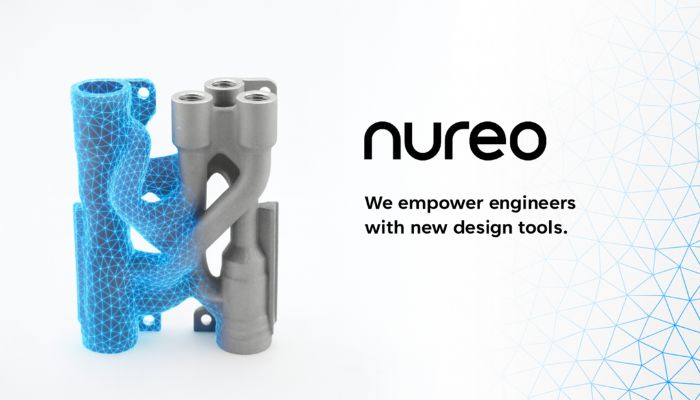
Image Credit: nureo
3DN: Can you describe how nureo’s software understands and encodes engineering knowledge into automated design workflows?
Today, the process of capturing and encoding engineering knowledge is carried out by our team, based on our experience in product development, AM, and software engineering. We translate this knowledge into validated design modules that capture specific engineering logic and recurring design tasks.
The next step for the nureo design platform is to increasingly leverage the reasoning capabilities of AI. We are currently working on training models that learn from previously developed design workflows and interact with our library of validated design modules. This will allow the system to break down a customer’s design task into individual steps, define the required inputs and outputs, and automatically assemble the most suitable modules into a tailored design workflow.
3DN: Design for AM has unique constraints (overhangs, supports, build orientation). Does your platform account for manufacturability and AM-specific requirements in automated designs?
Yes, this is one of the core requirements we set for our workflows and software. An automatically generated geometry that cannot be manufactured has very limited value. Our goal is therefore not to create a black-box AI design tool, but to give engineers the ability to influence the design output and maintain control over the design workflow.
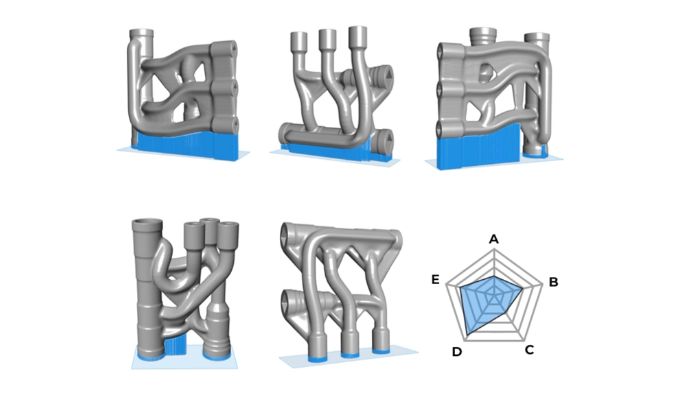
Since our work started with automated design for AM, ensuring manufacturability for a given AM process is part of the DNA of our platform. Manufacturing constraints such as the maximum overhang angle and minimal feature sizes, the influence of the build orientation, and process-specific design rules are therefore considered directly during design generation.
nureo’s software accounts for AM-specific design requirements. Image credit: nureo
3DN: Artificial intelligence and generative design are buzzwords in AM. How doesnureoleverage AI, if at all, in your automation approach?
Since our main goal is to ensure functionality and manufacturability of parts, we deliberately avoid offering a black-box AI solution that simply generates rough mesh geometries or design concepts. Instead, our modules follow a rule- and knowledge-based approach to automate and execute design tasks. This allows users to maintain a high level of control over the resulting geometry and generate production-ready 3D designs.
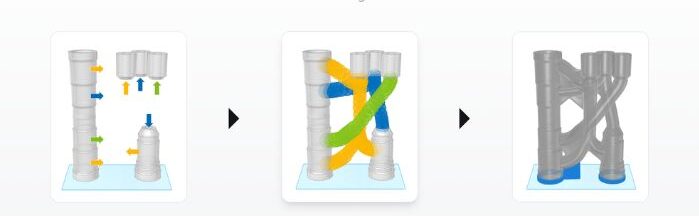
In our approach, AI acts as an intelligent assistant that helps structure complex design tasks and guides users in setting up automated design workflows. When a design task is defined, the system decomposes it into a sequence of steps and determines which validated modules should be used. By connecting these modules, the platform can automatically assemble a design workflow tailored to the specific application. This combination allows us to automate complex engineering tasks while still ensuring that the resulting geometries remain functional and manufacturable.
3DN: Can you share a specific customer case where your automation tools reduced design time or improved manufacturability?
I can share two examples from different application areas. The first comes from fluid manifolds, which was one of the areas where we initially started working in the field of design automation. These components are used in applications ranging from hydraulics to microfluidics and require efficient routing of multiple flow channels inside a compact part.
Designing these channels manually is complex and time-consuming, especially when channel cross-sections must be adapted to ensure manufacturability in AM. Our software automatically generates fluid manifolds within minutes, whereas manual design typically takes days or weeks.
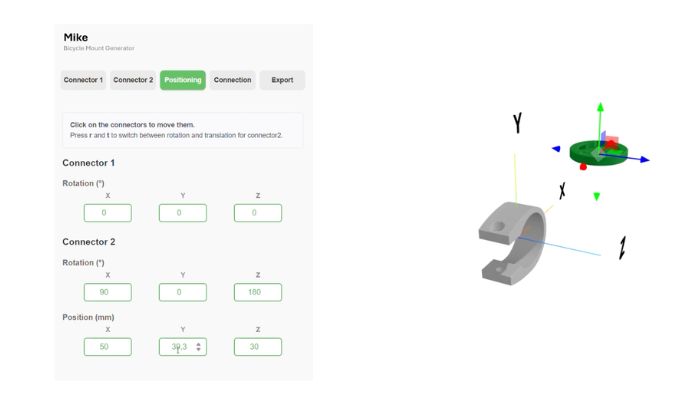
The second example comes from the packaging industry, where products such as cans need to be flipped during filling and labelling processes. Our solution enables the automated design of part flippers based on the product geometry and a few parameters, such as the rotation angle and flipper length. Designing these components manually usually requires multiple iterations to achieve a smooth and reliable flipping motion for high-speed production lines.
nureo’s software helps engineers with complex designs (Image credit: nureo).
3DN: How does nureo differ from other design automation and 3D software platforms?
The landscape for digital engineering software can broadly be grouped into three categories: traditional CAD tools based on manual 3D modelling, design automation platforms that focus on parametric workflows, and simulation-driven tools that focus on performance optimization through physics-based simulation. Each of these approaches has its advantages but also certain limitations. What is often missing is a more general approach to design automation that allows engineers to leverage a software-driven paradigm for engineering together with recent advances in AI. This is where nureo positions itself in the design software landscape. Instead of replacing CAD systems, we build on established geometric kernels and introduce a library of engineering modules that encode design rules and manufacturing constraints. Combined with AI orchestration, this allows us to automate complex tasks while keeping engineers fully in control of the results.
3DN: What are the long-term goals or areas of innovation you’re most excited about for nureo?
One of the milestones we are currently most excited about is finalizing the beta version of the nureo design platform. In the first step, we will use it internally to develop automated design workflows. This allows us to test, validate, and continuously improve the platform before rolling it out to customers.
Even at this stage, the platform will significantly accelerate how we develop new design workflows. Being able to structure and automate this process more efficiently is a key step toward making design automation scalable and accessible across a broader range of applications.
nureo’s software generates design based on user inputs, and delivers them via user-friendly tools. (Image credit: nureo)
3DN: Any final thoughts for our readers?
We strongly believe that design automation will play an increasingly important role in engineering. Our goal is to make these capabilities accessible to engineers across many industries and applications.
Every new application brings unique challenges, and we enjoy working closely with customers to translate those challenges into automated design solutions. If you have a design problem you think could benefit from automation, we would be very interested to hear about it.
If you want to learn more about nureo, visit the website HERE.
What do you think of nureo? Let us know in a comment below or on our LinkedIn or Facebook pages! Plus, don’t forget to sign up for our free weekly Newsletter to get the latest 3D printing news straight to your inbox. You can also find all our videos on our YouTube channel.
*Cover Photo Credit: Formnext I Mesago Messe Frankfurt GmbH



This is fascinating! It sounds like nureo is really tackling a core challenge in manufacturing by making complex design processes more accessible. I’m always impressed by how innovation in AI can streamline fields that were once very manual. It makes me think about how many different kinds of systems, from manufacturing to even simple online distractions like io games, are benefiting from smart automation these days.
We strongly believe that design automation will play an increasingly important role in engineering
The fluid-manifold example makes the value of this approach very clear. Generating a compact routing layout is not useful unless the channel geometry, build orientation, and feature limits have already been considered. I also appreciate the distinction between automating recurring decisions and removing the engineer from the process altogether. Keeping the underlying rules visible gives teams a way to review a result, adjust an input, and learn from each iteration rather than treating the software as a black box.