


#3DStartup: MATERIAL’s 3D Printed Batteries Could Change the Way We Build Devices
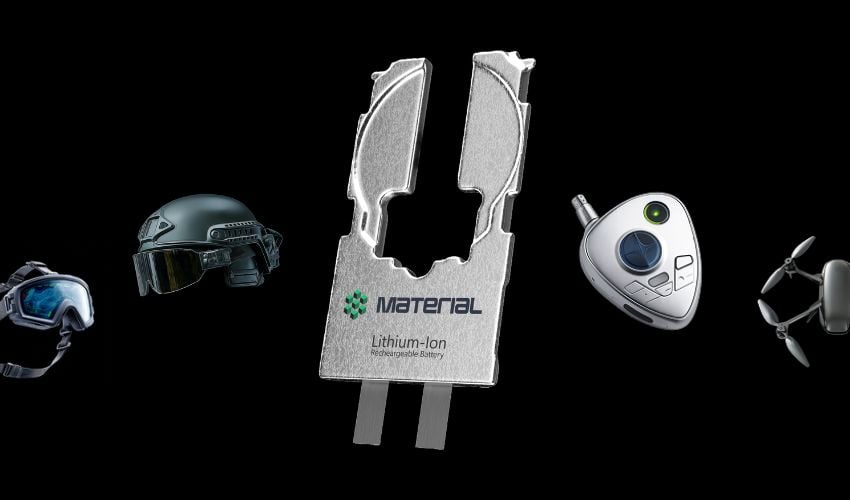
For decades, hardware design has been dictated by a stubborn reality: the battery is a block. Whether designing a drone or a smartphone, engineers have had to build around the rigid, heavy constraints of traditional cylindrical or prismatic cells, compromising on weight distribution and shape just to keep the lights on.
A Texas and Florida-based startup called MATERIAL is trying to break that mold. Using a proprietary 3D printing process, the company can manufacture batteries into custom geometries, essentially allowing the power source to conform to the product, rather than the other way around. The concept is summarized by their tagline: “We don’t build batteries. We print energy.” The idea has already caught the attention of both investors and the military, with the company securing a $7.1 million seed round and a $1.25 million Air Force contract earlier this year. Because their system allows a single machine to print entirely different power sources for entirely different objects, it introduces a level of flexibility that could fundamentally alter product development. For June’s Startup of the Month, we sat down with Dr. Chris Reyes, the company’s CTO, co-founder, and the inventor of the process, to learn about the company’s vision.
3DN: Could you introduce yourself and share what led you into 3D printing?
We are MATERIAL, an advanced manufacturing company, and we have an advanced machine that can print almost anything. And the thing we’re starting with is lithium-ion batteries, which we print with our in-house nanomaterials.
This grew out of my PhD work at Duke University. Back in like 2014, 2015, we were getting into additive manufacturing. We were a materials science lab, and we grew nanomaterials, made composite applications, and also studied nanomaterial growth. […] I wanted to do something more significant and test if you could 3D print a battery. I was one of the first in the world to fully 3D print a lithium-ion battery, using FDM composites and just mixing nano composites. And that’s where the idea for this company grew out of. I did my postdoc at Rice University, and that’s when I learned more advanced manufacturing techniques. […] And in 2023, we decided to form the company and really try to get the idea off the ground.

Co-founder Miles Dotson (left), CEO of MATERIAL Gabe Elias (center), and Chris Reyes (right)
3DN: Could you share more about the 3D printing technology MATERIAL uses?
I can’t get too much into the specifics, but it’s a multimodal print tool. We have a plastic extrusion. We do FDM right now, but we can also do pellets, any polymer composites. We built some screw extruders that extrude battery slurries. And we can do nano composites. We can dispense an array of types of slurries, nano composites, and then we have a custom sensoring system where it is post processed in-situ. It’s like direct ink writing […], we just have our own tweak on it because we have special materials that have special needs.
3DN: Why did you see the need to create custom batteries?
The core reason is going back to when I was trying to decide on what project to do. I wanted to do something that had a future. We’re always going to have batteries in some form. The lithium-ion battery may become the lead-acid battery, and we’re never getting rid of lead-acid batteries. They just have their own place. So, I wanted to be involved with technology that was going to evolve, and also be kind of as noble as I could. We’re always going to need energy sources.
Also, looking into the science of [batteries], we’re constrained volumetrically by using cylinders and prism cells. Everything is just cylinders crammed together. There’s lots of wasted space. 3D printing offers you a way to fill up all the space. You can optimize for volume, you can optimize for heat dissipation, you can optimize for strength. And 3D printing is the only way to do that, I believe.
3DN: What are the main benefits of 3D printing batteries?
The top ones are extreme energy density increases, because we’re removing a bunch of non-battery material, and we can fit batteries in places others can’t. All the void you see in a battery case is now the entire object, which increases runtime. That’s the other good thing. Plus, there’s conformability and the ability to change. One of the benefits of our batteries is that you can develop a battery for, say, a drone or an RC car with the same machine; you can start developing a battery for another product and use the same machine. […] Now, if you want a cylindrical battery, you build a factory, and that’s all you’re getting. There’s also efficiency. We cram seven to 12 steps of the battery process into one machine, so we have a much smaller footprint.
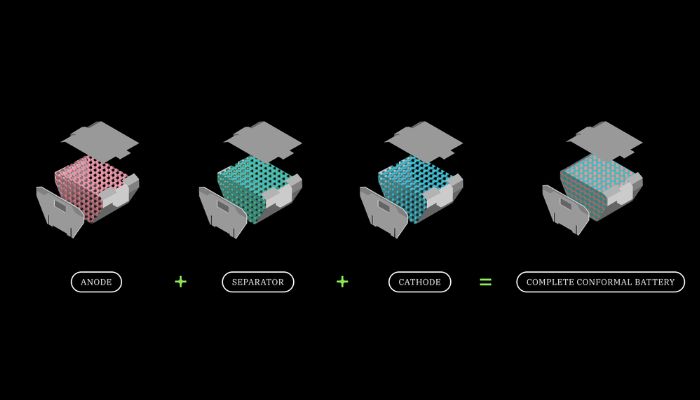
Fabricating the 3D printed battery involves assembling an anode, separator, and cathode.
3DN: Could you elaborate on your business model?
Since we have in-house expertise, we’ll be providing batteries for customers, meaning we will do the printing. We work closely with their design engineers and our engineers. Initially, that’s how it’s going. But in the future, we see cases where we could lease our machines. Or, say a big-name customer wants to start making the batteries in-house. [We could have] our machines on site and then start printing the batteries and assembling the products. And the other [scenario] is mid-scale and large-scale production, having our own facilities where we produce a bunch of batteries.
3DN: What are some of the challenges you’ve faced since starting MATERIAL?
The lowest-hanging fruit is tariffs. We’re building a company that has a lot of hardware and is a material science company. And so [tariffs] were one interesting, unique change. But there’s a big push to onshore everything. There were a lot of startup solutions and a lot of people transitioning to, “hey, we can get this here now.”
Another [challenge] is that we make our own nanomaterials. Making nanomaterials at scale is tricky because of their properties. The things that make nanomaterials great also make them difficult to work with. For instance, making sure they’re well dispersed and making sure they’re uniform at a very large scale. We’re talking about tiny things, but we have to control them precisely.
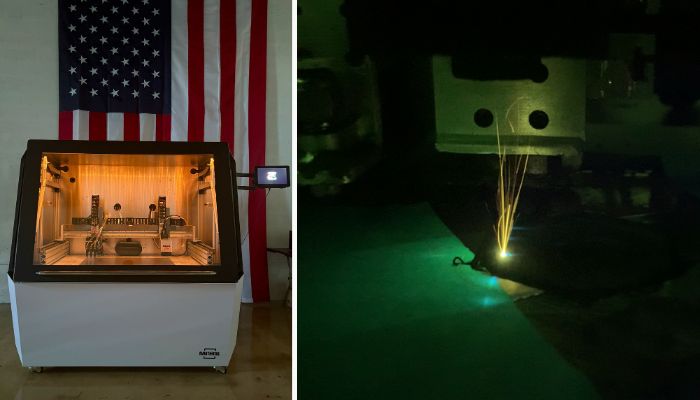
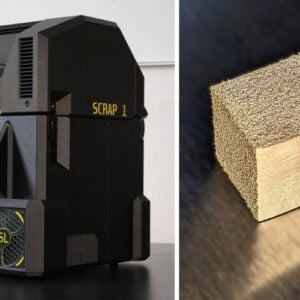
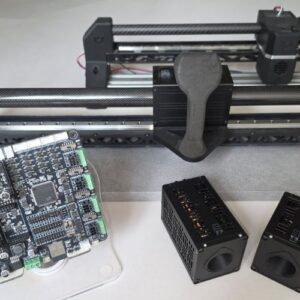
The Hybrid 3D Printer from MATERIAL (left) and an up-close look at the technology in action (right).
3DN: Could you explain the nanomaterials you use?
To successfully 3D print batteries, we developed a nanocomposite that acts like microscopic spaghetti and meatballs. A standard 3D printer nozzle is about 400-1000 microns wide, and our active battery particles (the “meatballs”) are about 1-10 microns. The secret to our HYBRID3D process is the addition of ultra-thin, highly conductive nanowires (the “nano-spaghetti”).
Under the printer’s pressure, these nanowires align perfectly to slide through the nozzle smoothly without clogging. The second they exit, the pressure drops, and the nanowires instantly tangle back together into a tight 3D web. This web acts like structural rebar, locking the battery particles in place so the printed shape holds its rigid structure without needing an external casing
3DN: What are some applications you are creating batteries for?
Right now, we’re targeting flying applications, drones, and things of that nature, because they have to balance their size and weight with how long they can run. That’s where we see the biggest benefit, because we can increase their run time without increasing their mass. The other one is AI wearables. […] Everything you wear has AI on it, and as companies put more AI on devices, the more power hungry they become. Right now, people either buy a little coin cell battery that goes in the back part or a rectangular battery that goes in there. But you’re still limited.
With our system, you’d be able to make the whole sidearm the battery, giving you hours more runtime.
Another interesting [application] is robotics, humanoid robotics. We have a couple of interns working on a robotic arm project. Robots right now last anywhere from four to eight hours, which means having to swap them out mid shift. But if robots could last all day, then they should. And I feel we can opt for that.
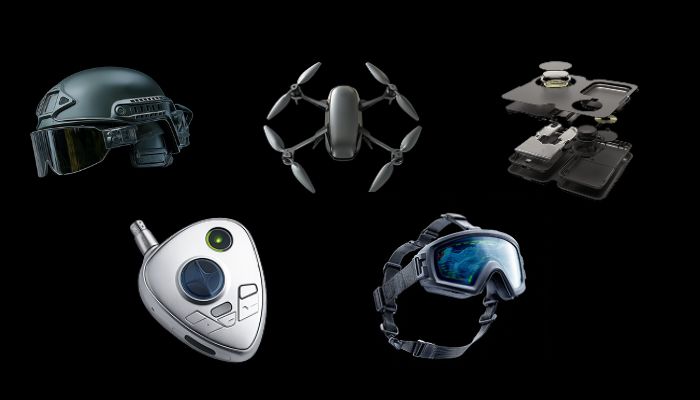
3D printed batteries can be used for drones, defense, AI wearables, medical devices, and more.
3DN: Any last words for our readers?
I’m a big fan of 3D printing. I have always been a big proponent of it. I believe it should be taught more in schools. On another note, I believe everybody should have access to 3D printers because it just makes life a bit better. My goal is to see what we can do with 3D printers and start with batteries. We plan to move on to other materials and beyond.
What do you think of MATERIAL? Let us know in the comments below or on our LinkedIn and Facebook pages. Plus, sign up for our free weekly Newsletter to get the latest 3D printing news straight to your inbox. You can also find all our videos on our YouTube channel.
*All Photo Credit: MATERIAL




Do you believe technology impacts our daily activities? Do you have any suggestions?
A lot of people will find it appealing and convincing. Your point of view on this subject is the same as mine.