

#3DStartup: Manufacturing Technology Project Turns Metal 3D Printing into a Predictive Process
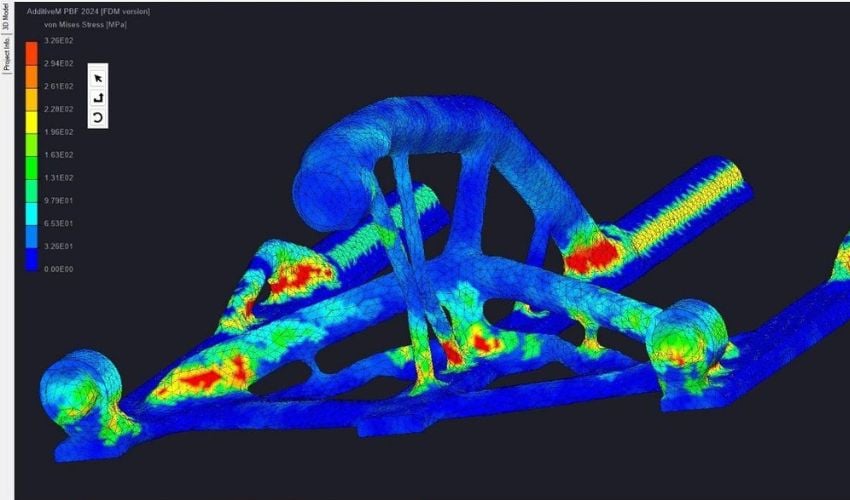
Manufacturing Technology Project (MTP) is an American start-up dedicated to developing engineering tools. These tools combine artificial intelligence, multiphysics simulation, and digital twins to optimize manufacturing processes and predictive modeling, with the ultimate goal of offering autonomous production control. Its first flagship product is called AdditiveM and, as its name suggests, is dedicated to metal additive manufacturing. One of the primary features of the simulation platform is that it improves the performance of 3D printing processes. We met with Hamed Hosseinzadeh, President & Tech Strategist, to learn more about the projects of this ambitious company!
3DN: Can you introduce yourself? How did you discover 3D printing?
I am a computational mechanical and materials engineer, and the President and Tech Strategist of Manufacturing Technology Project (MTP). My background is in physics-based modeling, multiphysics simulation, and AI-assisted engineering, with a strong focus on advanced manufacturing and materials processing.

Hamed Hosseinzadeh
I discovered metal additive manufacturing during my academic research while working on coupled thermal–mechanical–microstructural simulations. What immediately fascinated me was that additive manufacturing is not just a fabrication method, but a fully coupled physical system in which heat transfer, fluid flow, phase transformation, residual stress, microstructure evolution, and structural performance are all tightly interconnected. At the same time, I observed that much of the industry still relied heavily on trial-and-error and empirical tuning, which is costly, time-consuming, and risky for qualification-critical applications.
3DN: What is Manufacturing Technology Project? Why did you create the company?
Manufacturing Technology Project (MTP) is a deep-tech company focused on building the computational and AI infrastructure for next-generation digital manufacturing.
I founded MTP to bridge the gap between high-fidelity physics and real-world manufacturing practice. The vision was to create a new generation of engineering tools that combine multiphysics simulation, Physics-Based AI, and digital twin technologies to enable predictive modeling, process optimization, and eventually autonomous control of manufacturing systems.
Our first flagship platform, AdditiveM, was developed to provide qualification-grade process and performance modeling for metal additive manufacturing.
3DN: Tell us more about your platform AdditiveM: what are its main features?
AdditiveM is a physics-based process and performance simulation platform for metal additive manufacturing. It is designed to act as a digital twin of the printing process, capturing the full thermomechanical history of a part and linking it to residual stress, distortion, microstructure, and eventually fatigue and performance.
The core of AdditiveM is built on coupled multiphysics and multiscale modeling, including:
- High-fidelity transient thermal simulation of layer-by-layer melting and heat accumulation
- Thermo–elasto–plastic mechanical modeling with temperature-dependent plasticity, strain hardening, cyclic hardening, and Bauschinger effect
- Prediction of residual stress, distortion, and crack-prone zones
- Fatigue-relevant stress–strain history and performance indicators
- Stochastic and AI-assisted modules for anomaly-aware and uncertainty-aware prediction
- A direct link between G-code, scan strategy, material properties, and machine parameters and the final structural integrity of the part.
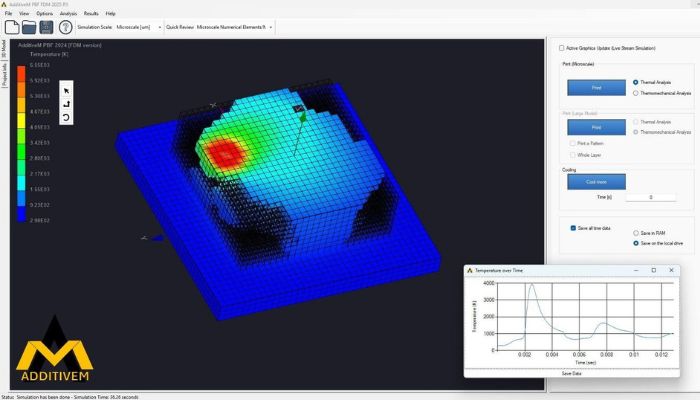
The AdditiveM platform
3DN: Is it compatible with all metal AM processes?
AdditiveM has been developed as a process-agnostic computational framework rather than a single-process tool. Currently, the platform focuses on laser-based Powder Bed Fusion (PBF) and Directed Energy Deposition (DED), where detailed thermal and thermo–elasto–plastic simulations are already implemented. The same physics-based backbone can be extended to other metal AM processes because the governing phenomena—heat transfer, phase change, plastic deformation, residual stress, and cyclic loading—are universal.
Our roadmap includes:
- Extension to additional energy sources such as electron beam and arc-based systems
- Increased compatibility with advanced commercial 3D printers, including multi-laser and multi-beam platforms, with full consideration of scan dynamics such as velocity, acceleration, and jerk, which strongly influence melt pool stability, thermal gradients, and defect formation
- A unified digital twin representation across different machines and process families, enabling consistent process-to-performance prediction and optimization while accounting for machine kinematics and control behavior.
3DN: What are the key benefits of your platform? What challenges does it solve?
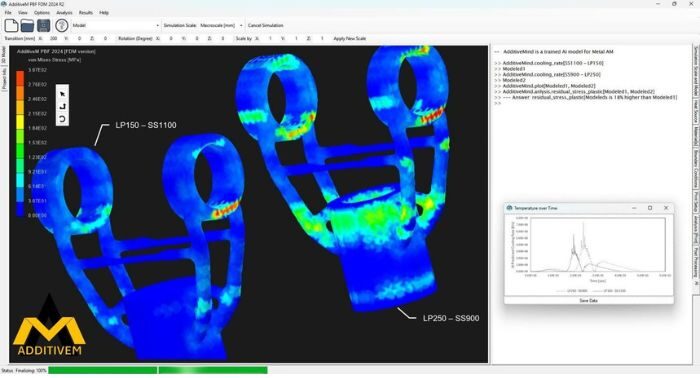
The main benefit of AdditiveM is that it transforms metal additive manufacturing from a trial-and-error process into a predictive, physics-based, AI-assisted digital twin workflow, while remaining computationally efficient enough to run on standard engineering workstations and even high-end personal laptops.
From an engineering and industrial perspective, AdditiveM addresses four fundamental challenges:
- Need for high-fidelity, physics-based predictive qualification tools: Many failures in metal AM originate from residual stress, elasto-plastic deformation, and microstructurally driven fatigue. AdditiveM addresses this through coupled thermo–elasto–plastic modeling, capturing temperature-dependent plasticity, strain hardening, cyclic hardening, and the Bauschinger effect.
- Disconnection between process parameters and performance: AdditiveM establishes a true process-to-performance simulation and digital twin. Scan strategy, laser power, speed, layer thickness, and material properties are directly mapped to residual stress, distortion, and fatigue indicators, enabling first-time-right manufacturing and informed design-for-AM.
- Lack of a validated physics-based big database and physically intelligent learning
- Computational cost and accessibility: A core focus of MTP is the development of highly optimized numerical algorithms and reduced-order, physics-aware solvers that dramatically accelerate simulation while preserving physical accuracy.
In this sense, AdditiveM will not be just a simulator; it will evolve into a Physics-Based Digital Twin platform enhanced by AI. It is being developed to support design, process optimization, qualification, and ultimately closed-loop, intelligent control of metal additive manufacturing systems.
3DN: Who are your main users?
AdditiveM is used by engineers and researchers who need a deep, physics-based understanding of metal additive manufacturing and its impact on part integrity and performance.
Our main user groups include:
- Industrial R&D and process engineers working on qualification, parameter development, and first-time-right production
- Aerospace, defense, and energy companies where residual stress, distortion, and fatigue life are critical for certification
- Machine manufacturers and service bureaus are developing and validating new scan strategies, materials, and machine architectures
- Universities and research centers using AdditiveM as a digital twin and Physics-Based AI platform for advanced manufacturing education and research.
In all these cases, users are not only interested in visualizing the process, but in building predictive digital twins that link process parameters to structural integrity and lifetime performance.
3DN: Any last words for our readers?
Metal additive manufacturing is entering a new phase, where qualification, reliability, and intelligence will be as important as geometric freedom.
At MTP, our goal is to provide the computational and AI infrastructure that enables this transition — from trial-and-error to digital qualification, from isolated simulations to living digital twins, and from purely data-driven models to physically intelligent systems that engineers can trust for critical applications.
This vision also extends beyond metal additive manufacturing. MTP is being developed as a broader digital manufacturing and materials innovation ecosystem, spanning metal AM, biomanufacturing, and energy systems, all built on the same foundation of physics-based digital twins and AI. Visit our website to learn more!
What do you think of MTP? Let us know in the comments below or on our LinkedIn and Facebook pages. Plus, sign up for our free weekly Newsletter to get the latest 3D printing news straight to your inbox. You can also find all our videos on our YouTube channel.
*All Photo Credits: Manufacturing Technology Project
I have to express gratitude to you for this great read! I really liked everything about it. I have you saved as a favorite so I can see your new posts.