







What If the Next 3D Printing Material Came from Your Kitchen?
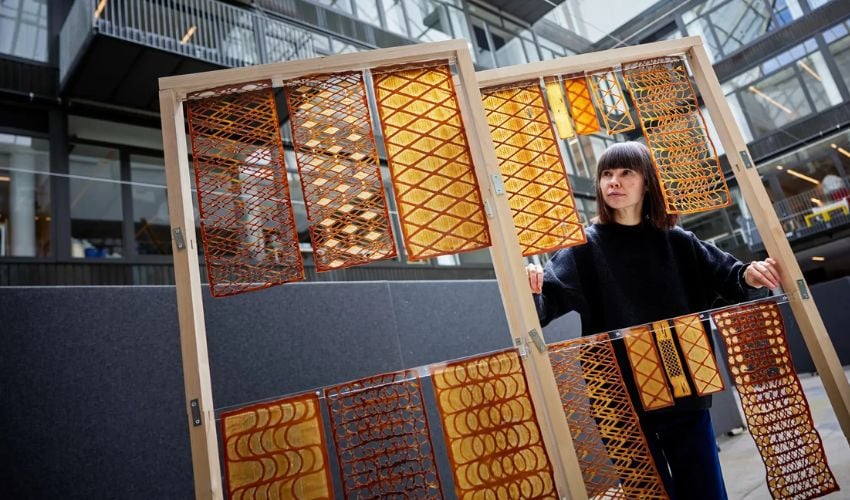
Researchers at Chalmers University (Sweden) have developed a biodegradable material for 3D printing made from baker’s yeast, wood cellulose fibers, seaweed alginate, vegetable glycerol, and water. The end result aims to be an alternative to construction materials such as plastic, plaster, or synthetic textiles, but made from organic and industrial byproducts.
Each ingredient serves a specific function. Alginate provides stability during printing; cellulose reinforces the structure and adds strength; glycerol acts as a plasticizer and provides flexibility. The yeast, meanwhile, acts as a binder for all the ingredients and gives the mixture viscosity. “Because [yeast] consists of single-celled organisms, we can produce a more homogeneous, predictable material,” explains Malgorzata Zboinska, a professor at Chalmers and the lead researcher on the study. The five ingredients form a malleable hydrogel that is ready for printing.
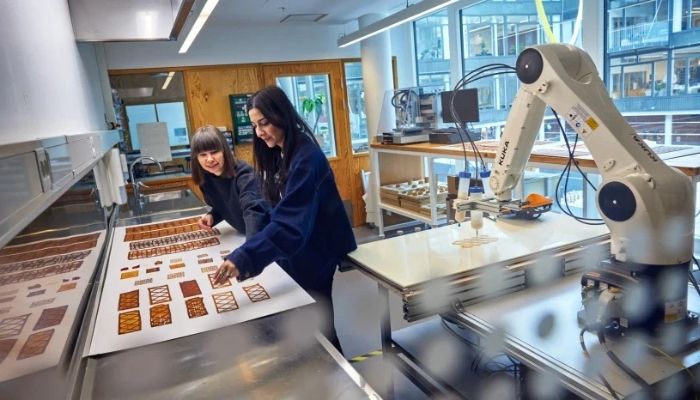
Malgorzata Zboinska (left) and Yagmur Bektas (right).
3D Printing with Yeast
The researchers explain the process as follows: first, the yeast is heated to deactivate it, and then all the ingredients are combined until a homogeneous paste is obtained. This paste is loaded into syringes that deposit the material with the help of a robotic arm. The entire process takes place at room temperature. Once printed, the piece is left to dry until it reaches its final shape. “3D printing makes it possible to create complex shapes without producing waste. We can design and manufacture the material directly – with a high degree of control over its shape, texture and material distribution,” notes Yagmur Bektas, a PhD student at Chalmers and co-author of the study.
With small variations in the recipe, it is possible to modify the material’s properties. Transparency, surface texture, and color change depending on the composition. By default, the material takes on natural tones ranging from yellow to brown, but natural pigments can be added or yeast strains that produce color on their own can be used. The authors note that it is also possible to design patterns and gradients of opacity, which opens up interesting options for controlling how light filters through a printed part.
What Are the Potential Applications for a Yeast-Based Material?
The Chalmers team is targeting this material for interior design elements that are currently made from plastic, plaster, or synthetic textiles—such as partition panels, solar control louvers, or wall coverings. But the possibilities extend far beyond that. Zboinska refers to ELMs (Engineered Living Materials) as the next step: “The future of architectural ELMs, or Engineered Living Materials, is very exciting, with great potential to customise them to perform a variety of functions. This could, for example, involve self-healing materials or materials that purify the air by neutralising harmful substances and pollutants.”
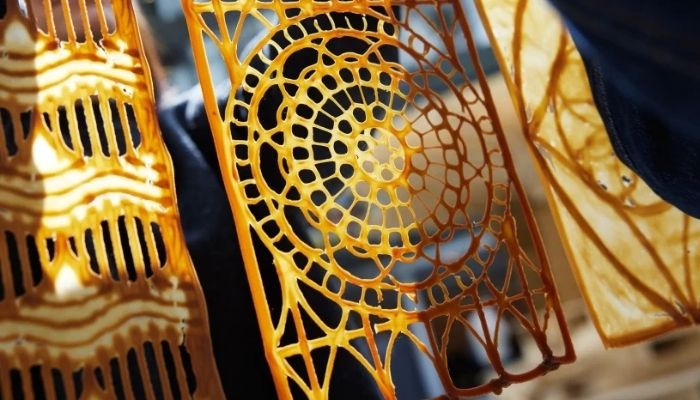
Pieces printed with yeast hydrogel. The natural color ranges from yellow to brown tones, depending on the composition of the formula.
The study, published in Frontiers of Architectural Research, is still exploratory. The team acknowledges that critical properties such as mechanical strength, fire performance, and moisture response still need to be evaluated, in addition to scaling up the manufacturing process.
The idea that a material is designed to degrade—and that this is a deliberate part of the design—is still not widely accepted. “This challenges the traditional notion that materials must last forever, or at least have as long a physical life cycle as possible. Instead, we can think in terms of shorter life cycles and even view the ageing or degradation of the material as part of the design,” the researcher concludes. You can find more information about the study here.
What do you think of yeast as a 3D printing material? Let us know in the comments below or on our LinkedIn and Facebook pages. Plus, sign up for our free weekly Newsletter to get the latest 3D printing news straight to your inbox. You can also find all our videos on our YouTube channel.
*All Photo Credits: Malgorzata Zboinska / Chalmers University of Technology