


OPPO Uses 3D Printing to Create a Crease-Free Foldable Smartphone
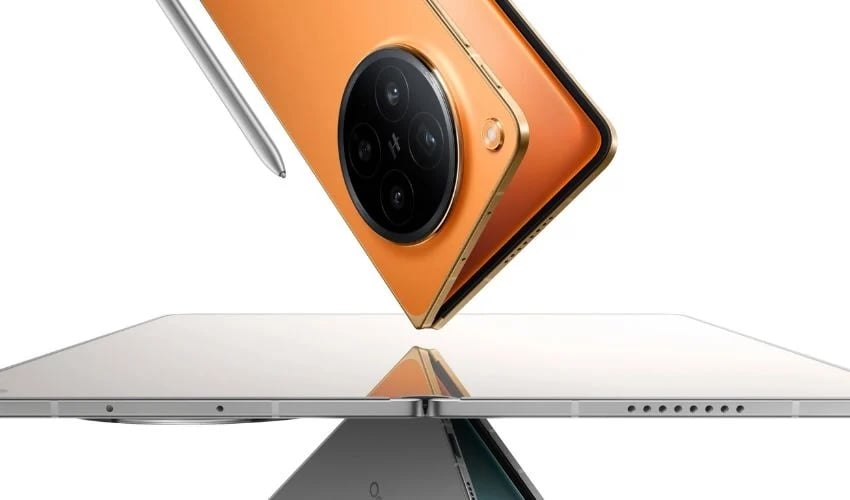
Are we seeing a new trend in additive manufacturing? Just last week, we told you about Apple’s new products and their use of this technology. This week, it’s Chinese manufacturer OPPO’s turn, as the company has announced a new foldable smartphone made possible by 3D printing. The device, the Find N6, officially launched on March 17 in the Asia-Pacific region and other selected markets.
Since the first foldable phones appeared, the central crease has been the biggest obstacle to achieving a perfect user experience and convincing more consumers to switch to this type of device. If you’ve ever owned a foldable phone, you know that the line between the two screens can become more pronounced over time and eventually become annoying. To solve this problem, OPPO has developed Zero-Feel Crease technology, an innovation that creates a perfectly flat internal support surface, eliminating the long-standing issue of a visible crease.
The key to this technical breakthrough lies in the use of 3D printing to manufacture the hinge. In fact, additive manufacturing is used at two different stages. First, the hinge itself and the side plates are 3D printed in grade 5 titanium. Second, OPPO uses what it calls Liquid 3D Printing, or stereolithography, to refine the hinge system.
The process begins with a laser scan that detects even the smallest irregularities in the hinge. A 3D printer then “applies droplets of a custom photopolymer measuring just 5 pL (picoliters) to fill in uneven areas with surgical precision.” This cycle is repeated around 20 times until an ultra-precise support base for the screen is achieved, something that had not been possible until now.
As if that weren’t enough, the device has received TÜV Rheinland certification for its ability to remain completely flat even after 600,000 folds. With results like these, it is clear that additive manufacturing is increasingly being used as a precision technology within mass production. Could this mean we will see more and more smartphones with 3D-printed components?
If you want to learn more about the features of OPPO’s new model beyond 3D printing, click HERE.
What do you think about the use of 3D printing in OPPO’s new smartphone? Let us know in a comment below or on our LinkedIn or Facebook pages! Plus, don’t forget to sign up for our free weekly Newsletter to get the latest 3D printing news straight to your inbox. You can also find all our videos on our YouTube channel.
*All Photo Credits: OPPO