






MIT Researchers Use 3D Printing to Democratize the Production of Electrospray Emitters
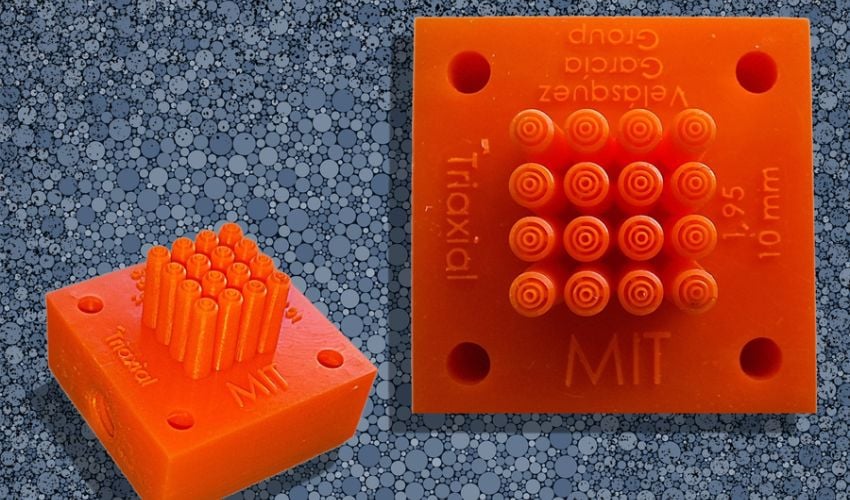
Researchers at the Massachusetts Institute of Technology (MIT) have created low-cost electronic nozzles, called triaxial electrospray emitters, via 3D printing. Traditionally, producing these devices requires days inside a multi-million-dollar semiconductor “cleanroom” (the same high-tech facilities where computer chips are made). Now, the MIT team hopes their 3D printable design will democratize the process. But what exactly do these devices do, and why are they important?
To understand the value of electrospray emitters, you first have to understand how they work. Imagine a standard spray bottle. When you squeeze the trigger, it forces liquid through a tiny hole, creating a mist of droplets. An electrospray emitter is like an advanced, microscopic spray nozzle. But instead of using physical pressure to squirt liquid, it uses electricity. By applying a high voltage to the liquid as it flows out of a microscopic tip, the electrical force pulls and shatters the liquid into a steady stream of tiny, identical droplets. Because it uses electricity, it can make droplets much smaller, faster, and more uniformly than a normal mechanical nozzle.
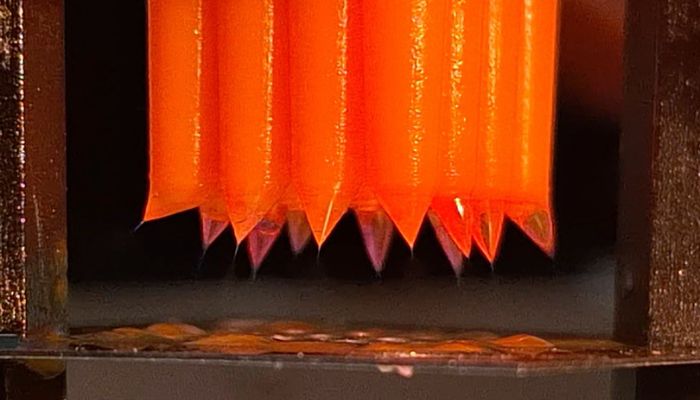
A close-up look at the electrospray nozzles
The Role of 3D Printing in Triaxial Emitter Production
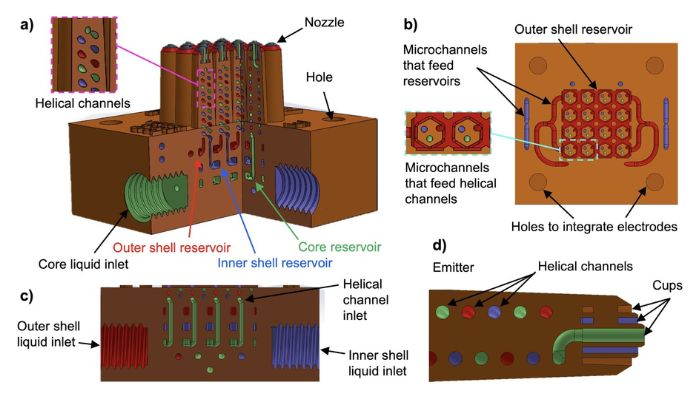
The device that the MIT team designed is unique: the researchers could not find any previous reports of a miniaturized triaxial electrospray array in the open literature. The electrospray array is about one square centimeter and contains a network of internal, coiled channels feeding 16 perfectly uniform nozzles. “Triaxial” refers to each nozzle having three concentric nozzles, that are nested inside one another. When this device runs, it shoots out three non-mixable liquids at the exact same time, forming a perfect layered droplet.
The team fabricated the device using vat photopolymerization via an Asiga Max X27, which allowed them to print layers that were only 25 micrometers tall. With this technique, they could manufacture helical microchannels to help maintain a uniform spray of microdroplets across the nozzles – all while keeping the device as compact as possible. These channels had to be designed without support structures, which could clog the device.
“We couldn’t make a device like this in a semiconductor cleanroom. This is only possible because they are 3D-printed,” said Luis Fernando Velásquez-García, a principal research scientist in MIT’s Microsystems Technology Laboratories (MTL) and senior author of the paper.
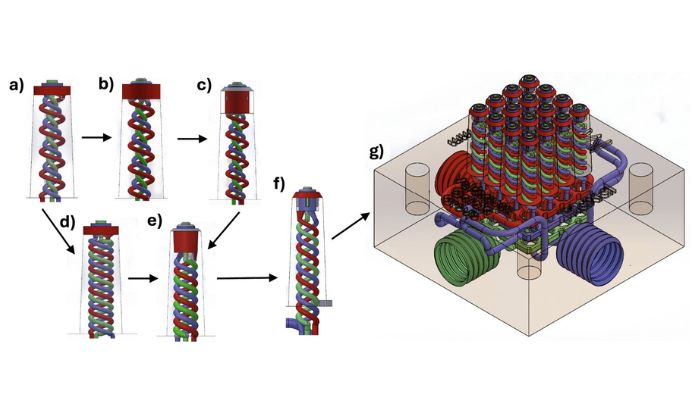
Evolution of the design of the triaxial electrospray emitters developed in this study
The rapid nature of 3D printing also permitted the researchers to test various architectures. They did multiple designs to determine the ideal combination of liquid flow rates to maximize the stability and consistency of emitted microdroplets. “We were able to aggressively optimize the design because we could iterate in a much timelier manner. This ability to exquisitely refine designs is a key advantage of 3D printing,” Velásquez-García added.
According to MIT, the team was surprised to find that the viscosity of the middle liquid plays the most important role in achieving stability in a microdroplet. This is because it maintains the thickness of each layer. The researchers also played with adjusting flow rates and voltages, discovering that they could tailor the thickness of each microdroplet layer.
Applications in Drug Delivery and Biosensing
One major application for these devices would be using them to make three-layer drug-delivery nanoparticles. For example, when a drug is ingested, the outer layer could slowly erode in the stomach, revealing a second material that controls the release of a core material, which delivers medicine to a specific area of the intestines.
When researches tested the devices, they successfully generated uniform, three-layered droplets at scale. Uniformity is critical for high-throughput manufacturing of layered microparticles for applications like biosensors to detect chemical substances, or artificial cells to aid in tissue regeneration. Another possible application lies in self-healing composites.
Going forward, the researchers would like to continue refining their fabrication process and designs to achieve even smaller dimensions. They are also interested in integrating conductive or dielectric materials to the devices to make more advanced electrospray emitter arrays.
“The particles these devices generate, whether they are used for a self-healing composite or to deliver medicine, can have a big impact in many applications,” Velásquez-García added. Ultimately, the design permits for the cost-effective production of electrospray emitters at scale.
aa
This research was funded, in part, by the Tecnológico de Monterrey – MIT Nanotechnology Program. Velásquez-García is joined on the paper by lead author Bryan Ivan Quintanar-Abarca of the Technological Institute of Monterrey in Mexico. You can read the research in Virtual and Physical Prototyping here.
What do you think of the 3D printed electrospray emitters? Let us know in the comments below or on our LinkedIn and Facebook pages. Plus, sign up for our free weekly Newsletter to get the latest 3D printing news straight to your inbox. You can also find all our videos on our YouTube channel.
*All Photo Credits: MIT