




3D Printing Creates Electrodes Tailored to Individual Brains
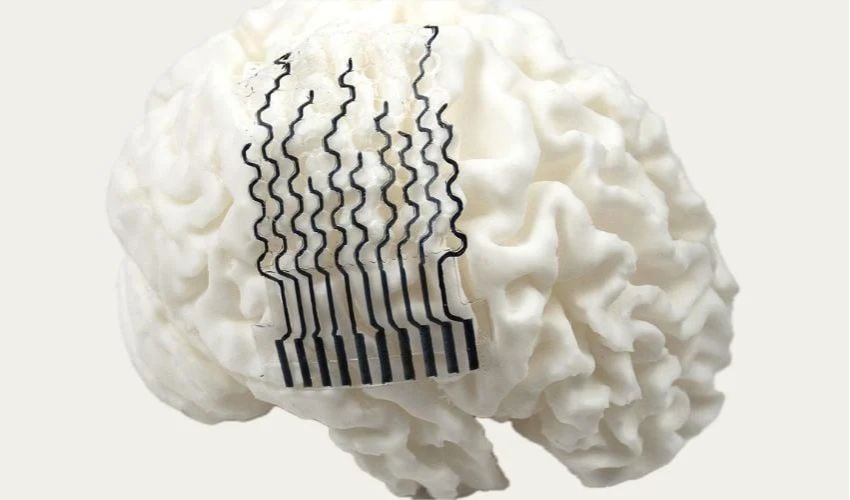
To record brain activity, neurosurgeons place sensors called bioelectrodes on the brain’s surface. These are thin sheets that capture the signals emitted by neurons. The problem is that they are manufactured with a one-size-fits-all design, intended to work for all patients equally, when in reality the specific arrangement of the cortex’s folds, gyri, and sulci varies from person to person depending on age, sex, weight, or height.
A team from Pennsylvania State University, led by Professor Tao Zhou, has just published an alternative in Advanced Materials: 3D-printed hydrogel bioelectrodes based on the patient’s own MRI scan.
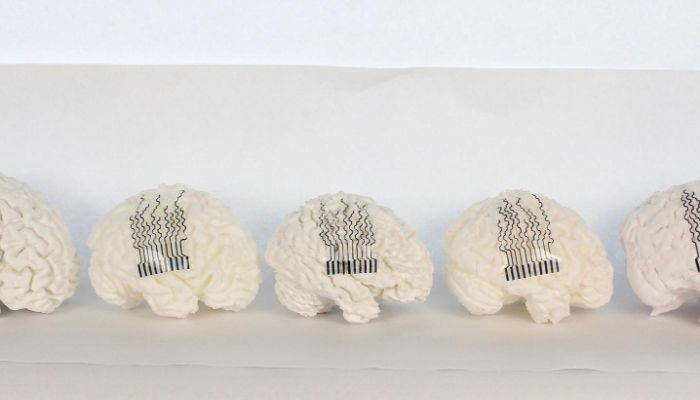
3D-printed electrodes that are perfectly adapted to the geometry of human brain models.
The workflow for creating the custom sensor is simpler than it seems. An MRI scan serves as the starting point. Based on this, a finite element analysis is performed—“a process that creates a detailed simulation of a person’s neural structure”—and a 3D model is reconstructed. Software then designs an electrode whose shape follows the specific ridges and grooves of that brain. Finally, that design is printed using direct ink writing.
The material, a hydrogel with a high water content, behaves like soft tissue. To ensure it doesn’t lose strength when softened, Zhou and his team opted for an architecture inspired by a honeycomb. The device weighs less, uses less material, and is manufactured quickly.
The researchers fabricated custom electrodes for 21 different brains and measured how they adhered to the cortical surface. In all cases, the fit was superior to that of traditional designs. Tested in rats over 28 days, the sensors functioned without triggering an immune response or signal degradation, and without interfering with cerebrospinal fluid circulation—something that rigid electrodes often do disrupt.
The team views this work as a foundation for future clinical applications. First, monitoring neurodegenerative diseases, and later, treatment. The idea is that a hospital could receive an MRI in the morning and provide the neurosurgeon, that very afternoon, with an electrode printed to match the patient’s exact anatomy. To learn more, read the study here.
What do you think of these sensors, which are customized for each individual’s brain? Let us know in a comment below or on our LinkedIn or Facebook pages! Plus, don’t forget to sign up for our free weekly Newsletter to get the latest 3D printing news straight to your inbox. You can also find all our videos on our YouTube channel.
*Cover Photo: Flexible bio electrodes with a honeycomb structure that allows them to stretch across the surface of the brain without losing their resistance. Photo credit: Marzia Momin