


3D Printed Microrobots that Swim and Move like Living Organisms
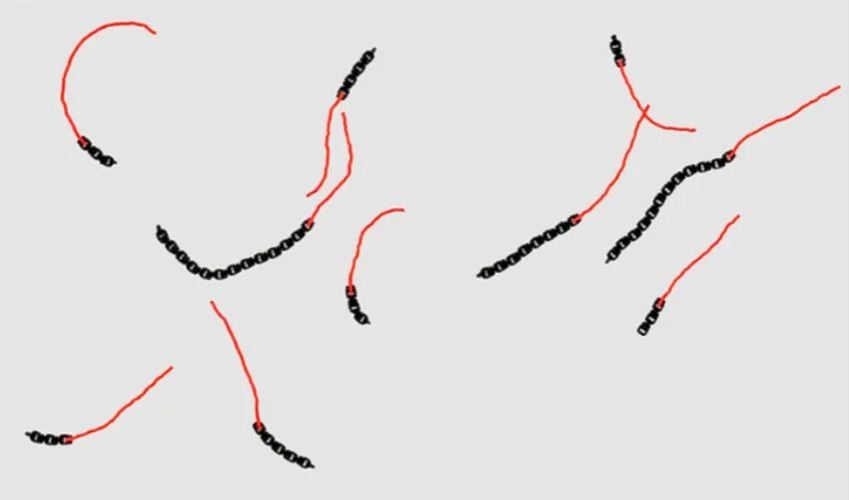
A robot that behaves like a living being but has no sensors. That moves without software. That makes decisions without a “brain.” This is the latest breakthrough by Professor Daniela Kraft at Leiden University (Netherlands). Recently published under the title “Life-like behavior emerging in active and flexible microstructures” the work by Daniela Kraft and her colleague Mengshi Wei presents a new class of 3D-printed microscopic structures that exhibit behaviors surprisingly similar to those of living organisms. All this without a single sensor, without a line of code, without a motor.
The secret to this project lies in a Nanoscribe 3D printer, a two-photon photopolymerization machine capable of working at the micrometer scale with high precision. Using this printer, the team fabricates flexible chains composed of individual segments just 5 µm wide, connected by 0.5 µm joints. To give you an idea: these parts are ten times thinner than a human hair. The researchers emphasize that “This is 3D-printing at the very edge of what is technically possible.”
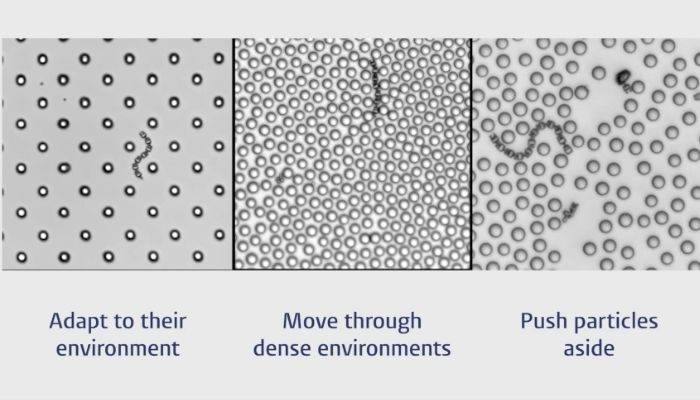
The microrobots adapt to different terrains.
The inspiration came from nature. Worms, snakes, and other organisms constantly change their shape as they move, allowing them to adapt to their surroundings. Flexible robots that utilize this principle already exist, but replicating it on a micrometer scale posed a challenge: until now, microrobots were either rigid and small, or flexible but large.
The Electric Field as a Motor
Propulsion is achieved by applying an external alternating current (AC) electric field. Once activated, the segments of the chain propel themselves autonomously, and the flexibility of the assembly generates a wave-like motion that immediately brings to mind the swimming motion of a microorganism. The team has identified several modes of locomotion that emerge spontaneously from the device’s very architecture.
What is striking is the discovered feedback mechanism: the robot’s shape influences how it moves, and the movement, in turn, modifies the shape. This dynamic gives the system a responsiveness that mimics the embodied intelligence of living beings. “This microrobot therefore senses how the environment changes its body and reacts to it, making it appear life-like,” explains Kraft. “This means that we don’t need microscopic electronics for integrating smart abilities.”
This emergent behavior translates into concrete results. When the robot encounters an obstacle, it automatically seeks another path; when two robots cross paths, they avoid each other; in dense environments, they are able to move objects blocking their way. The practical implications of this system are directly relevant to the biomedical field. The ability to navigate autonomously in complex environments, such as bodily fluids and tissues, opens the way to applications such as localized drug delivery, minimally invasive surgical procedures, or new diagnostic tools.
The next step, according to the researchers themselves, is to understand in depth how this dynamic and functional behavior emerges, knowledge that will make it possible to design more advanced micro robots and to shed new light on the physics of microswimmers and biological organisms. Read more about the research HERE.
What do you think of these 3D printed microrobots? Let us know in a comment below or on our LinkedIn or Facebook pages! Plus, don’t forget to sign up for our free weekly Newsletter to get the latest 3D printing news straight to your inbox. You can also find all our videos on our YouTube channel.
*All Photo Credits : University of Leiden / Daniela Kraft