


3D-Printed Hybrid Foam Absorbs 10 Times More Energy
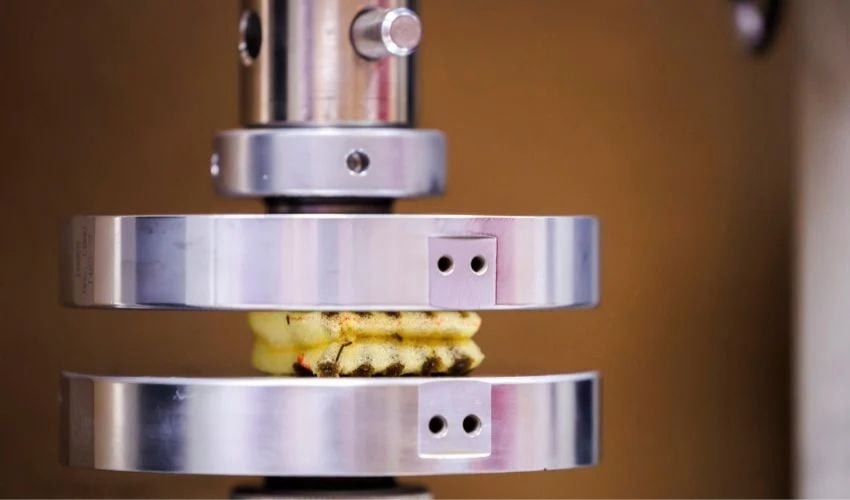
At Texas A&M University, researchers have created a superfoam using additive manufacturing. The composite is capable of absorbing up to 10 times more energy than conventional foam. This 3D-printed material could have a significant impact on the defense sector and potentially save lives.
One of the challenges associated with the conventional manufacturing of these foams lies in their internal structure. Manufacturers must typically choose between a random pattern, which limits energy absorption, or more technical materials and lattice structures that are more expensive and difficult to produce at scale. In other words, it is often a trade-off between precision and cost.
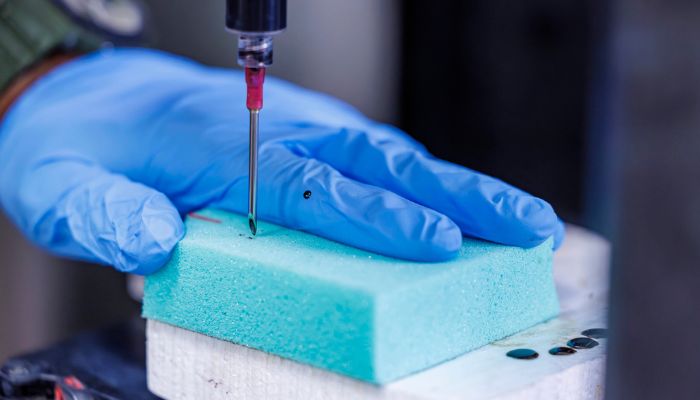
The team places 3D-printed struts inside the foam.
Foam and 3D Printing: How Does It Work?
But this could change thanks to 3D printing. The team has developed a technique called In-Foam Additive Manufacturing (IFAM) that enables the creation of a 3D network of plastic struts within a block of foam. Combining the two materials allows the structure to better withstand applied pressure. These plastic struts are placed exactly where needed, directly inside the foam. In this way, the 3D-printed structure becomes integrated into the foam.
Looking more closely at how the final block functions, the foam first acts as a reinforcement. Then, as force is applied to the structure, the struts come into play, redirecting the pressure outward through the foam. The result? The structure can absorb more energy and therefore withstand heavier loads. Dr. Eric Wetzel, team leader for strategic polymer additive manufacturing at the Army Research Laboratory, explains:
IFAM is a simple, computer-aided manufacturing process that allows us to build an elastomeric skeleton within conventional open-cell foam. The diameter, spacing, angle, and elasticity of the elastomer can be selected to achieve a wide range of properties. The IFAM process combines the best of both worlds, offering a customizable, efficient, and cost-effective composite energy absorber.
Applications of This Superfoam
Since the project is funded by the military, it is no surprise that this superfoam was developed for defense purposes. It is easy to imagine it being integrated, for example, into military helmets or blast-resistant seat cushions. Because the material is lighter and more effective at absorbing energy and impacts, it represents an ideal solution for numerous battlefield applications.
This foam could reduce the risk of injury and potentially save lives. But why stop there? Researchers also mention the possibility of integrating it into bicycle and motorcycle helmets, as well as sports equipment. It could even be used in car bumpers, helping to better protect passengers during severe collisions.
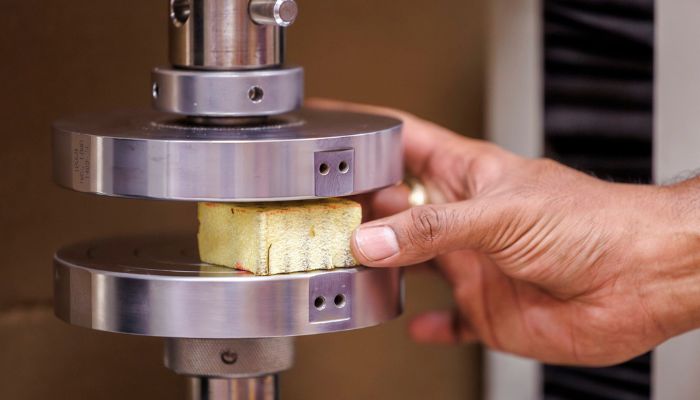
The structure could absorb up to 10 times more energy.
Beyond its ability to absorb energy, this hybrid foam could also absorb sound and reduce overall noise levels. Dr. Mohammad Naraghi, a professor at Texas A&M University and the lead author of the study, explains:
It would be possible to modify the foam’s properties to turn it into an excellent sound absorber capable of attenuating, or even completely eliminating, certain frequency bands and specific vibrations. Acoustic applications are still in the early stages of research, but we would like to explore this property further to turn the foam into an active acoustic filter that is more effective than current materials.
Finally, the team is interested in the customization offered by additive manufacturing. Why not design custom cushions that adapt to each person’s needs and physiology? For example, with a firmer section for the neck and a softer one for the legs. The possibilities are endless! While we wait to order this famous 3D-printed cushion, you can find all the information about the project HERE.
What do you think of this 3D-printed foam? Let us know in a comment below or on our LinkedIn and Facebook pages. Plus, sign up for our free weekly Newsletter to get the latest 3D printing news straight to your inbox. You can also find all our videos on our YouTube channel.
*All Photo Credits: Abbey Toronjo/Texas A&M University Division of Marketing & Communications