


University of Missouri Researchers 3D Print Artificial Human Brain Phantom
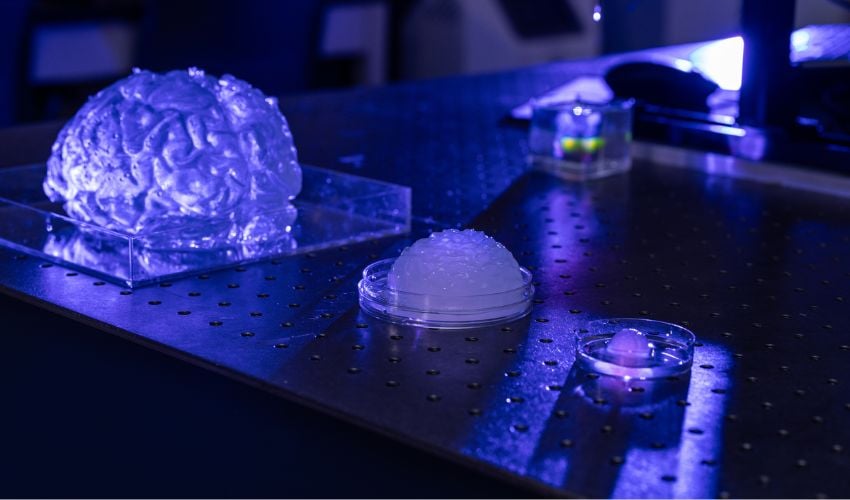
Researchers at the University of Missouri College of Engineering have successfully 3D printed an artificial human brain phantom. This has the potential to reshape how scientists study neurological conditions, train medical professionals, and develop personalized treatment tools.
The model is currently 15% of the size of a real human brain, but the team plans to produce a full-sized version within the next year. What sets this 3D printed brain model apart is that it closely mimics not just the appearance, but also the mechanical feel and electromagnetic behavior of real brain tissue.

The 3D printed brain model is 15% the size of a real human brain.
What Is a Brain Phantom?
In research, a “phantom” refers to a test specimen or model designed to replicate the material properties and imaging characteristics of real biological tissue. This brain phantom allows researchers to analyze how the brain responds to mechanical forces and electromagnetic waves. It provides data that goes beyond what computer model simulations can deliver.
A New Approach: Embedded 3D Printing
Most soft tissue models are produced using methods that result in a uniform internal structure, which fails to capture the heterogeneous nature of real brain tissue. To overcome this limitation, the University of Missouri team used a technique called embedded 3D printing.
Rather than printing in open air, the model was printed inside a jelly-like support bath. This support medium gives the print the structural stability needed to replicate the brain’s varied stiffness across regions, as well as its soft folds and grooves.

Embedded 3D printing allows for the model to have varying stiffness.
Custom Ink That Mimics Brain Tissue
A central innovation in this research is the development of a custom ink: a modified common polymer that researchers can fine-tune to replicate the mechanical, thermal, and dielectric properties of brain tissue.
By adjusting the ink’s chemistry, the team can print regions that behave like gray matter or white matter:
- Gray matter is found in the brain and spinal cord. It supports thinking, movement, and memory, and plays a key role in processing information, controlling actions, and managing emotions.
- White matter conducts, processes, and transmits nerve signals along the spinal cord, and interprets sensory information from the body.
Christopher O’Bryan, assistant professor of mechanical and aerospace engineering and co-author of the study, explained: “Human tissues are incredibly heterogeneous, made of different materials with different properties. Our 3D printing approach lets us capture that complexity in a way that wasn’t possible before.”
Applications: From Medical Training to Neurological Research
The 3D printed brain phantom has a broad range of potential applications across medicine and research:
- Medical education: Doctors and medical students can train on realistic 3D printed brain models, allowing safe, repeated practice before working with patients.
- Personalized treatment planning: Custom brain models generated from individual MRI or CT scans could help physicians plan and tailor treatment strategies.
- Medical device testing: The models can be used to study how implants or everyday electronic devices interact with brain tissue.
- Neurological disease research: The phantoms could help scientists study the progression of conditions such as Alzheimer’s disease, brain aneurysms, and traumatic brain injuries.
Mujtaba Rafique Ghoto, a doctoral student and lead researcher on the study, emphasized the broader significance: “This is about giving the medical and scientific communities a tool that’s both realistic and personalized. The possibilities for improving health and safety are enormous.”

Mujtaba Rafique Ghoto (left) and Christopher O’Bryan prepare the computer models used during the 3D printing process.
Study Details
The research is published in the journal Materialia under the title: “3D-printing soft tissue phantom models from photo-crosslinkable poly(vinyl alcohol) methacrylate.”
What do you think of the 3D printed brain model? Let us know in a comment below or on our LinkedIn or Facebook pages! Plus, don’t forget to sign up for our free weekly Newsletter to get the latest 3D printing news straight to your inbox. You can also find all our videos on our YouTube channel. Interested in more medical and dental 3D printing news? Visit our dedicated page HERE.
*All Photo Credits: Abbie Lankitus