

From Print to Load-Bearing in 7 Days: EPFL’s New Bone Scaffold Breakthrough
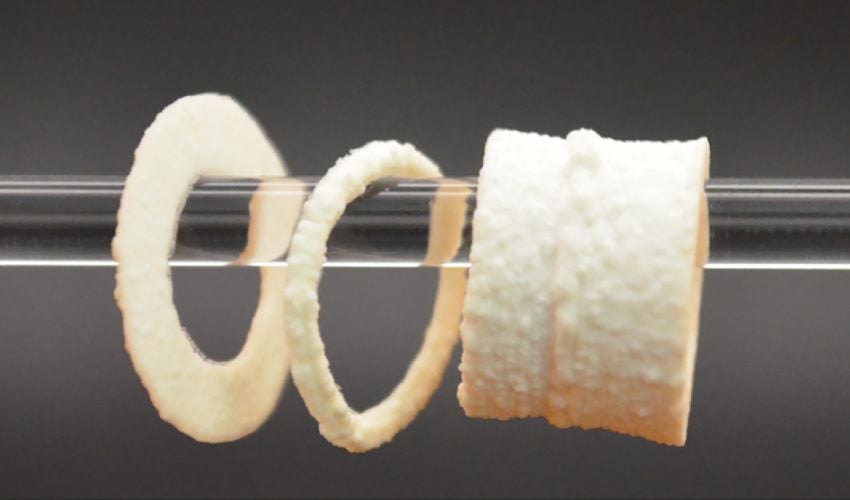
New research has been published in Advanced Functional Materials regarding the development of 3D printed bone scaffolds to encourage bone growth. A team from the Swiss Federal Technology Institute of Lausanne (EPFL) created a bone-like composite that uses naturally occurring enzymes to accelerate mineralization through an energy-efficient, room-temperature process. The researchers hope that this strong, lightweight material will work for bone repair applications.
The scientists used a mineral called hydroxyapatite (HA), which is one of the primary components of bones. Normally, producing HA-based materials requires significant energy and restricts the use of biologically active components, like enzymes that support bone growth. Researchers in the Soft Materials Laboratory (SMaL) in EPFL’s School of Engineering came up with a way to 3D print HA-based scaffolds using a room-temperature process. This method also permits them to utilize enzymes for fast mineralization. Within just seven days, these porous scaffolds can be load-bearing.
Creating the Bone “Ink”
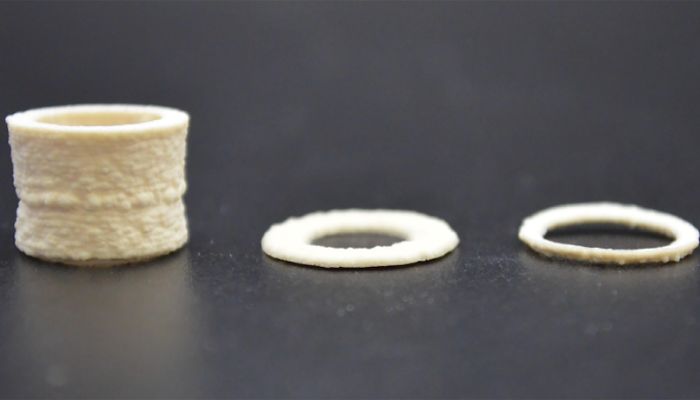
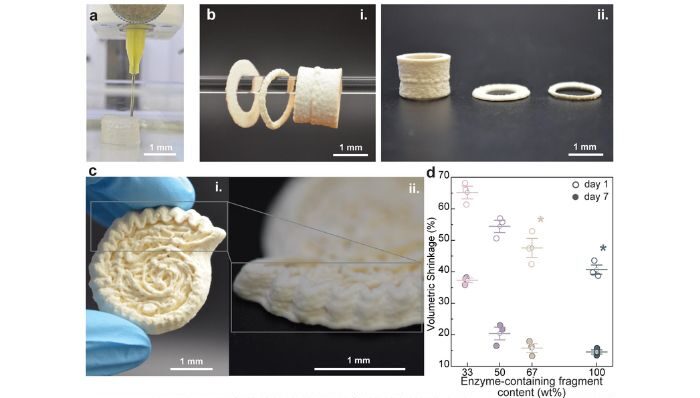
To create the ink, the EPFL scientists embed alkaline phosphatase (an enzyme) into gelatin microparticles. Then, they incubate them in a calcium and phosphate ion solution. The enzyme triggers HA crystals to form, which stiffen and strengthen the printed scaffolds. After four days of mineralization, the composite can hold the average weight of an adult human on an area as small as 1.5 cm x 1.5 cm.
Additionally, the team incorporates enzyme-free gelatin microfragments into the ink, which melt when the scaffold is incubated. When it melts, pores are left behind, thus creating a porous structure. So, once implanted at the site of a bone fracture, these pores can be replaced by healthy cells to promote the growth of new bone. The team can also control the density of these microfragments, which allows them to control the scaffold’s porosity. They could even introduce pores that make up around half of the scaffold volume, meaning that it would have plenty or room for cells to infiltrate and remodel the scaffolds.
“Our idea was to generate a 3D printable and injectable ‘ink’ that can be mineralized into scaffolds with mechanical properties similar to those of highly porous trabecular bone, which is found in human vertebrae and the ends of long bones like the femur,” laboratory head Esther Amstad said. “We hope that our technology’s combination of mechanical performance, bioactivity, and energy-efficient processing will open new avenues for bone tissue engineering.”
Cell Growth After 14 Days
Already, the work is showing potential. In one experiment, the researchers detected the presence of collagen and the bone matrix protein osteocalcin, which are indicators of cell growth. This occurred just 14 days after seeding scaffolds with human stem cells and placing them in a bone growth-supporting medium.
Amstad shared with EPFL that the SMaL team’s enzyme-aided approach yields HA scaffolds that are stronger than those produced via high-temperature methods. Plus, it demonstrates compressive strength comparable to that of human trabecular bone. The technique can fabricate highly complex scaffolds and is compatible with commercially available bioprinters.
“Looking ahead, our work might lay the foundation for injectable scaffolds that aid bone regeneration and potentially enable patients to load their broken bones much earlier than can be achieved with currently available technologies,” Amstad said. To learn more, read the study here.
This research aligns with an ongoing, global effort to 3D print bone scaffolds, and comes months after similar efforts were made by UNSW Canberra to fabricate bone scaffolds with stochastic lattice structures.
What do you think of these 3D printed bone scaffolds? Let us know in a comment below or on our LinkedIn or Facebook pages! Plus, don’t forget to sign up for our free weekly Newsletter to get the latest 3D printing news straight to your inbox. You can also find all our videos on our YouTube channel. Interested in more medical and dental 3D printing news? Visit our dedicated page HERE.
*All Photo Credits: EPFL