


3D Printed Boat Boosts Naval Innovation in the Netherlands
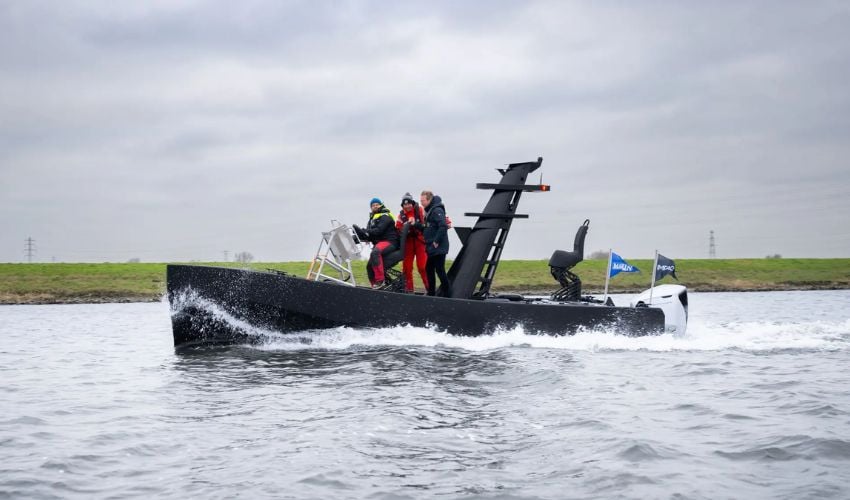
In a previous analysis of 2025 3D printing trends, we mentioned how the defense sector is showing increasing interest in additive manufacturing, to the point of integrating it as a key technology in its operations. A new application for the Navy in the Netherlands is reaffirming this trend. It’s called the SeaRush project, a functional prototype of a 3D-printed unmanned boat, which marks a new advance in the development of unmanned surface vessels (USVs).
The initiative was driven by the Maritime Research Institute Netherlands (MARIN), in collaboration with the MIND Innovation Center. The development of the prototype responds to the need for USVs that can be designed and deployed quickly, while keeping costs under control and allowing for continuous iterative improvements. In a context of growing international tensions and personnel constraints in navies, according to MARIN, SeaRush seeks to demonstrate that it is possible to move from concept to a fully operational system in a very short time frame.
The prototype was made possible thanks to close collaboration throughout the entire production chain. IMPACD Boats was responsible for transforming the conceptual design into a model suitable for 3D printing, while CEAD contributed its expertise in large-format additive manufacturing for the maritime sector. The hull was printed in less than a week at the Dutch Boat Factory in Delft, and the equipment was then completed as a fully operational USV in Woudsend. The propulsion system integrates a Honda outboard motor, connected to a control system developed in collaboration with the Italian company UltraFlex, which allows for remote operation.
USVs are becoming strategically important both in the field of defense and in the maritime sector in general. According to an official statement by MARIN, factors such as the intensification of international conflicts, the increased economic and geopolitical value of the North Sea, and the lack of specialized personnel are driving navies to adopt new operational concepts. In this scenario, unmanned vessels are emerging as an essential complement to manned units, as they reduce human risk and can operate in coordination with other systems, such as drones.
The first tests of the prototype were carried out last December at the Rijnhaven river port in Wageningen and confirmed the viability of the SeaRush approach, both in terms of rapid manufacturing and systems integration. After validating several operational concepts in simulations, the next step will be to demonstrate them at sea with multiple experimental USVs. These tests will culminate in the Maritime Uncrewed Sea Trials (MUST) 2026 exercise, where cooperation between manned and unmanned vessels will be evaluated. In any case, the SeaRush project confirms the potential of 3D printing as a key technology in future maritime operations.
What do you think of the 3D printed boat? Plus, don’t forget to sign up for our free weekly Newsletter to get the latest 3D printing news straight to your inbox. You can also find all our videos on our YouTube channel. For more 3D printing news in the aerospace and defense sectors, check out our dedicated page HERE.
*Cover photo: the 3D-printed SUV prototype during testing, photo credit: Maritime Research Institute Netherlands


This is a fascinating step forward for naval engineering.