



L’impression 3D permet à des cafards cyborgs de plonger sous l’eau et sauver des vies
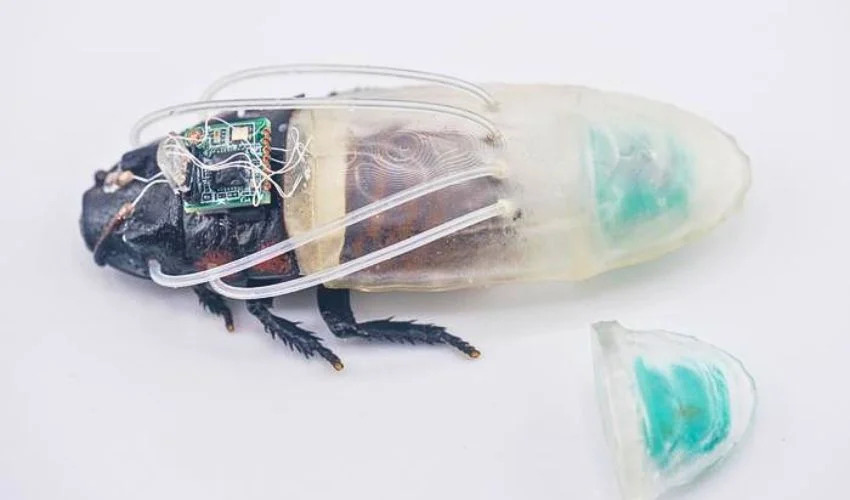
Les cafards sont sans doute les dernières créatures que l’on souhaite croiser. Des chercheurs de la Nanyang Technological University et de l’université Waseda en ont pourtant fait d’improbables auxiliaires de sauvetage : ils équipent des insectes vivants de combinaisons sous-marines imprimées en 3D qui leur permettent d’évoluer en milieu inondé.
Ce qui ressemble au scénario d’un film de science-fiction est en réalité le point de départ d’une étude publiée dans Nature Communications : des insectes cyborgs télécommandés, capables de passer de la terre à l’eau et de rester actifs plusieurs heures d’affilée, et ce dans des environnements exigus et extrêmes, où l’humain comme les robots conventionnels atteignent leurs limites.
Plutôt que de construire un robot imitant un cafard, les chercheurs ont directement équipé l’insecte vivant lui-même. L’association d’un animal et d’un contrôleur électronique porte un nom : l’insecte cyborg, un hybride qui exploite le corps déjà façonné par la nature plutôt que de chercher à le reproduire. À partir de blattes siffleuses de Madagascar, l’équipe a combiné les aptitudes naturelles des insectes avec un « sac à dos » de commande existant et un système respiratoire imprimé en 3D nouvellement conçu, les rendant ainsi amphibies.
Pourquoi un cafard ?
Le choix n’a rien d’arbitraire. Les cafards se faufilent dans des interstices de quelques millimètres, franchissent des amas de débris irréguliers sans jamais trébucher, se remettent presque instantanément sur pattes après une chute et tiennent des heures durant avec un minimum d’énergie. Voilà des années que les ingénieurs s’échinent à doter de petits robots ne serait-ce que d’une seule de ces capacités.
Sur terre, cette robustesse fait ses preuves. Sous l’eau, elle s’effondre rapidement. Les cafards respirent par de petits orifices situés sur les flancs, appelés stigmates. Une fois ceux-ci immergés, l’insecte ne reçoit plus d’air. C’est précisément ce problème que les chercheurs ont entrepris de résoudre.
Une combinaison de plongée imprimée en 3D
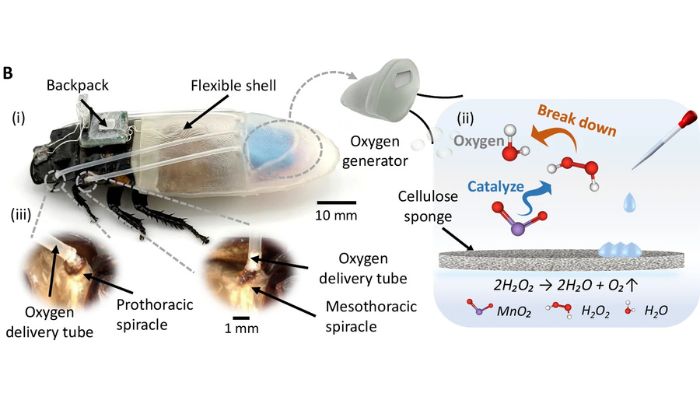
La solution ? Tout un attirail de plongée : une enveloppe souple imprimée en 3D qui vient enserrer l’abdomen, distincte du sac à dos de commande qui pilote les déplacements. Équipés de leur combinaison, les insectes sont restés actifs sous l’eau jusqu’à trois heures. Sans elle, l’autonomie ne dépassait pas les 2 min.
Adapter la combinaison à un insecte vivant s’est révélé plus délicat qu’il n’y paraît. Il fallait qu’elle soit légère, étanche et suffisamment précise dans sa forme pour ne pas entraver les mouvements naturels du cafard. Trois contraintes qu’aucun procédé, hormis l’impression 3D, ne permet de satisfaire simultanément.
Crédit photo : Nature Communications
Chaque pièce a été imprimée sur mesure, au plus près du corps de l’insecte concerné. La pièce maîtresse est un réservoir d’oxygène imprimé en 3D, réalisé dans une résine transparente de type PMMA, chimiquement proche de l’acrylique. À l’intérieur, une éponge imprégnée de dioxyde de manganèse réagit avec un peu de peroxyde d’hydrogène pour produire de l’oxygène, acheminé par de fins tubes en silicone directement jusqu’aux orifices respiratoires de l’insecte. L’enveloppe entourant le réservoir est imprimée dans une résine souple : elle accompagne les mouvements du cafard au lieu de les contrarier. Même les raccords reliant l’enveloppe aux stigmates ont été imprimés sur mesure, les deux paires d’orifices respiratoires n’ayant pas la même forme et nécessitant chacune son propre joint d’étanchéité.
Les cafards cyborgs vont-ils sauver des vies ?
Le scénario n’a rien d’hypothétique. Les insectes cyborgs de Hirotaka Sato ont déjà été déployés lors de véritables opérations de recherche et de sauvetage, notamment dans le cadre de l’opération Lionheart, menée après le séisme de magnitude 7,7 qui a frappé la Birmanie en mars 2025. L’équipe travaille désormais à étendre la technologie à l’inspection d’infrastructures.
« Notre nouvelle combinaison de plongée pour insectes fonctionne comme la bouteille d’oxygène utilisée par les plongeurs humains. Elle génère de l’oxygène et l’achemine directement vers les orifices respiratoires de l’insecte, permettant au cafard cyborg de survivre et de se déplacer sous l’eau ou dans des environnements pauvres en oxygène », explique Hirotaka Sato, professeur à l’École d’ingénierie mécanique et aérospatiale de NTU Singapore.
L’équipe estime par ailleurs que l’approche pourrait dépasser le seul cas du cafard. Les criquets et les coléoptères disposent d’un système respiratoire similaire, fondé lui aussi sur des stigmates : une version adaptée de la combinaison pourrait donc, en théorie, leur convenir également.
Que pensez-vous des cafards cyborgs ? Partagez votre avis dans les commentaires de l’article. Retrouvez toutes nos vidéos sur notre chaîne YouTube ou suivez-nous sur Facebook ou LinkedIn !
*Crédits de toutes les photos : NTU Singapore